


A whistle-stop tour of the state of artificial intelligence
Taking stock of the winners, losers, and users of the AI revolution so far.
If 2023 was the year it announced itself on the global stage, and 2024 was the year it started to take a leading role, then 2025 has been the year that AI really began calling the shots — whether we like it or not. The technology’s progress has driven the economy, powered the stock market, dictated political discourse, flamed the trade tensions between the US and China, encroached on the art world, infiltrated nearly all of our devices, and influenced the algorithms that decide what we watch, read, love, and hate. It’s also (finally) driving our cars.
So, how many people are actually using AI today?
If you’ve been on the internet lately, then you’ve definitely interacted with it in some form, whether through an AI-powered social media algorithm, a Google search that offered an AI summary you didn’t ask for, a customer assistance chatbot, or an article that perhaps wasn’t as human-penned as you’d thought. But among a myriad of surveys and benchmarks, one of the easiest ways to gauge the demand for AI is to track the development of the biggest name in the game: ChatGPT, which just last week was reported to be nearing 900 million weekly users. Not bad for a service that’s barely 3 years old.

In fact, most tech platforms have taken much longer to get to a billion users: Gmail had to wait more than a decade, Facebook about 8.5 years, and even the mighty TikTok took about five years. Considering those milestones were based on monthly users, whereas the reports for OpenAI’s app are weekly figures, it seems pretty likely that ChatGPT has already blown past the 1 billion monthly user mark… and Google’s not far behind. The tech behemoth’s own AI chatbot effort, Gemini — which recently made such a splash it caused a “code red” threat to OpenAI — is already up to 650 million monthly users.
Of course, as we’ve noted before, it’s a lot easier to scale a tech platform or app in 2025 than it was in 2005 — just ask teenagers, who have found ways to cram yet another platform into their ever-expanding screen time.
Taking accounts
Teenagers’ use of social media has become a hot topic in recent years, with parents and policymakers alike concerned about the impacts of the now AI-powered recommendation engines behind many popular apps. Just last week, Australia enacted a world-first ban, blocking under-16s from accessing 10 of the largest platforms to quell teen social media use.
American teens are similarly online, it seems, with a recent Pew Research Center study finding that a record number of those surveyed reported being on those platforms “almost constantly,” with huge shares visiting YouTube (76%) and TikTok (61%) every single day. Perhaps more concerning, though, are Pew’s new findings about young people’s AI chatbot use: roughly two-thirds (64%) of surveyed American teens reported ever using chatbots like ChatGPT and Character.AI, with 28% saying they use the tools daily.
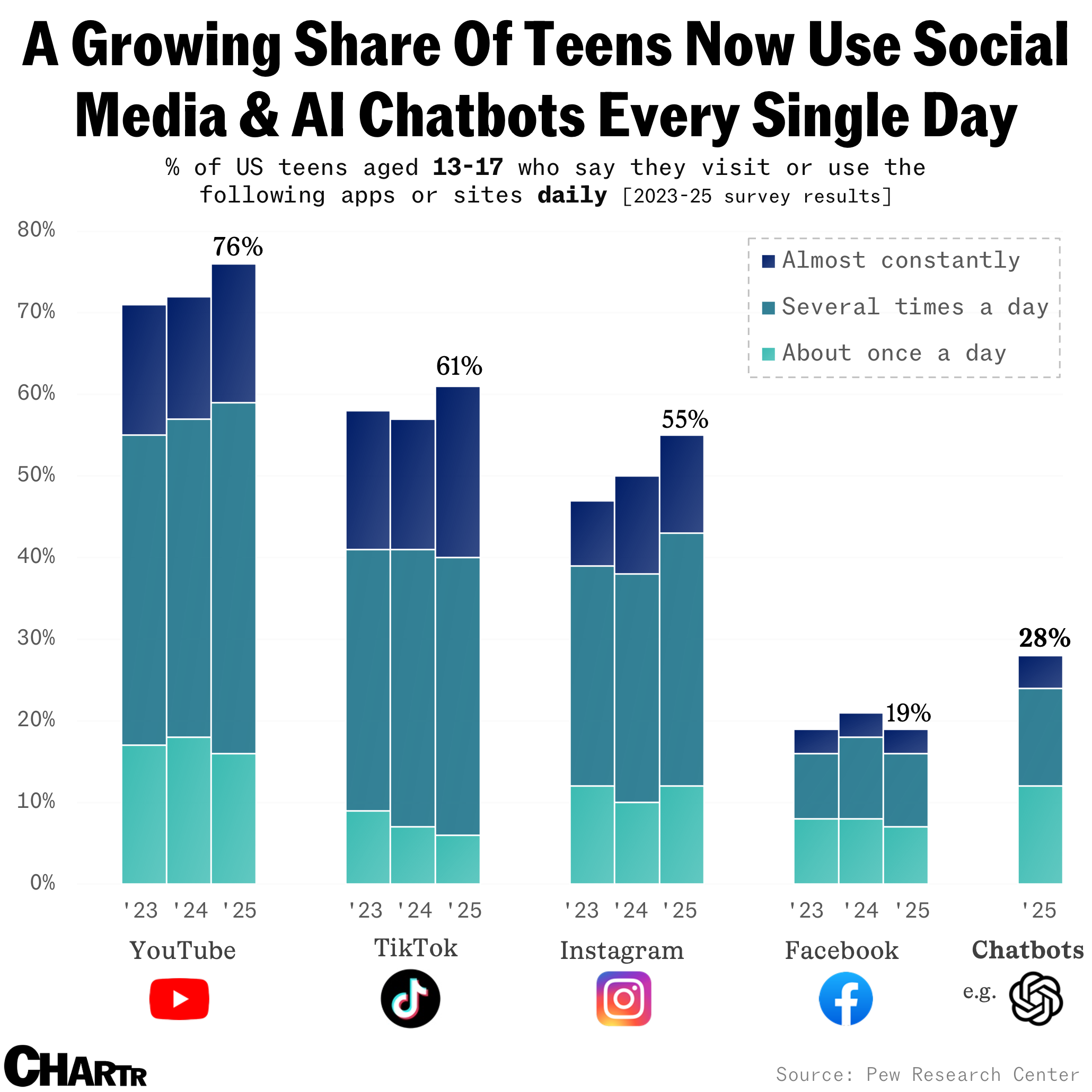
From helping students with their homework to acting as an online companion, AI is becoming a resource for a growing number of young people who use it to answer their questions on everything from personal issues to essay help to career and relationship advice. And, with the ubiquity and frequency of chatbot use rising, there’s a good chance AI could have a bigger impact on teens in the future than social media does today.
Firming up
At the corporate level, companies have also been keen to experiment with AI, hoping the tech could help them automate processes or unlock efficiencies. Surveys from the US Census Bureau have shown that commercial adoption of AI has been gently rising, with larger firms (those with over 250 employees) more likely to say they have used AI in a business function than smaller firms.

Failing real progress, “performative AI usage” has also become pretty common in the working world. For starters, public company execs can’t stop talking about it, hoping investors will reevaluate their stocks, having seen the prices of AI darlings at the center of the boom — names like Nvidia, Alphabet, Broadcom, Palantir, and CoreWeave — take off.
Even boring old power companies are now sexy, with many now of the belief that electricity supply is the most pressing bottleneck for the AI ecosystem. Things that used to just be called “software” are now “AI-powered,” and a new crop of opportunistic entrepreneurs are eschewing nearly all other ideas to build in the AI arena.
Check, please
Arguably the most important question — who is paying for all the chips, data centers, and electricity powering our AI queries — is probably the most complicated to answer.
Users are certainly picking up some of the tab; soaring sales figures from companies like OpenAI, which is near $20 billion in annualized revenue, and Anthropic, reportedly closer to $9 billion, are testament to the fact that there are real revenues being generated in the space. But those are a drop in the ocean compared to what’s being spent on setting up the AI infrastructure, with companies like Meta showing up in rural towns and building data centers the size of Manhattan.
Indeed, the age of the asset-light tech giant is officially over, with companies like Oracle and Meta now some of the most capital-intensive businesses in the S&P 500. And then there’s private OpenAI, which has signed something north of $1 trillion worth of infrastructure deals.
From an accounting perspective, much of the “bill for AI” has so far come in the form of capex. When Meta spends $1 million on Nvidia AI chips, the company books that as capex. It doesn’t directly affect Meta’s bottom line until the next accounting period, when bookkeepers start to reduce the asset’s value through depreciation, over however many years they think those chips will be useful for. Nvidia, on the other hand, gets to book the $1 million as revenue straight away.
So, in the short term, rampant capex spending actually boosts profits in aggregate — part of the reason why Corporate America and the stock market have had such a great year.
Of course, Wall Street is penciling in for costs to rise: estimates for depreciation expenses for America’s nine largest tech giants have all soared as they’ve become owners of seriously large physical assets.
History is AI-generated by the victors
But, while AI has been a huge boon for many American businesses, in turn helping Big Tech to get much bigger this year, some sectors have suffered in the shadow of the technology, and that’s even without considering the impact on individuals.
Software players like Adobe, Workday, and Docusign are under pressure, as AI lowers the barriers to entry in their respective fields; educators and publishers are battling, too, with AI able to whip up a decent essay or write a blog post in minutes. Young grads are facing a brutal job market, which many are blaming on AI, and entire industries like consultancy, customer service, and, ironically, even software development face threats from AI and automation. As the old saying goes: the only constant is change.
Go Deeper:



