

Tech
tech

A record 1 in 8 cars sold in America is now a hybrid, estimates show

When the leadership of the world’s largest car manufacturer makes a prediction about the future of driving, it’s probably worth paying attention. However, despite warnings from Akio Toyoda — Toyota Motor’s former CEO and current chairman — that full-battery electric vehicles would only ever get to a 30% market share, much of the industry has continued to drive full-throttle into an expensive, electrified future.

Increasingly, Akio Toyoda is looking like he might have a point.

Hybrid theory

As America’s enthusiasm for full-battery electric vehicles slows, the humble hybrid is gathering speed. Estimates from Wards Intelligence, reported last week by the US Energy Information Administration, revealed that 12.4% of the light-duty vehicles sold in America over the last three months were hybrid EVs. Just 7.1% were full-battery electric (BEV) and 2.1% were plug-in hybrids (PHEV).
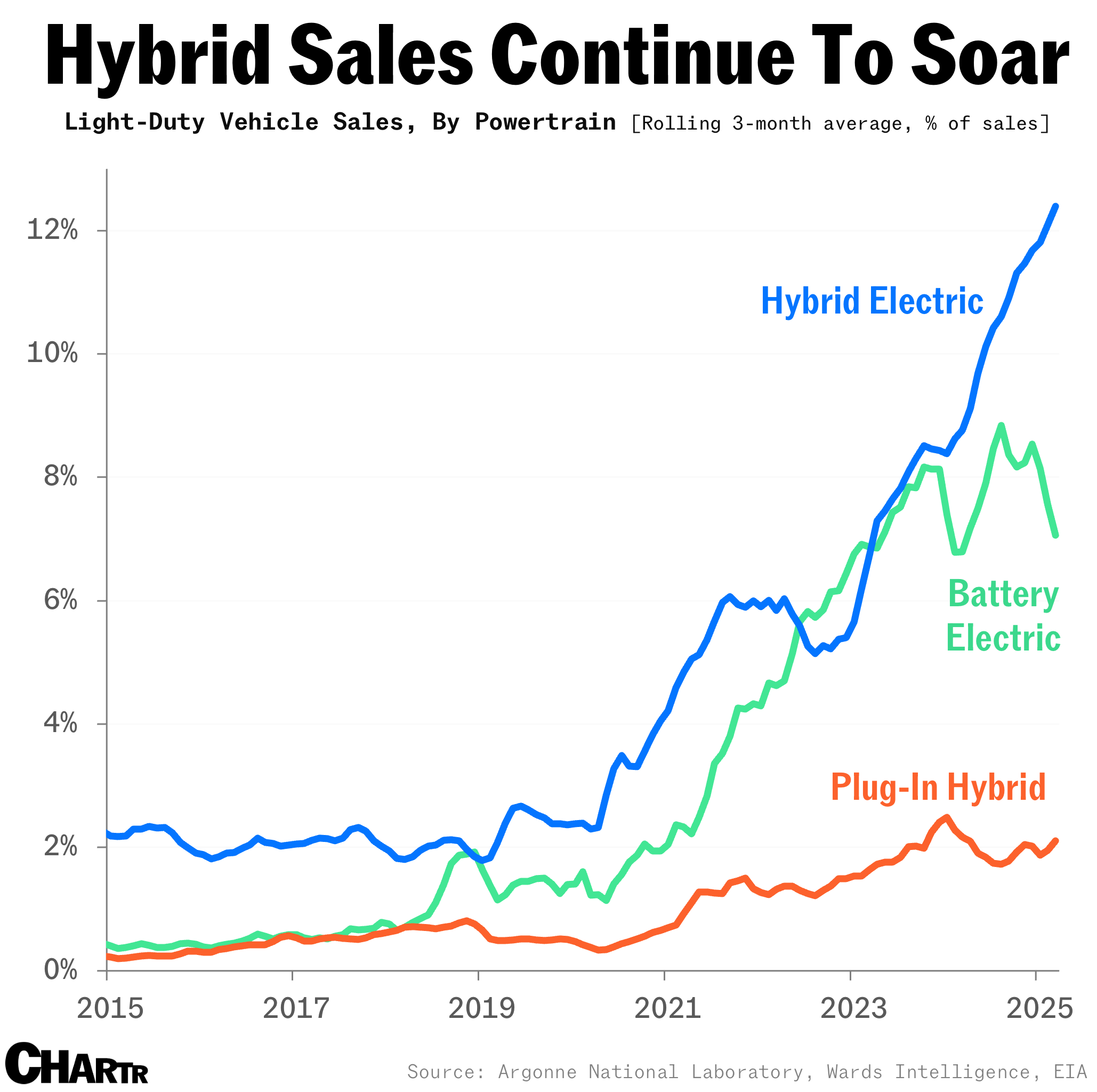
Hybrid vs. BEV vs. PHEV cars
Sherwood News

The remainder, some 78%, were traditional internal-combustion engine vehicles, confirming that America remains a long way from fully embracing electric. Tesla, the country’s bestselling EV producer, reported a decline in deliveries last quarter, with sales in Europe continuing to come under pressure.

Toyota, on the other hand, while still facing the wider industry pressures like tariffs and higher material costs, has held on to its crown as the world’s largest car manufacturer, selling 10.8 million vehicles last year. Just over 1% of those were full BEVs, while nearly 40% were hybrids of some description.

More Tech

See all Tech
tech

Google’s AI chip business could be a $900 billion boon for the company

Google may be sitting on a massive new business that it has yet to fully exploit.

Google’s custom tensor processing unit (TPU) AI chips have been getting a lot of attention recently, making the tech world wonder if there are other ways to power its AI dreams rather than just by using Nvidia’s GPUs.

Bloomberg spoke with analysts who estimate that, if it does decide to sell its chips to others, Google could capture 20% of the AI market, making it a $900 billion business. For comparison, Google Cloud pulled in $43.2 billion of revenue last year.

Even if Google just sticks with renting access to its TPUs, it will continue to drive down costs and increase margins as it ekes out performance improvements, such as the 30x improvement in power efficiency that the latest generation of TPUs has delivered for the company.

Bloomberg spoke with analysts who estimate that, if it does decide to sell its chips to others, Google could capture 20% of the AI market, making it a $900 billion business. For comparison, Google Cloud pulled in $43.2 billion of revenue last year.

Even if Google just sticks with renting access to its TPUs, it will continue to drive down costs and increase margins as it ekes out performance improvements, such as the 30x improvement in power efficiency that the latest generation of TPUs has delivered for the company.

tech

OpenAI’s Sam Altman has explored bringing his feud with Tesla’s Elon Musk to space

Billionaires, they’re just like us: they want to bring their terrestrial beefs to outer space.

OpenAI CEO Sam Altman has explored buying or partnering with a rocket company to compete with Tesla CEO Elon Musk’s SpaceX, The Wall Street Journal reports. The two billionaires have had numerous public feuds over the years that have played out in the courts and on social media. They also both lead AI companies that have insatiable needs for data centers and have publicly discussed building data centers in space.

Altman seems like he thinks this could be more than science fiction. He reportedly reached out to rocket maker Stoke Space to potentially make equity investments in the company to get a controlling stake, though the talks are no longer active, WSJ reports.

Or perhaps he just wanted a Sherwood bobblehead of himself.

tech

Report: Meta to slash metaverse, VR spending by up to 30%

Four years after changing its name to reflect its focus on the loosely defined “metaverse,” Meta is planning deep cuts to the company’s money-losing virtual reality efforts, according to a report from Bloomberg.

Meta’s Reality Labs division, home to the teams working on metaverse products — which include Quest VR headsets, Horizon Worlds, and its Ray-Ban Meta glasses — has lost about $70 billion since the company started breaking out the unit in 2020.

The company has struggled to get consumers to buy into CEO Mark Zuckerberg’s vision of working and playing in virtual reality worlds, like the company’s Horizon Worlds platform.

Investors seem to love the news of the pivot, as shares shot up as much as 5% in early trading.

Meta’s recent hiring spree of AI superstars from competitors for its Meta Superintelligence Labs shows that the company’s attention is now all in on AI.

Meta’s Reality Labs division, home to the teams working on metaverse products — which include Quest VR headsets, Horizon Worlds, and its Ray-Ban Meta glasses — has lost about $70 billion since the company started breaking out the unit in 2020.

The company has struggled to get consumers to buy into CEO Mark Zuckerberg’s vision of working and playing in virtual reality worlds, like the company’s Horizon Worlds platform.

Investors seem to love the news of the pivot, as shares shot up as much as 5% in early trading.

Meta’s recent hiring spree of AI superstars from competitors for its Meta Superintelligence Labs shows that the company’s attention is now all in on AI.

Salesforce CEO Marc Benioff Kicks Off Dreamforce With Keynote Presentation

The best quotes from Salesforce’s earnings call

CEO Marc Benioff doesn’t disappoint.

tech

Salesforce jumps as Q3 earnings top expectations

Salesforce jumped after-hours Wednesday as it posted earnings and guidance that beat analysts’ expectations. Its adjusted earnings per share came in at $3.25 for the third quarter of fiscal 2026, above the FactSet analyst consensus estimate of $2.86. Its revenue rose 9% to $10.3 billion, in line with expectations.

The software-as-a-service company issued fourth-quarter revenue guidance of $11.13 billion to $11.23 billion, well above the $10.9 billion analysts had predicted. It also forecast adjusted earnings of $3.02 to $3.04 per share, compared with analysts’ expectations of $3.04.

Shares were up 4.3% in recent trading.

“Our Agentforce and Data 360 products are the momentum drivers,” CEO Marc Benioff said in the press release.

Last quarter, Salesforce shares fell after the company issued disappointing third-quarter guidance. Coming into today’s report, the stock was down about 30% year to date.

Investors will be watching the earnings call closely for updates on the company’s AI strategy — particularly progress on Agentforce and broader adoption of its AI-driven cloud offerings.

Latest Stories

Sherwood Media, LLC produces fresh and unique perspectives on topical financial news and is a fully owned subsidiary of Robinhood Markets, Inc., and any views expressed here do not necessarily reflect the views of any other Robinhood affiliate, including Robinhood Markets, Inc., Robinhood Financial LLC, Robinhood Securities, LLC, Robinhood Crypto, LLC, or Robinhood Money, LLC.