

Tech
laptop with School textbooks popping out of the screen on a spring
(Getty Images)

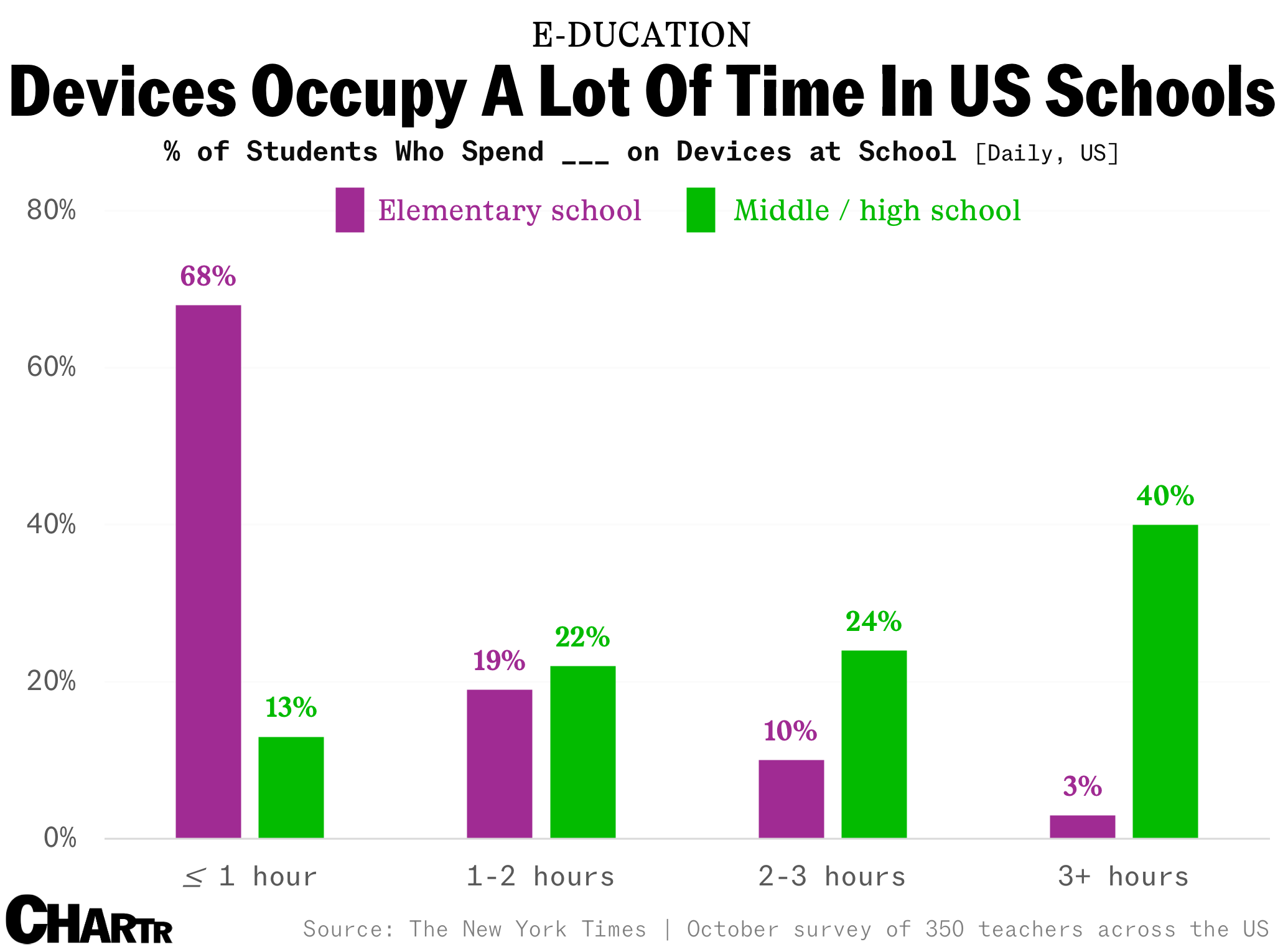
40% of middle and high school students spend about half the school day on devices

A recent NYT survey of US teachers reveals how much screen time American students get in class.

Tom Jones

In March 2020, when the pandemic had kicked off in earnest and schools shut around the world, educational institutions rushed to source e-learning devices to ensure kids could keep learning from home. Now, as we hurtle time-warpingly close to six years on from that point, students are back in class as normal, except they now arrive equipped with the devices that helped them through the remote learning era.

Plugged in

Per an October survey from The New York Times published by The Upshot last week, 8 in 10 American teachers say that students at their schools now have devices assigned to them, up from around a third who said the same in 2019. While that might not be the most surprising news to anyone who has kids or knows even a little bit about modern classroom dynamics, the amount of time some students are spending on those screens each day may come as a little more of a shock.
Student screen time chart
Sherwood News

As you might expect, tablets, laptops, and other school-issued tech are relied on less heavily in elementary schools, with a healthy majority of students spending less than one hour a day on devices in the classroom, according to their teachers. Older kids, however, spend more time with devices in school. Per the most recent Pew Research Center figures, the average school day is around six hours in the US, meaning that the 40% of middle and high school students who spend more than three hours on devices see at least half of their time in school consumed by tech.

Teachers are already worried about screens in schools — a different part of the survey revealed that 70% of respondents said devices are distracting students at least “a little” from schoolwork. Still, despite how you may personally feel, all of this becomes pretty tricky when you remember that many of the so-called “good jobs” that parents and teachers may hope children get are, when stripped back, basically just eight hours spent staring at a screen all day.

More Tech

See all Tech
tech

OpenAI shares how it will charge for ChatGPT ads

Last week, OpenAI announced that ads were going to be rolling out in ChatGPT in the coming weeks.

Now we have more details about what OpenAI is telling advertisers. According to a report from The Information, the company has reached out to “dozens” of advertisers, and will charge based on ad views.

Advertisers are still waiting for further details, but OpenAI is asking for less than $1 million each in ad spending while it tests out the new system, per the report.

Ads are supposed to begin in February, and will only appear for free ChatGPT and ChatGPT Go users.

Advertisers are still waiting for further details, but OpenAI is asking for less than $1 million each in ad spending while it tests out the new system, per the report.

Ads are supposed to begin in February, and will only appear for free ChatGPT and ChatGPT Go users.

tech

Apple is reportedly working on a wearable AI pin

Move over OpenAI, Apple is reportedly also developing a mysterious AI-powered wearable device: a pin that looks like a thin, flat, circular disc with an aluminum-and-glass shell.”

The Information reports that the device is the size of an Apple AirTag and has two cameras, a speaker, three microphones, and wireless charging. It could be available by early 2027.

Apple, which has lagged its peers in AI and recently teamed up with Google to support its upcoming Siri revamp, is hoping to keep up with ChatGPT and Google, which, like Apple, has an AI smartphone. Meta and Google are both also pushing into smart AI glasses.

It’s not to be mistaken with OpenAI’s secretive wearable AI device, which is being made in conjunction with former Apple designer Jony Ive and expected to debut in late 2026. The latest rumors suggest the unnamed device, meant to eventually compete with smartphones, might be earbuds.

Apple, which has lagged its peers in AI and recently teamed up with Google to support its upcoming Siri revamp, is hoping to keep up with ChatGPT and Google, which, like Apple, has an AI smartphone. Meta and Google are both also pushing into smart AI glasses.

It’s not to be mistaken with OpenAI’s secretive wearable AI device, which is being made in conjunction with former Apple designer Jony Ive and expected to debut in late 2026. The latest rumors suggest the unnamed device, meant to eventually compete with smartphones, might be earbuds.

tech

Morgan Stanley expects Tesla to have 1,000 Robotaxis by the end of 2026. Musk had predicted 1,500 by the end of 2025

Ahead of Tesla’s earnings report next week, Morgan Stanley has released a note estimating that the company will scale its Robotaxi fleet much more slowly than CEO Elon Musk has said. The firm thinks the automaker will have 1,000 vehicles in its Robotaxi service by the end of 2026 — 500 fewer than Musk estimated a few months ago Tesla would have by the end of 2025.

More key to Tesla’s success, however, will be removing the safety monitors from those rides, which Morgan Stanley says will be a “precursor to personal unsupervised FSD [Full Self-Driving] rollout.” Musk, of course, had also promised to remove safety drivers in Austin by the end of 2025, but driverless rides are still in the testing stage.

tech

Meta says it’s delivered new AI models internally this month and they’re “very good”

Meta’s last AI model release, Llama 4, was marred by delays and accusations of rigged benchmarks, but the company says the latest models built by its Superintelligence Labs team look promising. CTO Andrew Bosworth told reporters at the World Economic Forum that the team delivered new models internally in January and they’re “very good.”

Bosworth didn’t specify what the models are, though The Wall Street Journal has reported that Meta is working on a large language model and an AI image and video model code-named Avocado and Mango, respectively.

Latest Stories

Sherwood Media, LLC produces fresh and unique perspectives on topical financial news and is a fully owned subsidiary of Robinhood Markets, Inc., and any views expressed here do not necessarily reflect the views of any other Robinhood affiliate, including Robinhood Markets, Inc., Robinhood Financial LLC, Robinhood Securities, LLC, Robinhood Crypto, LLC, or Robinhood Money, LLC.