


Traders are increasingly reaching for index options in an uncertain market
As volatility becomes more event-driven and market leadership more concentrated, traders are increasingly turning to index options as tools for managing exposure and expressing short-term market views.
For traders, dramatic swings and sentiment shifts are all in a day’s work. Let’s say the Nasdaq-100 Index® (NDX®) opens sharply lower, following a major geopolitical event. By mid-morning, buyers step in, erasing much of the decline. An afternoon AI announcement shifts sentiment again, and by the closing bell, the index has logged a swing of several percentage points between its intraday high and low.
Moves like this aren’t uncommon. While central bank commentary, earnings, and macro data releases (rate decisions, jobs data and CPI releases, to name a few) have always contributed to market chatter, now even a single post on X can produce sharp intraday reactions.
As a steady flow of market-moving information recalibrates valuations in real time, broad and growth-oriented benchmarks like the Nasdaq-100 Index tend to absorb the effects — but volatility alone doesn’t explain this heightened sensitivity.
A game of concentration
As market performance has become more tightly tethered to a narrow group of mega-cap technology stocks, reactions to events like earnings results are magnified by the market’s largest companies. That’s particularly true for innovation-focused and tech-heavy benchmarks, with over 40% of NDX’s weight concentrated in the market-leading stocks known as the “Magnificent 7.”
Of course, exposure to these stocks is essential for any growth-oriented strategy. As a diversified index spanning 100 leading U.S. tech companies, the Nasdaq-100 Index is broad enough to aggregate tech exposure — yet concentrated by mega-cap dominance. Since concentration risk also amplifies volatile market conditions, the present-day landscape makes managing index-level exposure a matter of strategic importance.
That might go some way in explaining why more and more traders are utilizing index options. Since the final quarter of 2022, average daily volume for index options has increased 67%; when narrowed to Nasdaq-100 Index® Options, we see 344.5% ADV growth over the same period.1
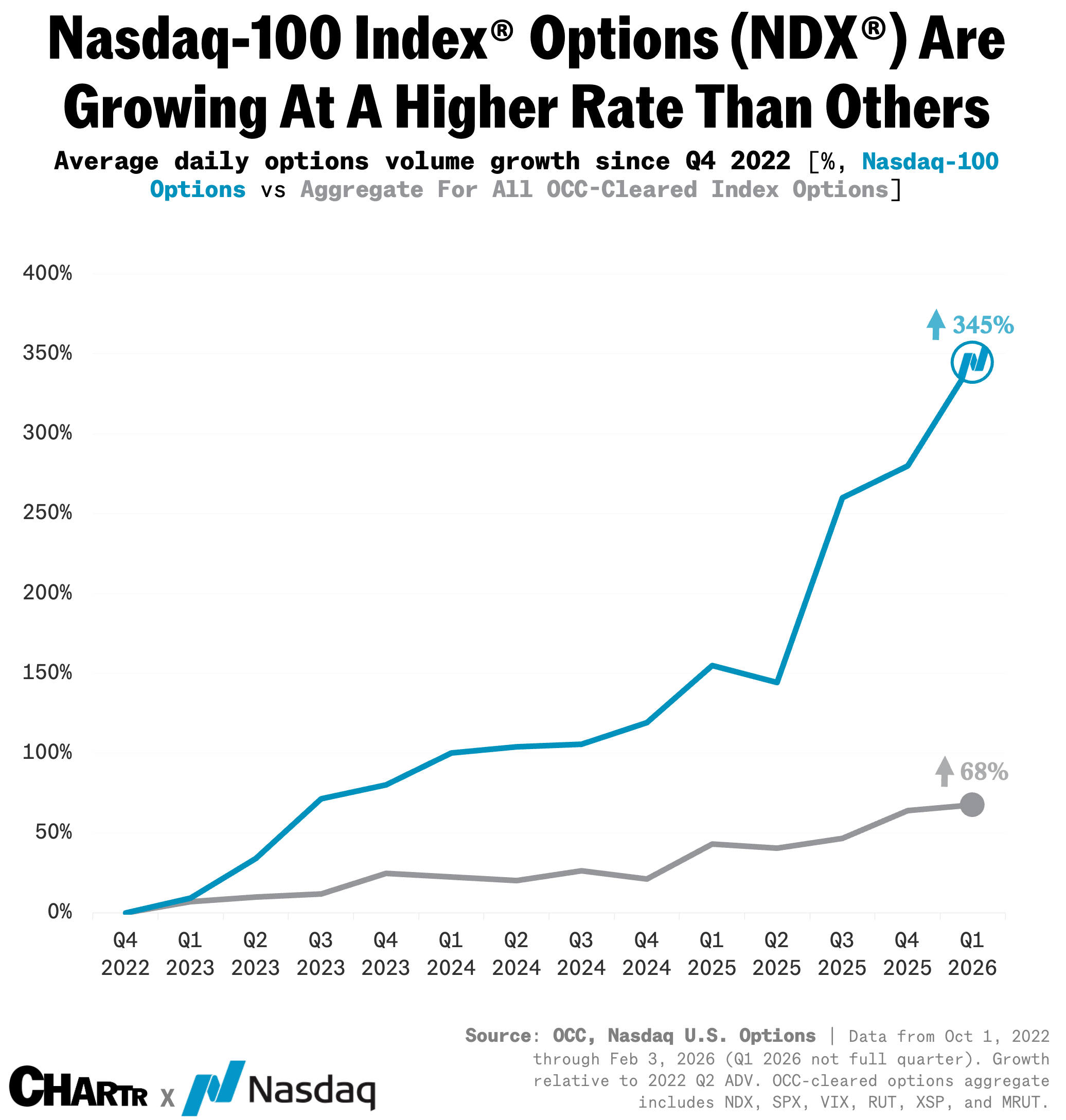
Seemingly, traders are leveraging index-based derivatives to manage risk, pointing to the appeal of instruments that reflect a broader benchmark over the idiosyncrasies of a single stock. Nasdaq-100 Index Options — which include the flagship NDX contract and the smaller-sized XND® — sit squarely in that space. Both contracts are cash-settled and European-style, meaning they settle in cash at expiration and can’t be exercised early. For traders focused on managing index exposure, that structure keeps the trade focused on the benchmark, without the share-delivery or early-assignment considerations associated with equity and ETF options.
Particularly in an environment where a handful of mega-caps can (and often do) steer the tape, an aggregate lens becomes tactical as well as efficient. A single NDX contract can serve as a vehicle to position around macro catalysts, earnings clusters, or broader sentiment shifts without taking a company-specific view — and the additional risk that can come with it.
Precision and participation
At the same time, the rise of daily options in addition to weekly, monthly, and quarterly expirations has given traders an additional layer of precision, especially when it comes to managing intra-day volatility. CME’s data shows that short-dated expiries have taken an increasing share of total E-mini Nasdaq-100 options volume since 2021 — a pattern often linked to growing retail participation in the derivatives market. Indeed, recent estimates suggest the retail share of zero-day options activity could be as high as 60%.
Retail growth hasn’t just added volume to the derivatives market. It has fundamentally altered market structure, as retail and institutional strategies for managing volatility intersect in the same kinds of contracts. With more participants gravitating toward benchmark-based tools like NDX and XND, order flow has strengthened around index options, helping to deepen liquidity across strikes and expirations. In the resulting ecosystem, index options are no longer seen as supplementary tools used in institutional hedging strategies, but a central meeting point in modern markets.
The broad signal
In the current climate, index options are proving useful — and traders of all ilks are switching on to the benefits. But while uncertainty and concentration in the market have added to their utility, the growing trading activity on Nasdaq-100 Index Options isn’t just an indicator of volatility. It’s a pattern that reflects a broader shift in how modern markets function: faster, more concentrated, more event-driven, and more participatory.
Nasdaq-100 Index Options are some of the most robust tools traders have for mitigating risk and managing benchmark exposure. For those looking to explore how Nasdaq-100 Index Options function in practice, get additional product details and even test out your strategies — and to stay plugged-in, sign-up for the bi-weekly Nasdaq-100 Index Options Newsletter.
Advertiser's Disclosure:
1 Source: OCC, Nasdaq U.S. Options. Data from Oct 1. 2022 through Feb 3. 2026 (Q1 2026 not full quarter). Growth relative to 2022 Q4 ADV. OCC-cleared options aggregate includes NDX, SPX, VIX, RUT, XSP and MRUT.
Nasdaq® is a registered trademark of Nasdaq, Inc. The information contained above is provided for informational and educational purposes only, and nothing contained herein should be construed as investment advice, either on behalf of a particular security or an overall investment strategy. Neither Nasdaq, Inc. nor any of its affiliates makes any recommendation to buy or sell any security or any representation about the financial condition of any company. Statements regarding Nasdaq-listed companies or Nasdaq proprietary indexes are not guarantees of future performance. Actual results may differ materially from those expressed or implied. Past performance is not indicative of future results. Investors should undertake their own due diligence and carefully evaluate companies before investing. ADVICE FROM A SECURITIES PROFESSIONAL IS STRONGLY ADVISED.
For the sake of simplicity, the examples included do not take into consideration commissions and other transaction fees, tax considerations, or margin requirements, which are factors that may significantly affect the economic consequences of a given strategy. An investor should review transaction costs, margin requirements and tax considerations with a broker and tax advisor before entering into any options strategy.
Options involve risk and are not suitable for everyone. Prior to buying or selling an option, a person must receive a copy of Characteristics and Risks of Standardized Options. Copies may be obtained from your broker, one of the exchanges or The Options Clearing Corporation, One North Wacker Drive, Suite 500, Chicago, IL 60606 or call 1-888-OPTIONS or visit www.888options.com.
Any strategies discussed, including examples using actual securities and price data, are strictly for illustrative and education purposes and are not to be construed as an endorsement, recommendation or solicitation to buy or sell securities.
© 2025. Nasdaq, Inc. All Rights Reserved.