

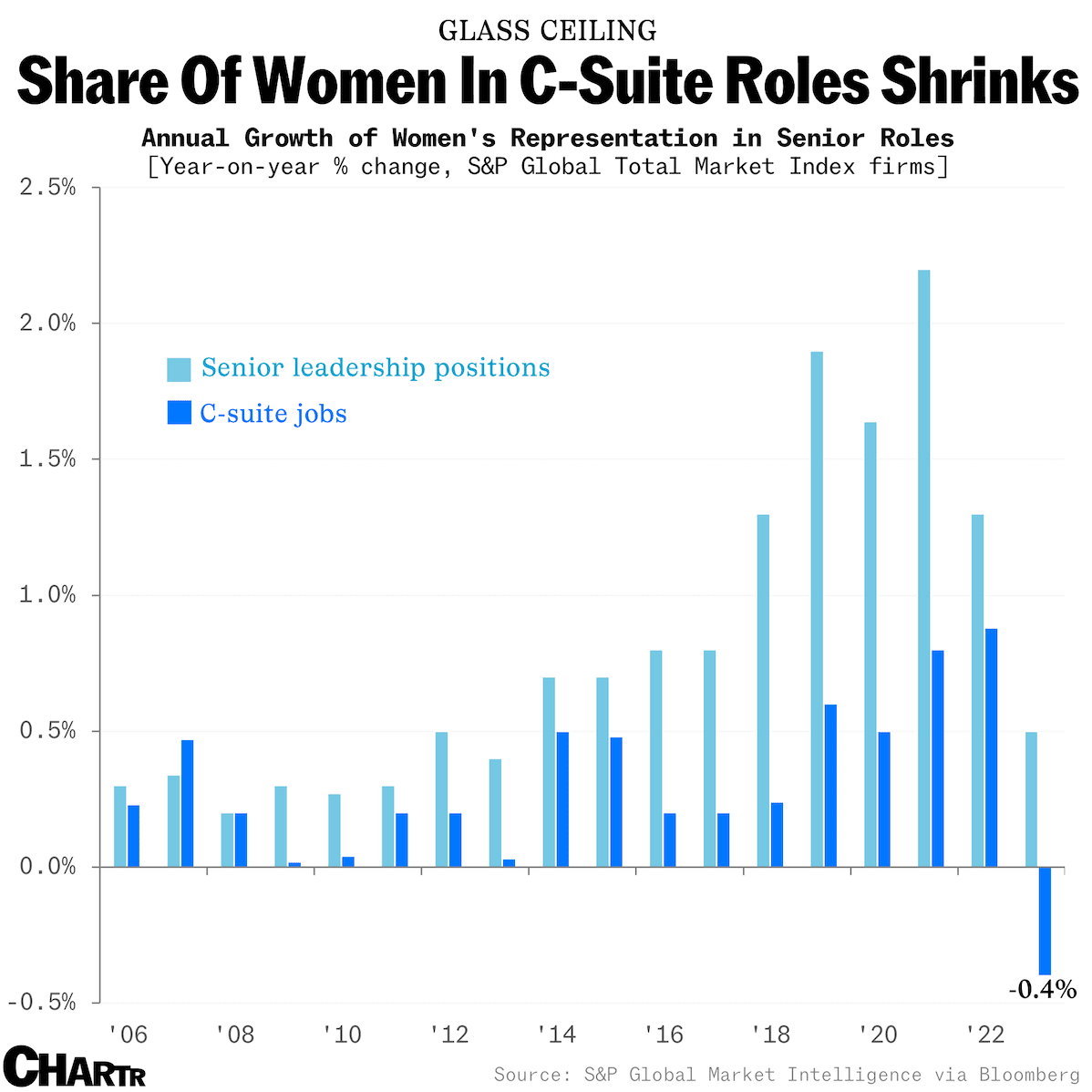
For the first time in almost 20 years, the share of women holding executive positions at publicly traded US companies has dropped, with a recent report from S&P Global finding that there were roughly 60 fewer women in “C-suite” roles last year.
The news marks a departure from nearly two decades of progress — it’s the first time since 2005, when S&P Global began recording the figures, that the share of women in the C-suite has fallen, dropping by 0.4%. Out of the ~15,000 executive roles tracked, women accounted for 11.8% of them, down from 12.2% the previous year. While the more broadly defined “senior leadership positions” did see an increase in women’s representation, its growth rate also slowed significantly.
According to the report, one possible contributing factor to this trend is a “waning focus on diversity initiatives”. Mentions of “diversity” and “inclusion” on S&P earnings calls — which surged during the pandemic, when the terms were mentioned 1,367 times in total — have fallen consecutively to fewer than 100 in the most recent quarter, as legal complexities and backlash have stalled inclusion efforts.
Beyond this, several other factors might play a part in the regression: S&P Global published research just last month finding that women held less than a third of stepping-stone management positions, with Fortune also finding that women stayed for an average ~2.7 years less than male counterparts once they reached the coveted top spot.
More Power
See all Power

FTC will appeal Meta antitrust case
Only a few months after successfully defending itself from an FTC antitrust lawsuit, Meta may be heading back to court. Today, the FTC announced that it would appeal the decision, reopening a yearslong suit.
The FTC called Meta’s acquisition of Instagram and WhatsApp an illegal monopoly. The judge in the case found that in the years since the suit was first brought, the competitive landscape had changed dramatically, with Meta facing fierce competition from TikTok.
Netflix goes all-cash in bid for Warner Bros., boosting its odds
Netflix on Tuesday applied more pressure to Paramount Skydance in the ongoing bidding war for Warner Bros. Discovery, amending its offer to an all-cash proposal.
Netflix shares ticked up in premarket trading, while Paramount and Warner Bros. were down less than 1%.
The move, which was expected, does not increase the value of Netflix’s $82.7 billion offer for WBD. Netflix said shareholders will be able to vote on the deal in April.
In a Tuesday filing, Warner Bros. said that it values Discovery Global, the spin-off of its cable assets, at between $1.33 and $6.86 per share. Earlier this month, Paramount said it valued the cable TV business at $0 per share.
With Tuesday’s update, event contracts have swung even further in Netflix’s favor, with Paramount’s odds to end up in control of Warner Bros. falling to 14%. That’s below the odds for “none.”
(Event contracts are offered through Robinhood Derivatives, LLC — probabilities referenced or sourced from KalshiEx LLC or ForecastEx LLC.)

The move, which was expected, does not increase the value of Netflix’s $82.7 billion offer for WBD. Netflix said shareholders will be able to vote on the deal in April.
In a Tuesday filing, Warner Bros. said that it values Discovery Global, the spin-off of its cable assets, at between $1.33 and $6.86 per share. Earlier this month, Paramount said it valued the cable TV business at $0 per share.
With Tuesday’s update, event contracts have swung even further in Netflix’s favor, with Paramount’s odds to end up in control of Warner Bros. falling to 14%. That’s below the odds for “none.”
(Event contracts are offered through Robinhood Derivatives, LLC — probabilities referenced or sourced from KalshiEx LLC or ForecastEx LLC.)
Paramount doesn’t improve its offer for Warner Bros., leaving its fate to a long-shot shareholder appeal
Paramount Skydance on Thursday reaffirmed its $30-per-share offer to buy Warner Bros. Discovery, again stating that it believes the offer to be superior to rival Netflix’s.
In a press release, Paramount said its last amendment to the offer — which included a $40.4 billion personal guarantee from Larry Ellison, the father of Paramount CEO David Ellison — “cured every issue raised by WBD.”
The problem: Warner Bros.’ board on Wednesday unanimously voted to reject that offer, its sixth rejection of a Paramount takeover and second rejection of this specific $30-per-share bid. Warner’s board stated that it believes Paramount’s offer to be inferior to Netflix’s due in part to an “extraordinary amount of debt financing” and lower effective termination fees should the deal not clear the regulatory process.
By not improving the bid, Paramount is effectively leaving the deal in the hands of Warner Bros.’ shareholders, who will have to weigh the bids and the multiple rejections. Event contracts show a moderate boost in Parmount’s odds to end up in control of WBD on Thursday morning, jumping to 31% as of 9:30 a.m. ET, up from 27% at 9:00 a.m. ET.
(Event contracts are offered through Robinhood Derivatives, LLC — probabilities referenced or sourced from KalshiEx LLC or ForecastEx LLC.)
Warner Bros. Discovery’s board tells shareholders to turn down Paramount’s “inadequate” hostile bid
Warner Bros. Discovery has told shareholders to reject Paramount’s hostile takeover bid, with the company releasing a statement early Wednesday urging shareholders to take the Netflix offer on the table. WBD’s board of directors said the outcome of the Netflix deal is “extraordinary by any measure.”
Paramount’s offer, in contrast, was described in the letter as “illusory,” providing “inadequate value,” and likely to impose “numerous, significant risks and costs on WBD.” The board said Paramount has “misled WBD shareholders that its proposed transaction has a ‘full backstop’ from the Ellison family,” and the board also outlined that it doesn’t believe there is a “material difference in regulatory risk between the PSKY offer and the Netflix merger.”
WBD shares dipped in the minutes leading up to the market close on Tuesday after news leaked that its management was preparing to encourage shareholders to reject Paramount’s bid, and shares of the HBO parent were down at $28.66, off 0.83% from yesterday’s close, as of 7:56 a.m. ET on Wednesday. Netflix was ticking higher, up around 1.7%, and Paramount Skydance was modestly in the red, down 1%.
Several outlets have reported that Jared Kushner’s firm would back out of the group that had been assembled to help finance the Paramount bid. Confirming this withdrawal, a spokesperson for the firm helmed by the president’s son-in-law told NBC News that “the dynamics of the investment have changed significantly since we initially became involved in October.”
Analysts this month have said that a renewed bidding war for Warner Bros. seems “inevitable” given the antitrust concerns surrounding Netflix’s potential acquisition. President Trump on Tuesday appeared to distance himself from speculation around his closeness to Paramount’s owners, posting on Truth Social, “If they are friends, I’d hate to see my enemies!”
Warner’s attempt to influence its shareholders could fuel a higher bid from Paramount in the coming weeks — shareholders currently have until January 8 to decide whether to accept the current offer.

Paramount’s offer, in contrast, was described in the letter as “illusory,” providing “inadequate value,” and likely to impose “numerous, significant risks and costs on WBD.” The board said Paramount has “misled WBD shareholders that its proposed transaction has a ‘full backstop’ from the Ellison family,” and the board also outlined that it doesn’t believe there is a “material difference in regulatory risk between the PSKY offer and the Netflix merger.”
WBD shares dipped in the minutes leading up to the market close on Tuesday after news leaked that its management was preparing to encourage shareholders to reject Paramount’s bid, and shares of the HBO parent were down at $28.66, off 0.83% from yesterday’s close, as of 7:56 a.m. ET on Wednesday. Netflix was ticking higher, up around 1.7%, and Paramount Skydance was modestly in the red, down 1%.
Several outlets have reported that Jared Kushner’s firm would back out of the group that had been assembled to help finance the Paramount bid. Confirming this withdrawal, a spokesperson for the firm helmed by the president’s son-in-law told NBC News that “the dynamics of the investment have changed significantly since we initially became involved in October.”
Analysts this month have said that a renewed bidding war for Warner Bros. seems “inevitable” given the antitrust concerns surrounding Netflix’s potential acquisition. President Trump on Tuesday appeared to distance himself from speculation around his closeness to Paramount’s owners, posting on Truth Social, “If they are friends, I’d hate to see my enemies!”
Warner’s attempt to influence its shareholders could fuel a higher bid from Paramount in the coming weeks — shareholders currently have until January 8 to decide whether to accept the current offer.