Power
Job switchers and stayers

The FTC is banning non-compete clauses

Why that might make job switching even more lucrative

Yesterday, the US Federal Trade Commission voted 3-to-2 for a near-total ban on non-compete agreements, the contract stipulations that prevent millions of employees — from bankers, to biochemists, to bartenders — from finding new work or starting businesses in their field after they leave their jobs.

Lost clause

The new rule, coming almost 3 years after Biden signed an executive order that encouraged limiting the agreements, will work to prevent the “unfair methods of competition” from keeping wages low, suppressing new ideas, and “robbing the American economy of dynamism”, according to FTC Chair Lina Khan.

The FTC reports that non-competes affect nearly 1 in 5 American workers, with the regulator also estimating that the ban will raise the average employee’s annual earnings by $524 and create thousands of new startups.

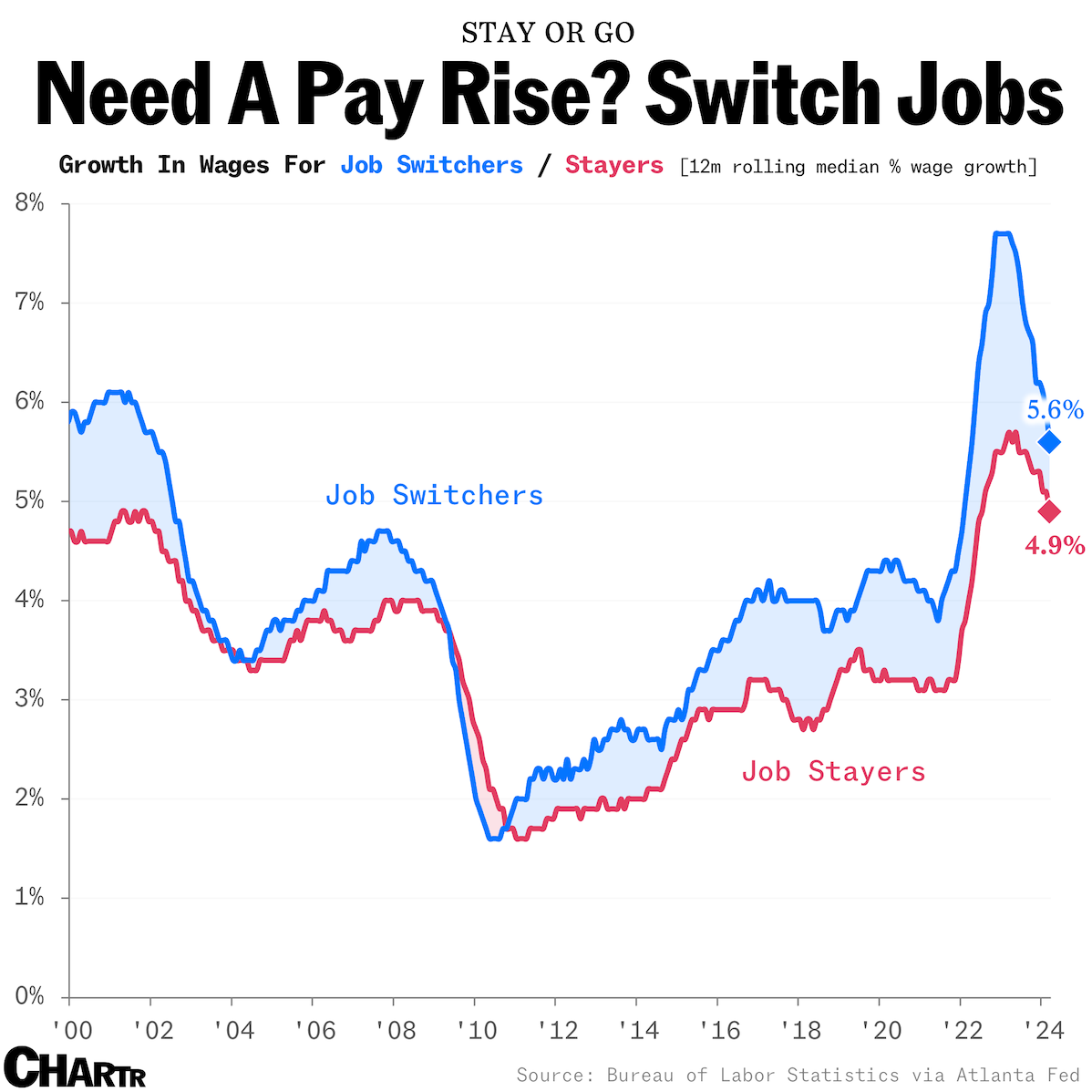
While the $524 average pay rise is a theoretical benefit for now, there is a substantial body of evidence that suggests moving jobs is a good way to get a pay bump. Data from the Atlanta Fed reveals that, for much of the last 24 years, the employees who go, rather than stay, have typically seen larger pay rises within 12 months. The theory follows that reducing frictions in that switching process would lead to more competition for talent and, thus, rising wages.

Still, the anti-anti-competition measure has already drawn criticism from industry groups that consider the move too drastic. The Chamber of Commerce, the largest business lobby in the US, plans to sue the regulator as early as today on the basis of the “dangerous precedent” that the ban sets for government involvement in business and compromises its ability to protect confidential information.


More Power

See all Power
power
Hyunsoo Rim

TIME names the “Architects of AI” as its Person of the Year for 2025

TIME just announced its Person of the Year… and it’s not a single person.  

The magazine selected the “Architects of AI” as its 2025 honoree, spotlighting the executives and engineers behind the year’s AI boom. One of the two covers features eight tech leaders perched on a steel beam — recreating the iconic “Lunch Atop a Skyscraper” photo from 1932 — including Meta’s Mark Zuckerberg, AMD’s Lisa Su, xAI’s Elon Musk, OpenAI’s Sam Altman, and Nvidia CEO Jensen Huang at the center, whose chips power many of today’s AI models.

Western Auctioneer with Two Fingers up and Gavel in Hand

As investors pick sides in Netflix vs. Paramount, analysts say a renewed Warner Bros. bidding war looks inevitable

Analysts at Bloomberg on Wednesday said Paramount’s WBD hostile takeover offer could go as high as $35 per share.

Netflix WBD CEOs

The Netflix-Warner Bros. deal now faces a wall of opposition

Netflix will owe Warner Bros. $5.8 billion in cash if the deal is terminated on antitrust grounds.

power
Jon Keegan

The New York Times, Chicago Tribune sue Perplexity

The New York Times is suing the AI search engine startup Perplexity, alleging repeated copyright violations.

In the complaint, the Times accuses Perplexity of scraping the company’s content and generating outputs that are “identical or substantially similar” to Times content:

“Upon information and belief, Perplexity has unlawfully copied, distributed, and displayed millions of copyrighted Times stories, videos, podcasts, images and other works to power its products and tools.”

The Times also alleges that Perplexity’s AI tool generates “hallucinations” and falsely attribute them to the Times, creating confusion that harms the company’s brand.

In a separate suit filed Thursday, the Chicago Tribune accused Perplexity of similar copyright violations.

Perplexity’s “answer engine” made early inroads in an attempt to replace traditional web searches with AI-powered responses, but its larger competitors such as OpenAI, Google, and Anthropic have been adding similar features. OpenAI recently released its own AI-powered web browser, ChatGPT Atlas, which challenges Perplexity’s Comet browser.

Jesse Dwyer, Head of Communication for Perplexity told Sherwood News in a statement:

“Publishers have been suing new tech companies for a hundred years, starting with radio, TV, the internet, social media and now AI. Fortunately it’s never worked, or we’d all be talking about this by telegraph.”

“Upon information and belief, Perplexity has unlawfully copied, distributed, and displayed millions of copyrighted Times stories, videos, podcasts, images and other works to power its products and tools.”

The Times also alleges that Perplexity’s AI tool generates “hallucinations” and falsely attribute them to the Times, creating confusion that harms the company’s brand.

In a separate suit filed Thursday, the Chicago Tribune accused Perplexity of similar copyright violations.

Perplexity’s “answer engine” made early inroads in an attempt to replace traditional web searches with AI-powered responses, but its larger competitors such as OpenAI, Google, and Anthropic have been adding similar features. OpenAI recently released its own AI-powered web browser, ChatGPT Atlas, which challenges Perplexity’s Comet browser.

Jesse Dwyer, Head of Communication for Perplexity told Sherwood News in a statement:

“Publishers have been suing new tech companies for a hundred years, starting with radio, TV, the internet, social media and now AI. Fortunately it’s never worked, or we’d all be talking about this by telegraph.”

power
Jon Keegan

European regulators will examine if Apple’s maps and ads businesses require stricter oversight

Apple has notified European regulators that its Apple Maps and Apple Ads platforms meet the threshold to be called “gatekeepers” under the European Commission’s Digital Markets Act, the European Commission said.

European antitrust regulators will now examine if the tech giant’s Maps and Ads units should be subject to stricter regulation. According to the DMA, when a platform reaches 45 million monthly active users and a market cap of €75 billion ($79 billion), it triggers the “gatekeeper” designation and additional rules apply.

While Apple notified regulators that the threshold has been met, it is pushing back on the designation, saying in a rebuttal to rule makers that the platforms are actually relatively small compared to the competition in Europe and should be excluded. The EC has 45 working days to make a final determination about the designation, and Apple would have six months to comply, Reuters reported.

European antitrust regulators will now examine if the tech giant’s Maps and Ads units should be subject to stricter regulation. According to the DMA, when a platform reaches 45 million monthly active users and a market cap of €75 billion ($79 billion), it triggers the “gatekeeper” designation and additional rules apply.

While Apple notified regulators that the threshold has been met, it is pushing back on the designation, saying in a rebuttal to rule makers that the platforms are actually relatively small compared to the competition in Europe and should be excluded. The EC has 45 working days to make a final determination about the designation, and Apple would have six months to comply, Reuters reported.

Latest Stories

Sherwood Media, LLC produces fresh and unique perspectives on topical financial news and is a fully owned subsidiary of Robinhood Markets, Inc., and any views expressed here do not necessarily reflect the views of any other Robinhood affiliate, including Robinhood Markets, Inc., Robinhood Financial LLC, Robinhood Securities, LLC, Robinhood Crypto, LLC, or Robinhood Money, LLC.