
Power
Cinder block about to fall on red alarm clock on white surface, yellow background
(Getty Images)
Against the clock

America seems ready to call time on daylight saving

A new poll finds that most US adults want to phase out the practice, as the government brings biannual clock changes into question.

Millie Giles

For those who woke up lamenting the sleep they lost last night, there’s some good news: the sun could soon be setting on daylight saving time (DST).

While President Trump described the removal of DST as a “a 50-50 issue” last Thursday, softening his previously hard-line anti-DST stance, more state-level lawmakers (and Elon Musk) are moving to scrap the time-honored ritual.

Call it a day

The biannual clock change (forward at the start of the spring; backward for winter) was initially introduced in the US during World War I and later formalized by Congress in 1966. Today, all US states besides Arizona and Hawaii participate — though 20 other states have since passed laws or resolutions to move to permanent DST, with state legislatures considering over 750 bills in recent years to establish year-round standard time as soon as federal law allows.

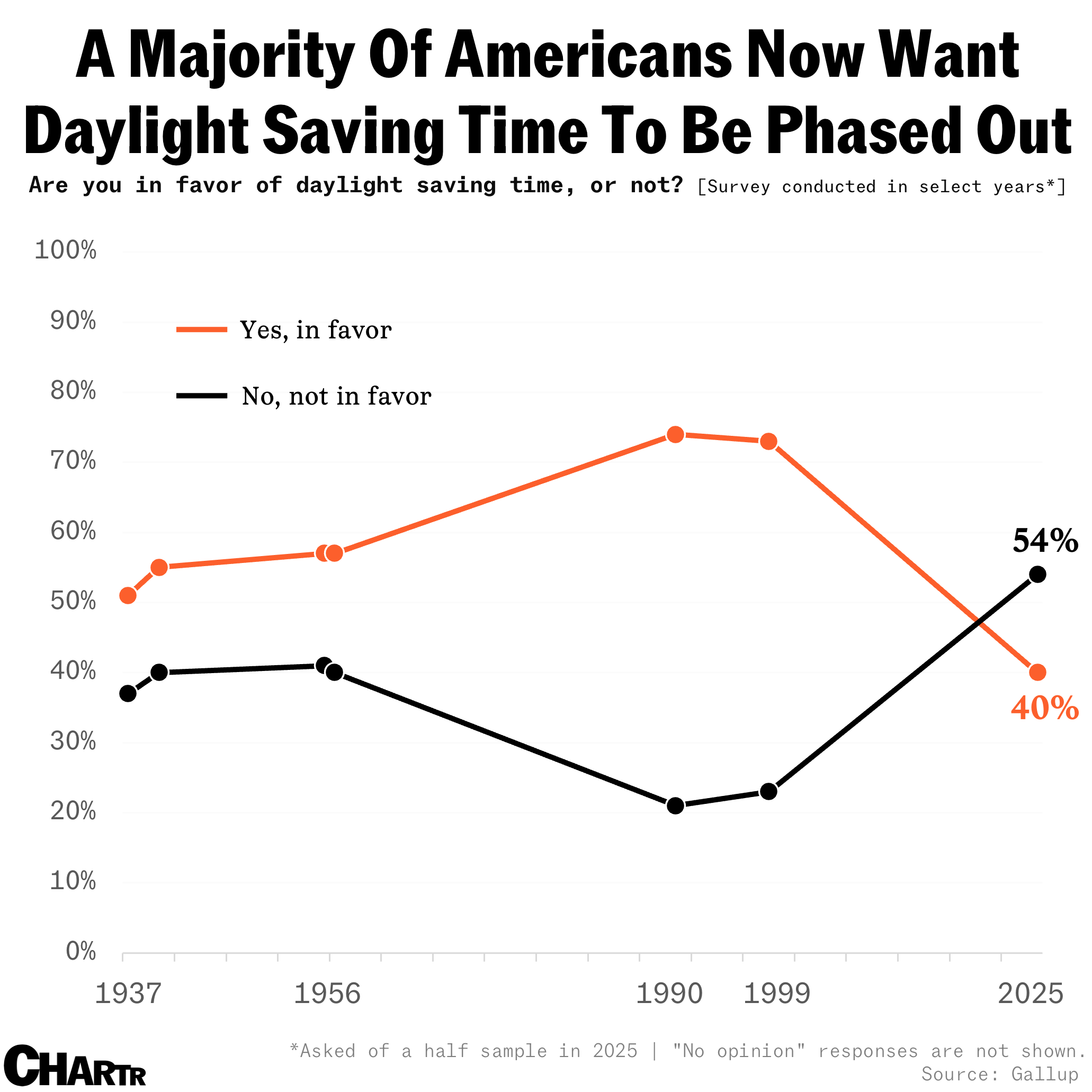
Generally, it seems that Americans are now less supportive of observing daylight saving. A new Gallup poll found that 54% of Americans surveyed did not support the practice, preferring year-round standard time instead — a complete reversal from decades prior, with 73% of respondents favoring DST in 1999.
Daylight savings chart
Sherwood News

Still, this stark shift in opinion could have something to do with the 26-year gap between survey recordings, with an entire digital era in between where Americans might have become increasingly resentful of their smartphone’s untimely wake-up calls.

Cause for alarm? There’s growing evidence that twice-yearly time changes have several negative societal and health impacts, with days after the change seeing higher national rates of car accidents, strokes, heart attacks, overdoses, and even migraines, per NPR.

More Power

See all Power
Netflix WBD CEOs

The Netflix-Warner Bros. deal now faces a wall of opposition

Netflix will owe Warner Bros. $5.8 billion in cash if the deal is terminated on antitrust grounds.

power

The New York Times, Chicago Tribune sue Perplexity

The New York Times is suing the AI search engine startup Perplexity, alleging repeated copyright violations.

In the complaint, the Times accuses Perplexity of scraping the company’s content and generating outputs that are “identical or substantially similar” to Times content:

“Upon information and belief, Perplexity has unlawfully copied, distributed, and displayed millions of copyrighted Times stories, videos, podcasts, images and other works to power its products and tools.”

The Times also alleges that Perplexity’s AI tool generates “hallucinations” and falsely attribute them to the Times, creating confusion that harms the company’s brand.

In a separate suit filed Thursday, the Chicago Tribune accused Perplexity of similar copyright violations.

Perplexity’s “answer engine” made early inroads in an attempt to replace traditional web searches with AI-powered responses, but its larger competitors such as OpenAI, Google, and Anthropic have been adding similar features. OpenAI recently released its own AI-powered web browser, ChatGPT Atlas, which challenges Perplexity’s Comet browser.

Jesse Dwyer, Head of Communication for Perplexity told Sherwood News in a statement:

“Publishers have been suing new tech companies for a hundred years, starting with radio, TV, the internet, social media and now AI. Fortunately it’s never worked, or we’d all be talking about this by telegraph.”

“Upon information and belief, Perplexity has unlawfully copied, distributed, and displayed millions of copyrighted Times stories, videos, podcasts, images and other works to power its products and tools.”

The Times also alleges that Perplexity’s AI tool generates “hallucinations” and falsely attribute them to the Times, creating confusion that harms the company’s brand.

In a separate suit filed Thursday, the Chicago Tribune accused Perplexity of similar copyright violations.

Perplexity’s “answer engine” made early inroads in an attempt to replace traditional web searches with AI-powered responses, but its larger competitors such as OpenAI, Google, and Anthropic have been adding similar features. OpenAI recently released its own AI-powered web browser, ChatGPT Atlas, which challenges Perplexity’s Comet browser.

Jesse Dwyer, Head of Communication for Perplexity told Sherwood News in a statement:

“Publishers have been suing new tech companies for a hundred years, starting with radio, TV, the internet, social media and now AI. Fortunately it’s never worked, or we’d all be talking about this by telegraph.”

power
Jon Keegan

European regulators will examine if Apple’s maps and ads businesses require stricter oversight

Apple has notified European regulators that its Apple Maps and Apple Ads platforms meet the threshold to be called “gatekeepers” under the European Commission’s Digital Markets Act, the European Commission said.

European antitrust regulators will now examine if the tech giant’s Maps and Ads units should be subject to stricter regulation. According to the DMA, when a platform reaches 45 million monthly active users and a market cap of €75 billion ($79 billion), it triggers the “gatekeeper” designation and additional rules apply.

While Apple notified regulators that the threshold has been met, it is pushing back on the designation, saying in a rebuttal to rule makers that the platforms are actually relatively small compared to the competition in Europe and should be excluded. The EC has 45 working days to make a final determination about the designation, and Apple would have six months to comply, Reuters reported.

European antitrust regulators will now examine if the tech giant’s Maps and Ads units should be subject to stricter regulation. According to the DMA, when a platform reaches 45 million monthly active users and a market cap of €75 billion ($79 billion), it triggers the “gatekeeper” designation and additional rules apply.

While Apple notified regulators that the threshold has been met, it is pushing back on the designation, saying in a rebuttal to rule makers that the platforms are actually relatively small compared to the competition in Europe and should be excluded. The EC has 45 working days to make a final determination about the designation, and Apple would have six months to comply, Reuters reported.

power
Jon Keegan

Delhi High Court says Apple could face $38 billion penalty in Indian antitrust case

India’s Delhi High Court says that Apple could face a penalty as high as $38 billion for what its investigators describe as abusive conduct” related to the tech giant’s app store, Reuters reports.

Apple is challenging the constitutionality of the country’s new antitrust law, taking specific issue with the fact that penalties are calculated based on companies’ total annual global revenue, rather than just revenue derived from India.

That global figure could mean fines as high as $38 billion, according to a court filing seen by Reuters.

The Competition Commission of India has not issued a final ruling in the case.

That global figure could mean fines as high as $38 billion, according to a court filing seen by Reuters.

The Competition Commission of India has not issued a final ruling in the case.

power
Jon Keegan

Anthropic CEO Amodei asked to testify before Congress about Claude-powered Chinese cyberattack, Axios reports

Earlier this month, Anthropic revealed that Chinese state actors had used its Claude chatbot to orchestrate and execute a cyber espionage campaign for the first time. The company said that after it detected its product was being used in that manner, it was able to respond and disrupt malicious behavior.

Now, Anthropic CEO Dario Amodei has been called to testify before the House Committee on Homeland Security, along with Google Cloud CEO Thomas Kuria and Quantum Xchange CEO Eddy Zervigon, Axios reports.

The House committee is seeking information about how nation-state actors are using AI agents to devise and execute novel cyberattacks, like the one that Anthropic disrupted.

The House committee is seeking information about how nation-state actors are using AI agents to devise and execute novel cyberattacks, like the one that Anthropic disrupted.

Latest Stories

Sherwood Media, LLC produces fresh and unique perspectives on topical financial news and is a fully owned subsidiary of Robinhood Markets, Inc., and any views expressed here do not necessarily reflect the views of any other Robinhood affiliate, including Robinhood Markets, Inc., Robinhood Financial LLC, Robinhood Securities, LLC, Robinhood Crypto, LLC, or Robinhood Money, LLC.