

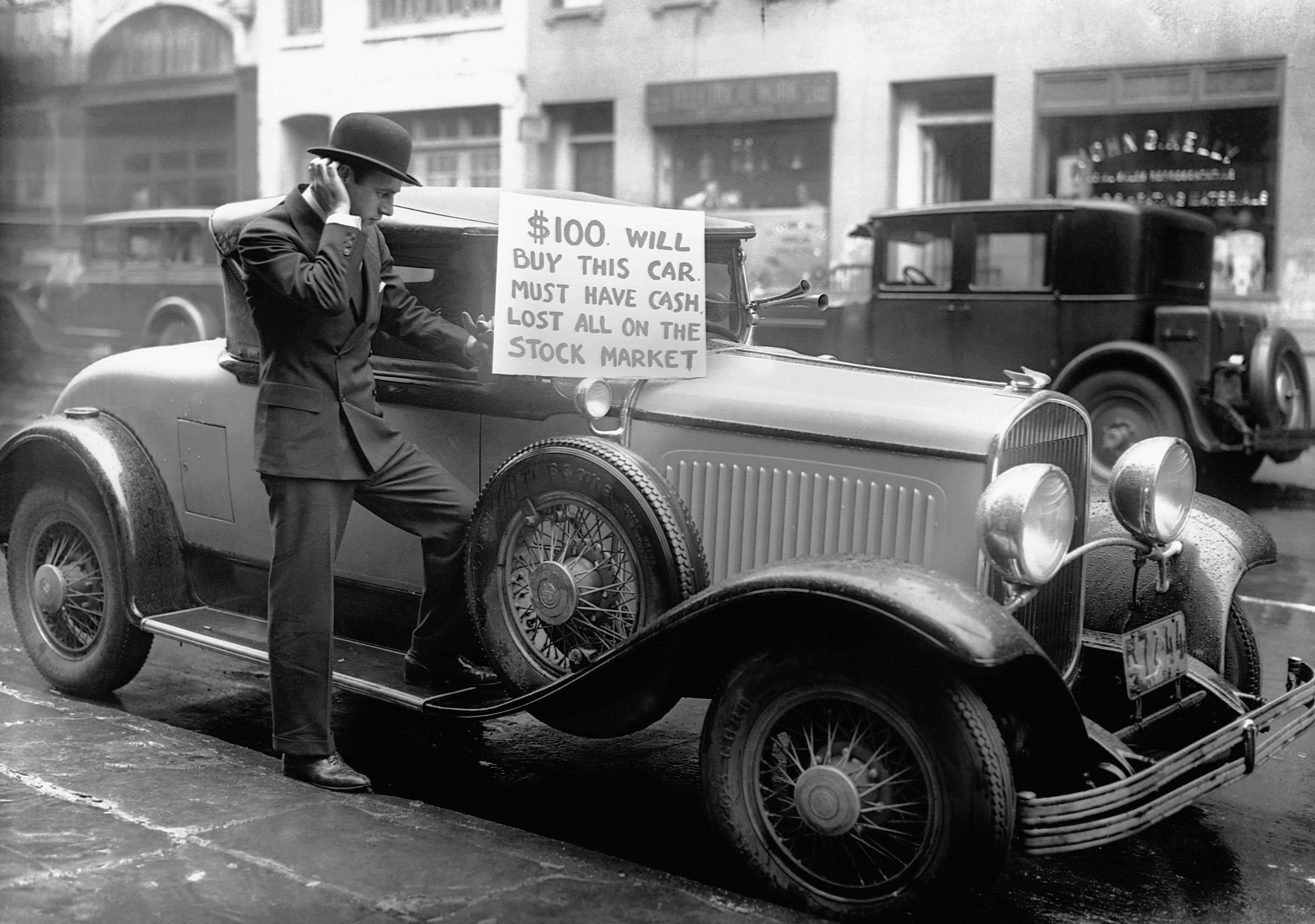
Why the 1929 stock market crash still matters, almost a century later
Andrew Ross Sorkin’s new book, “1929,” follows the foremost financiers of the era through the market’s darkest days and the aftermath that created Wall Street as we know it.
This is the most recent installment of Sherwood News’ Q&A series, Talk Your Book, featuring brief discussions with writers of new work on finance, economics, and markets.
It’s been more than 15 years since Andrew Ross Sorkin — CNBC coanchor, New York Times columnist, and arguably the best-known financial journalist of his generation — published his first book, “Too Big To Fail,” a fly-on-the-wall account of how the financial titans at the time experienced the market meltdown and economic collapse that slammed the US in 2008.
An instant bestseller, it remains, for many, the definitive account of how a nationwide housing boom went bust and came uncomfortably close to sinking the US into a second Great Depression.
His just-released follow-up, “1929,” looks back to that earlier economic calamity, using details plucked from court transcripts, letters, personal journals, and contemporary newspaper accounts to reanimate long-forgotten financial figures and follow them through a novelistic retelling of some of the most harrowing days in Wall Street history.
The second half of the book shows how the same cast of characters tried — with varying degrees of success — to negotiate the shifting political terrain created first by the onset of the Great Depression and later by the New Deal push for reforms that largely continue to define the US market to this day, foremost among them being the creation of the Securities & Exchange Commission.
Sorkin took a few minutes last week to speak with Sherwood about why, nearly a century later, the lessons of 1929 still matter — especially for the new generation of retail traders who’ve rushed into the markets over the last few years.
(This interview has been edited for clarity and concision.)
Matt Phillips, Sherwood News: Andrew, congrats on the performance of the book. It’s a great read; I really enjoyed it.
You know, at Sherwood our readers are, conceptually, the great-great-grandchildren of some of those traders that took part in the great bull market of the 1920s.
But that’s a century ago. What are some of the lessons that you think people active in the markets today can learn from episodes that are that distant.
Andrew Ross Sorkin: I think the biggest lesson is in the overextension of credit — borrowing too much money. Margin.
I think that was the problem in 1929. I think it’s the problem that creates every financial crisis. And it’s that thing that exposes you as an investor.
You know, one of the things that surprises many people is that by the end of the year of 1929, the stock market was only down 17%. You might say to yourself, “Oh, that doesn’t seem so bad.” If you could have just held on to your stocks, you would have been fine by the end of the year.
But the problem was that the stock market fell in September and October through November about 50%. And most people who bought on margin couldn’t hold on, because the bank called them and said, you owe us, in many cases, your home.
So I think probably biggest single thing for somebody reading this book today who is active in the markets is just to understand how exposed you are, as a function of margin, and what a margin call could do to you.

Sherwood: Tell me if I’m wrong, but it seems like a very American thing, this tradition of speculation in the stock market.
Sorkin: I think that the thing that you’re maybe pointing to is that there’s an optimism, a sort of “dreamer” mentality around new innovations in technology, which I think is very American. The American public oftentimes wants to bet on the future. And by the way, for the most part, betting on the future of America has been a good bet.
A lot of times people think the word “speculation” is a dirty word. The truth is that you need some kind of speculation in the economy, in the ecosystem, to fund some of the great innovations. The early investors in Elon Musk’s SpaceX were investing in something that, at the time, I’m sure people thought was absurd.
So, it’s not that you don’t want any speculation. It’s that you want — and I don’t know if it’s an oxymoron — responsible speculation.
Sherwood: Matt Levine at Bloomberg wrote this thing that I thought was just so smart, where he said something like the fundamental problem of finance is time travel.
To get funding, entrepreneurs basically need to take investors into the future and say, “Look at this factory we’re going to build, with all these magnificent products rolling off the assembly line.” But in reality there’s actually nothing there yet. So speculation seems to be like tapping into that dreamer mentality a bit to make that possible.
Sorkin: On the other side of the ledger, there are still things to be cautious about. I do think one of the things we learned from the late 1920s is that often people talk about “democratizing finance,” and they introduce all sorts of new products into the market in that context of democratizing finance.
Sherwood: I can think of one company, for sure.
(Robinhood Markets Inc. is the parent company of Sherwood Media, an independently operated media company subject to certain legal and regulatory restrictions.)
Sorkin: Yeah, but I’m not being critical of your parent co. Where I was going to go is that oftentimes the early products, these sort of new financial products don’t come with the same transparency and regulations, the guardrails that more mature products do.
I’ll give you a great example SPACs. We had the SPAC mania in 2020, 2021, 2022. I don’t think SPACs unto themselves are bad products. In fact, I think they could be quite useful products. But most of them failed, or didn’t perform up to expectations, I think it’s fair to say.
I would tell you that the reason they didn’t perform up to expectations was because there wasn’t enough transparency. Oftentimes when new products emerge, there are misalignments, lack of transparency, or just a misunderstanding of how they even work.
So, you’re saying, “What’s the lesson of 1929?”
And I think that was true then, and it’s true now, that you need to be very careful, especially with the new products. And then probably more importantly, if you are going to be investing in new products, to be even more careful with using margin in those cases.

Sherwood: The market crash of 1929 had such a giant impact on the mass psychology of America. What do you think we get wrong about that whole experience? Is it this notion of bankers, you know, flinging themselves off buildings?
Sorkin: There are a couple of real misunderstandings. If you went out on the street and you asked the average person what happened in 1929, they’d say, oh, there was a crash on one day in October. (Maybe they wouldn’t even know it was October.) And then it led directly to the Great Depression.
All of that’s not true. It wasn’t just that there was a Black Thursday, or a Black Tuesday. This happened over a longer period of time.
Sherwood: It was more of a process than an event.
Sorkin: And there were people screaming from the rooftops that something like this would happen. So it wasn’t like this came out of nowhere.
Most importantly, it was really just the first domino in a series of dominoes that led to the Great Depression.
It was a series of policy choices by President Hoover, by the Federal Reserve, and others that exacerbated the problems that began in 1929 and ultimately led to 25% unemployment and 9,000 banks going out of business.
Understanding the what those dominoes were — which included austerity measures as the economy got worse, efforts to raise taxes, the Smoot-Hawley tariff, the Federal Reserve not injecting additional capital into the system. All of those things and more is really what led to the Great Depression itself.
Sherwood: I should have looked it up before I got on the phone with you, but off the top of my head, I think the peak-to-trough decline during the crash and into the early 1930s was something like 90%?
Sorkin: 89%. Yes. You’re onto something.
Sherwood: In your opinion, is there any world in which the US, and US policymakers, would tolerate that kind of drop in the market today?
Sorkin: No, I think we learned the lesson of the crash. Ben Bernanke, who was the chairman of the Federal Reserve in 2008, did his Ph.D. thesis on the Great Depression. And he learned the lessons of this period, which is that when you have a crash or a crisis of this sort, you have to throw money at the problem, even if it’s politically unpalatable.
That is what he did in 2008. And I would argue, despite how politically unpopular it was, it was the right thing to do to save the system. And by the way, we did something actually very similar again during the middle of the pandemic.
The one thing that could eventually be different, that’s not sort of in the playbook, is that the amount of debt the US owes actually matters.
In recent crises, when we’ve thrown money at these problems, there’s always been concerns the bond market would get so rattled that the US government would have to pay extraordinary, almost usurious kinds of interest rates, and that would create a vicious cycle of austerity. That has not happened yet.
So I think we know what to do in the old playbook, which has worked for us in the past. If there’s another crash, you’d think there would be another bailout.
But what I don’t know is if there’s some red line that the bond market has that could tip everything over. What do we have, $38 trillion in debt right now?
If there’s another bailout needed and you had to very quickly spend $5 trillion, I don’t know what the line is, but is there a moment at which the bond market just says, “Enough,” and then all of a sudden you’re really creating a true crater in the system?
Sherwood: OK, Andrew, this has been great. Thanks a lot for your time and congrats again on the book.
“1929” is available wherever books are sold.
