Markets
A protester waves the upside down U.S. flag during the
An inversion of the norm in US stocks (Getty Images)

War and AI doubts have fueled an unprecedented divergence between stock prices and earnings estimates

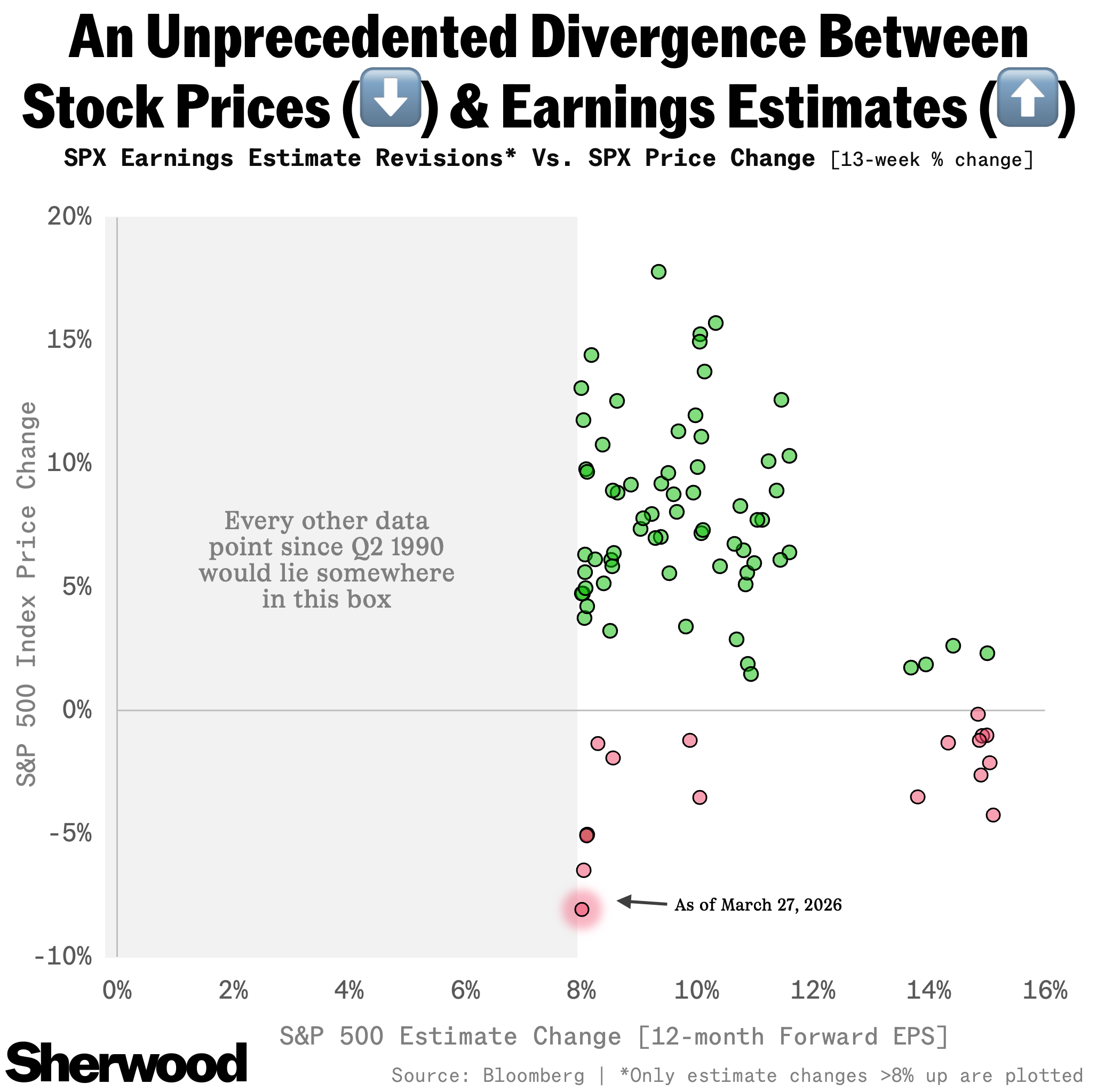
The S&P 500 has never been down this much when earnings estimates have risen by this much, based on data going back to Q2 1990.
Over the long term, earnings drive stock prices.

But in the here and now, we’re experiencing an unprecedented divergence between the S&P 500’s earnings estimates and the performance of the benchmark US stock index, driven by skittishness about the return of oil shipments through the Strait of Hormuz and the long-term ROI for the hundreds of billions in AI capex.

Over the three months ended March 27, analysts have ratcheted up their projected bottom-line results for the largest US publicly traded companies by 8%. Over the same time, those stocks are down 8%. Stocks have never been down this much when earnings estimates have risen by this much, based on data going back to Q2 1990.

Stock Prices vs Earnings estimates

The closest such episodes to the present environment were in mid-2010 amid fears of a double-dip recession following the financial crisis, and in 2018 following a short-lived blowup in volatility markets.

For what it’s worth, every S&P 500 downturn of at least 14% from a bull market high since the financial crisis has only bottomed after forward earnings estimates start to come under the knife.

Oil price spike not recession fuel (yet)

The world in which these earnings estimates are realized is incompatible with a long-lived oil disruption that sparks a US economic downturn. Oil price spikes are infamously a drag on other parts of consumers’ spending; accordingly, durables and household personal products are the worst two industry groups in the S&P 500 since the end of February.

But as a general matter, markets do not appear to be pricing in elevated recession risk. For all the conniptions in private credit, public high-yield credit isn’t screaming. Spreads in US junk bonds (excluding energy!) are still below their average level since the start of 2015.

Heck, even the oil markets haven’t shown the same degree of alarm (even at the front end!) despite a more meaningful supply shock than what followed Russia’s invasion of Ukraine. Stock markets have the luxury of being more forward-looking than commodity markets, because commodity markets must clear in spot: oil has to be delivered to a certain place at a certain time at this agreed-upon price. WTI oil futures for delivery in May have to reflect supply/demand dynamics in May, not a rose-colored view of a future where we’ve gone from conflict to kumbaya. That’s the danger associated with imagining $150-per-barrel oil to be as unlikely and impractical as 150% tariffs on Chinese imports.

Megacaps, Megapain

Of course, this unprecedented divergence between earnings (higher) and stocks (lower) is over three months; the war has only been going on for one. The unwillingness to buy into megacap AI stocks — especially hyperscalers, but also Nvidia — despite rising earnings estimates predates the Mideast conflict. Risk-off sentiment has weighed on stocks generally, but the Magnificent 7 have lagged since the attacks commenced. 

For some time now, investors have been of the view that 2026 earnings don’t really matter for the hyperscalers and have more creeping doubts on whether this capex binge will prove worth it in the long run — or whether the most meaningful impact on these companies will be the destruction of their free cash flow generation amid these aggressive build-outs. And Nvidia’s fate has been tied to the perception of its biggest customers.

The war started off as a major rotation trade. Three major trades that had been tumbling — software vs. semiconductors, US stocks vs. the rest of world, and the Magnificent 7 vs. S&P 500 equal weight — all enjoyed some nascent reversals in the early days of the war. Of those three, Mag 7 versus equal weight is the only one that’s given up all of that rebound and then some.

No Trump card? 

In some respects, the current market situation is similar to 2025. The Q1 peak in stocks came when Walmart, a major component in momentum indexes, issued a poor full-year outlook and once high-flying stocks got clobbered. It started as a momentum-centric rather than tariff-centric sell-off.

This time around, the difference is that many parts of the AI trade (especially the megacaps) didn’t have any momentum coming into this. A theme that investors had already been souring on is continuing to unwind.

“Trump Always Chickens Out” (or TACO) is a popular explanation for why markets haven’t reacted more negatively to the prospect of significant negative economic impacts from this oil supply shock.

It’s also worth remembering that a game of chicken involves two sides barreling toward each other at high speed, and that the chicken only ducks conflict when presented with imminent, catastrophic loss. 

Both investors (and the president) have been increasingly conditioned to react late when faced with (or bringing forward) negative market catalysts.

And President Trump isn’t the only party with a vote on this matter. While he can change his mind on how much military action in the Middle East is appropriate as the facts on the ground (and market conditions) evolve, that doesn’t mean leaders in Iran (or Israel) will be moving in lockstep.

None of the market fundamentals, the most impacted asset, or the stock market price action have caused a white-knuckle moment just yet.


More Markets

See all Markets
$4

US average gas prices hit $4.018 a gallon on Tuesday, crossing the $4 threshold for the first time since August 2022, according to the American Automobile Association. That’s roughly a 35% jump, or $1.04 more per gallon, since the Iran war began in late February. Diesel has surged even more sharply, rising about 45% to $5.45, raising concerns about higher shipping, grocery, and consumer goods prices.

With the Strait of Hormuz — through which roughly a fifth of global oil supply previously flowed — effectively closed, crude prices are up more than 50% since the war began, feeding quickly into pump prices across the US.

Still, regional differences remain, with drivers in California now facing nearly $5.90 a gallon for regular gasoline, followed by Hawaii ($5.50) and Washington ($5.30), while those in Oklahoma, Iowa, and Kansas pay under $3.30 a gallon.

Prices could even approach $5 nationwide if the strait remains blocked, Patrick De Haan, head of petroleum analysis at GasBuddy, told CNBC.

markets

Memory, optical, and AI-construction stocks dive as embattled SaaS stocks rebound

Memory stocks sank on Monday, continuing a sell-off that began last week with new details about a potentially more memory-efficient AI algorithm from Google Research.

Western Digital, Micron, Seagate Technology Holdings, and retail favorite Sandisk all tumbled.

Industry publication Wccftech flagged that some memory chip prices have seen a “significant drop” recently across multiple US retailers.

A new, upbeat initiation for Seagate by JPMorgan analysts — they rated it “overweight,” basically a buy, on “opportunity for significant upside” — couldn’t help Seagate shake off the slump in the broader data center trade.

Optical stocks — recent high-flyers — also got slammed, taking down Applied Optoelectronics, Corning, Lumentum, Coherent, and Ciena Corp. . The group may also under particular pressure in light of reports that Samsung is entering the silicon photonics market.

AI construction trades like Emcor, Vertiv Holdings, and Sterling Infrastructure also sank.

Meanwhile, traders seemed to be scurrying back to securely profitable software-as-a-service (SaaS) and cybersecurity stocks as a place to wait out the market mayhem.

ServiceNow, Zscaler, CrowdStrike, Salesforce, and Atlassian were all solidly in the green in midday training.

markets

Meta rallies after being named a “top pick” by Morgan Stanley

Meta is off to a strong start to the week after being named a new “top pick” of Morgan Stanley’s internet analysts.

Their case: the social media giant is cheap and commands an ever-increasing amount of eyeballs, which it’ll leverage to make money from its massive AI capex through nascent opportunities like agentic shopping and assistants.

“META sentiment has troughed due to GenAI ROIC and long-term positioning fears, and more recently macro ad market and regulatory question marks,” wrote analyst Brian Nowak. “In all, META now trades at ~15X our ’27 $36 EPS, 1 standard deviation below the long-term average, which creates a strong buying opportunity, in our view.”

Reported job cuts would also be “a bullish development” that boosts earnings, he added.

Even so, Nowak trimmed his price target on the stock to $775 from $825, which still represents upside of about 50%.

The hyperscalers have come under persistent pressure as investors remain reticent to bet that this capex binge will have a happy ending. Per The New York Times, Meta recently delayed the launch of its new model because of performance issues.

(That being said, the company’s latest earnings report did show that its ability to use AI tools to grow its top line remains impressive, even if its models aren’t best in class.)

markets

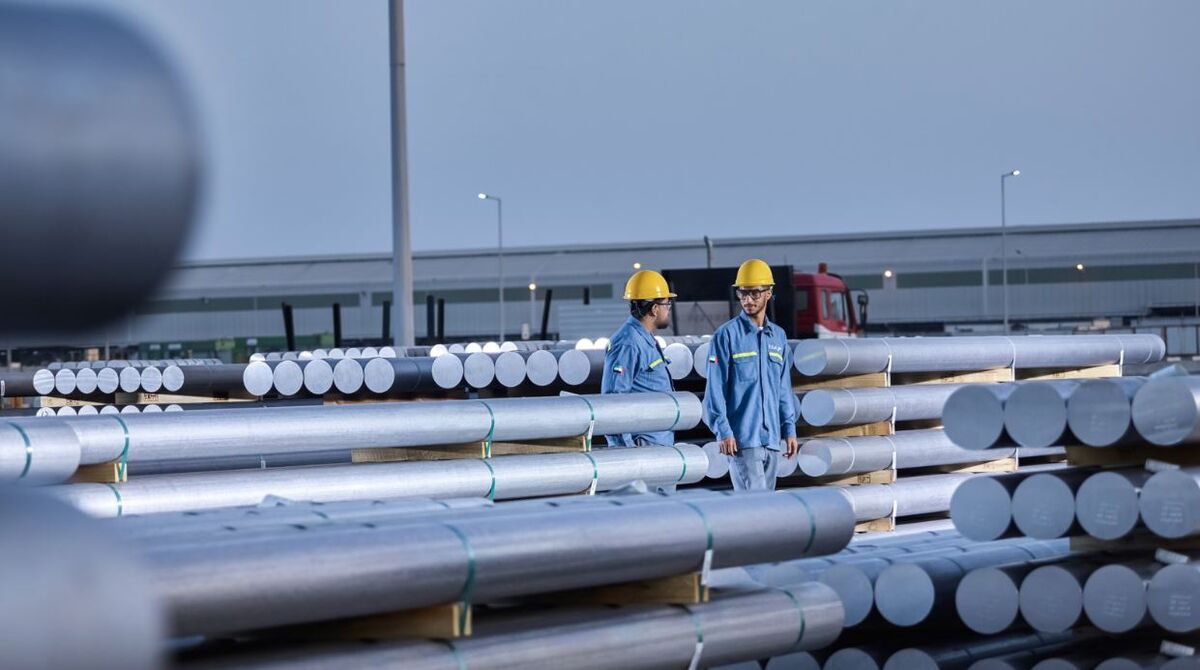
American aluminum stocks rip following strikes against Gulf’s giant smelters

Aluminum stocks soared Monday after Iran attacked major smelting operations in the Gulf region over the weekend.

Alcoa and Century Aluminum both surged Monday, after strikes Saturday hit aluminum plants in Bahrain and the United Arab Emirates. New York aluminum futures were up about 4% shortly after 11 a.m. ET.

Bloomberg reports that the Gulf is the source of roughly 9% of the world’s aluminum supply, which was already imperiled by the closure of the Strait of Hormuz.

Iran’s Revolutionary Guard Corps said the combined drone and missile attacks on the plants were justified by the aluminum producers’ links to the US military and aerospace industries in the region.

Producing aluminum is highly energy-intensive, and the Gulf has emerged as a center of the industry in recent years due to its energy assets. Emirates Global Aluminum, for example, is one of the world’s largest producers of the lightweight metal.

The attacks on the plants only add to the upward pressure on prices, as it can take months to restart closed smelters.

Bloomberg reports that the Gulf is the source of roughly 9% of the world’s aluminum supply, which was already imperiled by the closure of the Strait of Hormuz.

Iran’s Revolutionary Guard Corps said the combined drone and missile attacks on the plants were justified by the aluminum producers’ links to the US military and aerospace industries in the region.

Producing aluminum is highly energy-intensive, and the Gulf has emerged as a center of the industry in recent years due to its energy assets. Emirates Global Aluminum, for example, is one of the world’s largest producers of the lightweight metal.

The attacks on the plants only add to the upward pressure on prices, as it can take months to restart closed smelters.

Latest Stories

Sherwood Media, LLC produces fresh and unique perspectives on topical financial news and is a fully owned subsidiary of Robinhood Markets, Inc., and any views expressed here do not necessarily reflect the views of any other Robinhood affiliate, including Robinhood Markets, Inc., Robinhood Financial LLC, Robinhood Securities, LLC, Robinhood Crypto, LLC, Robinhood Derivatives, LLC, or Robinhood Money, LLC. Futures and event contracts are offered through Robinhood Derivatives, LLC.