

Markets
markets
Luke Kawa

UBS unpacks the most controversial slide from Nvidia CEO Jensen Huang’s GTC presentation

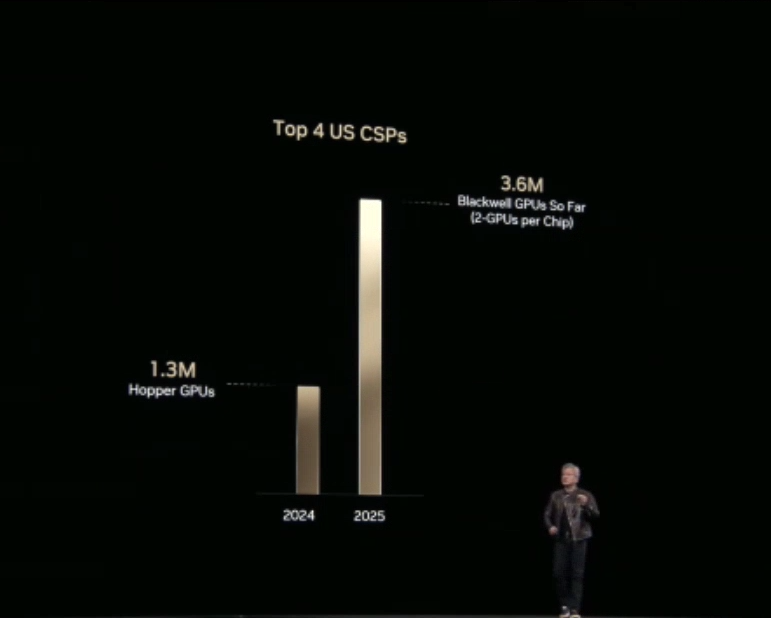
Nvidia CEO Jensen Huang didn’t move markets when he delivered his keynote address at the chip designer’s conference on Tuesday. But he did raise eyebrows, particularly with one slide that compared shipments of Nvidia’s old flagship chip (Hopper) to its Blackwell current ramp.

The chart illustrated that Blackwell demand this year from the top four cloud service providers (Microsoft, Alphabet, Amazon, and Oracle) has already far outstripped Hopper’s from last year, which was peak demand for that particular product.
NvidaBlackwellHopper
Source: Nvidia

“So you can kind of see that in fact AI is going through an inflection point,” Huang said in reference to the chart.

The CEO had specified that Hopper’s figures were 2024 shipments, but there was a lack of clarity on precisely what the 2025 Blackwell numbers meant.

UBS analysts led by Timothy Acuri got the lowdown on the matter.

“The slide generating the most controversy was a comparison of unit shipments to just the top 4 US CSPs for both Hopper and Blackwell, implying to us these customers were ~40% of total units last year,” he wrote in a note maintaining a buy rating and $185 price target on the stock. “In speaking to the company, the Blackwell number was meant to essentially represent shipments ‘in process’ — we think roughly equivalent to backlog and roughly looking out through CQ3 of this year.”

Putting this all together, Acuri has higher conviction in his call that the chip designer’s near-term earnings growth will be much more substantial than his peers anticipate.

“So assuming a similar mix and netting off the ~100k units that we think shipped to these customers in the month of January, this would imply total Blackwell units in the ~4.2 million range in the period from FQ1 (April) to FQ3 (Oct) of this year,” he continued. “While inexact math, this is nicely above our ~3.8 million model for Blackwell units over this period making us feel pretty good about our ~$5.30 EPS this year (Street still ~$4.50).”

More Markets

See all Markets
markets

Oil tumbles below $80 to 3-month low on US-Iran deal

Oil prices slid to their lowest levels in more than three months today after a preliminary ceasefire agreement between the US and Iran raised expectations that more crude could return to global markets and key shipping routes through the Strait of Hormuz could reopen.

Brent crude fell below $78 a barrel while West Texas Intermediate dropped to $73.31, extending losses as traders priced in lower geopolitical risk premiums tied to Middle East supply disruptions.

The preliminary pact announced by President Donald Trump and Iranian leaders establishes a 60-day ceasefire to end the active hostilities that have choked the Middle East since late February. A formal memorandum of understanding is scheduled to be officially signed in Switzerland this Friday, according to Bloomberg report.

Trump said on Sunday that the Strait of Hormuz would be opened when the agreement is signed in Switzerland on Friday, writing on Truth Social, “Ships of the World, start your engines. Let the oil flow!

US Energy Department data, meanwhile, showed that Americas strategic oil stockpiles sank last week to their lowest level since 1983, indicating sustained demand to rebuild them even if the Mideast conflict ends.

Stocks that moved lower:

markets

Eos Energy surges on commercial launch of second battery production line

Eos Energy Enterprises is surging in early trading after announcing the official start of commercial production at its second automated battery manufacturing line.

In a statement, the company said this milestone positions it to scale production of its proprietary zinc-based long-duration energy storage systems to meet rising commercial demand.

Management touted the enhanced efficiency of this facility, with design upgrades slashing raw material travel by 86% and shortening the physical production line length by 40% compared to Line 1.

“Battery Line 2 demonstrates our ability to continuously improve as we scale,” said John Mahaz, Chief Operating Officer of Eos. “It validates that our manufacturing system can be replicated and scaled with discipline.”

The battery energy storage company confirmed that while subassemblies will continue coming online through the early third quarter, full production capacity is targeted for the fourth quarter of 2026. The ultimate goal is to hit an aggregate 4 gigawatt-hours of annual manufacturing capacity by the end of 2026. Management also highlighted that Battery Line 1 already surpassed its full-year 2025 output within the first 164 days of 2026.

Today’s announcement builds on recent operational momentum for Eos, which posted better-than-expected Q1 sales and announced a joint venture with Cerberus Capital Management in May. However, shares are still down 37% year to date.

For the full year, Eos still expects to achieve revenues between $300 million and $400 million, in line with its previously provided guidance.

markets

Qualcomm reportedly in talks to acquire AI chip design company Tenstorrent

Qualcomm is in talks to acquire AI chip design firm Tenstorrent for $8 billion to $10 billion, according to The Information.

This transaction, if completed, would be another concrete signal of the San Diego-based chip company’s attempt to carve out a niche in the upstream AI space (data centers), rather than focusing on end-user devices.

Qualcomm’s key business of handset chips has fallen on hard times, particularly in China, due to the memory chip shortage.

Less than eight weeks ago, the chip company was the lowlight in the Philadelphia Semiconductor Index, down about 20% year to date.

Shares proceeded to surge over 60%, buoyed by optimism that the rising AI tide will lift all boats. With the release of Q2 earnings, CEO Cristiano Amon said that initial shipments of AI chips to a “leading hyperscaler” were on track for later this year, and to expect more on the company’s AI growth plans at its investor day on June 24 (next week). Last month, Bloomberg reported that Qualcomm is poised to sell “millions” of AI chips to TikTok parent ByteDance.

Established AI chip giants and hyperscalers alike have reached agreements with or gobbled up burgeoning AI chip companies as the boom rolls on. In December, Nvidia announced a major licensing deal with AI inference specialist Groq, while Meta bought AI chip startup Rivos in September.

Latest Stories

Sherwood Media, LLC and Chartr Limited produce fresh and unique perspectives on topical financial news and are fully owned subsidiaries of Robinhood Markets, Inc., and any views expressed here do not necessarily reflect the views of any other Robinhood affiliate, including Robinhood Markets, Inc., Robinhood Financial LLC, Robinhood Securities, LLC, Robinhood Crypto, LLC, Robinhood Money, LLC, Robinhood U.K. Ltd, Robinhood Derivatives, LLC, Robinhood Gold, LLC, Robinhood Asset Management, LLC, Robinhood Credit, Inc., Robinhood Ventures DE, LLC and, where applicable, its managed investment vehicles.
