
Markets
Red Sailboat Off Coast of Southern California
Getty Images
DOL-DRUMS

There’s one major tailwind for the Mag 7 ahead of earnings

A weaker dollar could quietly boost profits for the global tech giants.

Hyunsoo Rim

Tariffs are set to rise again, with country-specific duties kicking in next month — yet Wall Street remains firmly unbothered.

Major stock indexes notched new highs last week, fueled in part by a strong start to second-quarter earnings season, with 83% of S&P 500 companies beating expectations so far. And one tailwind helping corporate America’s bottom line is the falling US dollar.

An unintended byproduct of the “T word,” a significant amount of demand for the US dollar has evaporated in the last few months, with the DXY — a weighted average of the USD against six global currencies — down 7% since the start of the year.

Perhaps counterintuitively, a lower dollar translates into higher revenue for companies that do a lot of business overseas. In fact, per Goldman Sachs estimates published Friday, every 10% drop in the dollar translates into roughly 2% to 3% gains for S&P 500 earnings per share — and that’s already showing up: last week, companies like 3M, PepsiCo, and Netflix have all attributed their strong Q2 results to favorable foreign exchange.
2025-07-21-Mag7
Sherwood News

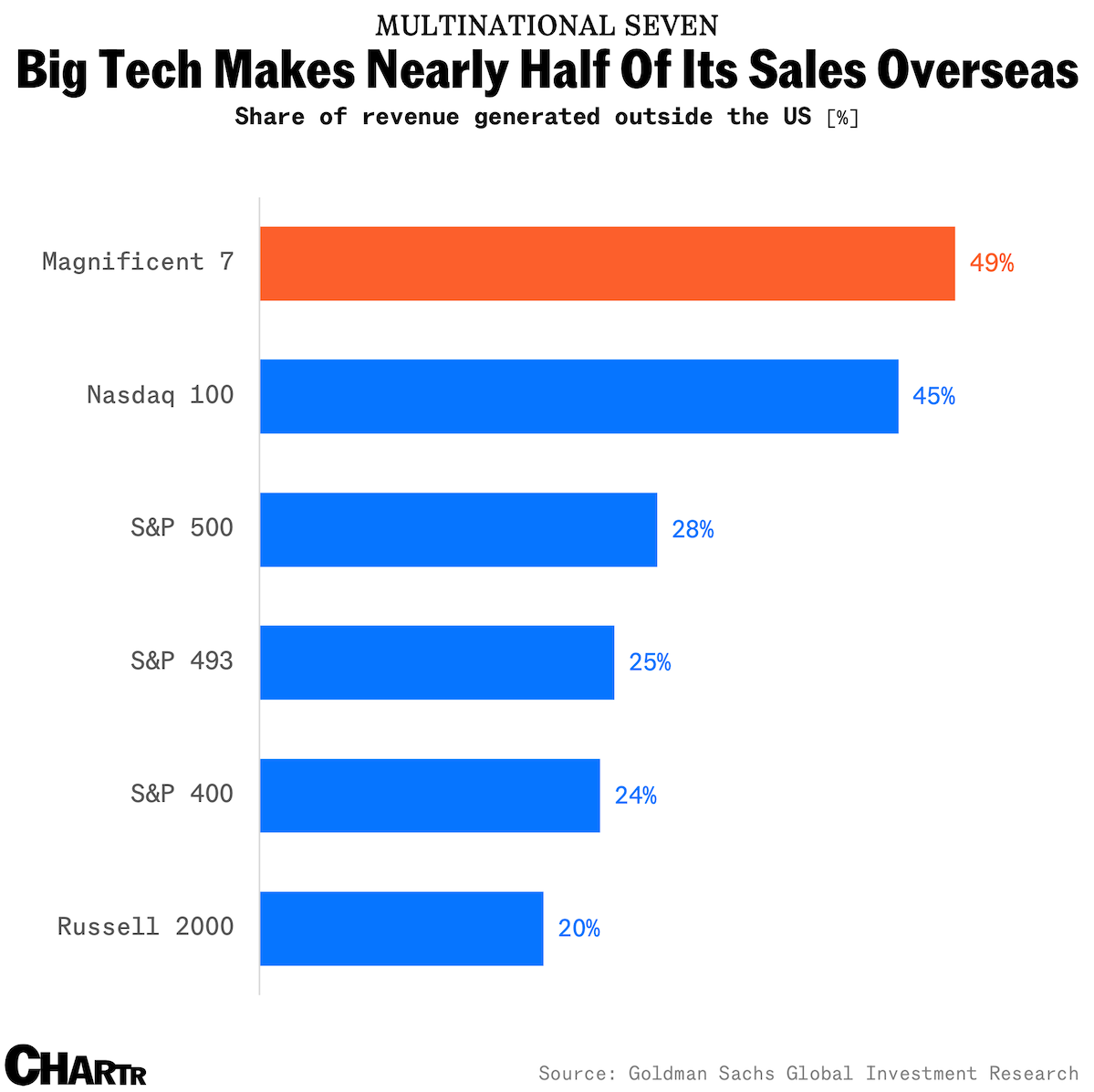
But the larger beneficiaries could be the tech giants of the Magnificent 7, which Goldman estimates generate 49% of their combined revenue overseas, far above the S&P 500 average of 28%. Alphabet and Tesla are the first two of the Mag 7 set to report Q2 earnings on Wednesday.

Of course, it’s not all upside: any parts or services bought from abroad will be more expensive as well, offsetting some of the benefit. These global companies will also face “above-average risk” if trade tensions escalate further, and while a weaker dollar boosts profits on paper, it can also mask deeper concerns — namely, the reasons that the dollar fell in the first place, such as uncertainty around federal debt and US growth prospects.

More Markets

See all Markets
markets

Report: US senators plan to introduce bill blocking Nvidia from selling advanced chips to China for 30 months

US senators are on the verge of introducing a bill that would block Nvidia from selling its H200 or Blackwell chips to China for 30 months, the Financial Times reports. The H200 is Nvidia’s best chip from the Hopper generation, while the Blackwell line is its current flagship offering.

Shares of the chip designer are little changed in the wake of this report, still up more than 1% on the session. The reaction makes sense, seeing as previous positive indications on Nvidia’s ability to sell advanced chips to China failed to inspire much positive momentum in its shares.

The stock got a short-lived jolt higher (that didn’t last the day!) on November 21 after Bloomberg reported that the Trump administration had discussed the possibility of selling its H200 chips to China.

Nvidia has effectively been shut out of China’s AI market in 2025. First, export restrictions meant it could no longer sell the H20, a nerfed version of its Hopper chip, to the world’s second-largest economy. After that export ban was lifted, demand from China “never materialized,” per Nvidia CFO Colette Kress. Reports indicate that China banned its leading technology giants from purchasing these semiconductors, instead pushing them toward domestic alternatives.

President Donald Trump had mused about allowing Nvidia to sell Blackwell chips to China prior to his meeting with Chinese President Xi in late October, but failed to do so. The two leaders did not discuss the topic at that time.

Per the FT, this upcoming bill would be a bipartisan effort, being cosponsored by the leading Republican and Democrat members of the Senate Foreign Relations East Asia subcommittee.

markets

AI energy plays soar on an explosion of call buying

Like their quantum computing counterparts, AI-linked energy plays are benefiting from an explosion of bullish options activity on Thursday.

  • Oklo is up double digits with call volumes above 106,000 as of 2:46 p.m. ET, more than double its 20-day average for a full session, with a put/call ratio of about 0.6. Call options with a strike price of $110 that expire this Friday (which are now in-the-money thanks to today’s surge) are seeing the most activity.

  • Nuscale, another nuclear energy play, has seen nearly 140,000 call options change hands versus a 20-day average of 51,073.

  • And fuel cell company Bloom Energy has traded nearly 80,000 calls, roughly twice its 20-day average, with a put/call ratio of about 0.3.

During his appearance on Joe Rogan’s podcast released on Wednesday, Nvidia CEO Jensen Huang talked up the potential for nuclear energy, saying, “In the next six to seven years I think you are going to see a whole bunch of small nuclear reactors.”

This adds to the evidence that the speculative bid is back in a big way after smaller stocks tied to the AI boom and quantum computing cratered from mid-October through most of November as credit risk began to seep into the AI trade.

Old electronic items tossed on ground for disposal, Hudson

Technology giants don’t look like they used to, as the asset-light era fades

Oracle and Meta are now some of the most capital-intensive businesses in the S&P 500, spending more than energy giants. I guess data really is the new oil?

markets

Space stocks rip amid speculation on Altman joining race

Space stocks AST SpaceMobile, Planet Labs, and Rocket Lab all soared Thursday amid a recovery in the high-beta momentum class of shares coveted by some retail traders.

(High-beta momo stocks are basically shares that have been on a winning streak for a while, and tend to go up a lot more than the overall market on positive days. Goldman Sachs includes all three of the aforementioned space stocks in its themed basket of such shares.)

There’s little other fundamental news out there on the companies themselves.

But a Wall Street Journal report that OpenAI impresario Sam Altman has been toying with the idea of entering the space industry, potentially standing up a rival to Tesla CEO Elon Musk’s Starlink satellite service, may also be contributing.

As we’ve mentioned elsewhere, sometimes these stocks seem to trade on a what’s-bad-for-the-Musk-empire-is-good-for-us-and-vice-versa vibe.

Latest Stories

Sherwood Media, LLC produces fresh and unique perspectives on topical financial news and is a fully owned subsidiary of Robinhood Markets, Inc., and any views expressed here do not necessarily reflect the views of any other Robinhood affiliate, including Robinhood Markets, Inc., Robinhood Financial LLC, Robinhood Securities, LLC, Robinhood Crypto, LLC, or Robinhood Money, LLC.
