
Markets
Berkshire Hathaway’s Warren Buffett
Warren Buffett: old school (Bonnie Schiffman/Getty Images)

The Buffett Indicator just hit an all-time high

The simplest of all valuation metrics is flashing red; but there are reasons to ignore the alarm.

For most, comparing market caps to the GDP of a country is usually a bit of a no-no. GDP is a flow concept, economic activity over a year; market value, meanwhile, is a stock concept, just a snapshot of all the pieces of paper multiplied by their latest price.

But, as with all other disciplines, once you truly master the rules, you can break them — which is exactly what Warren Buffett did when he popularized the “Buffett Indicator,” the ratio of the total US stock market value to the country’s GDP.

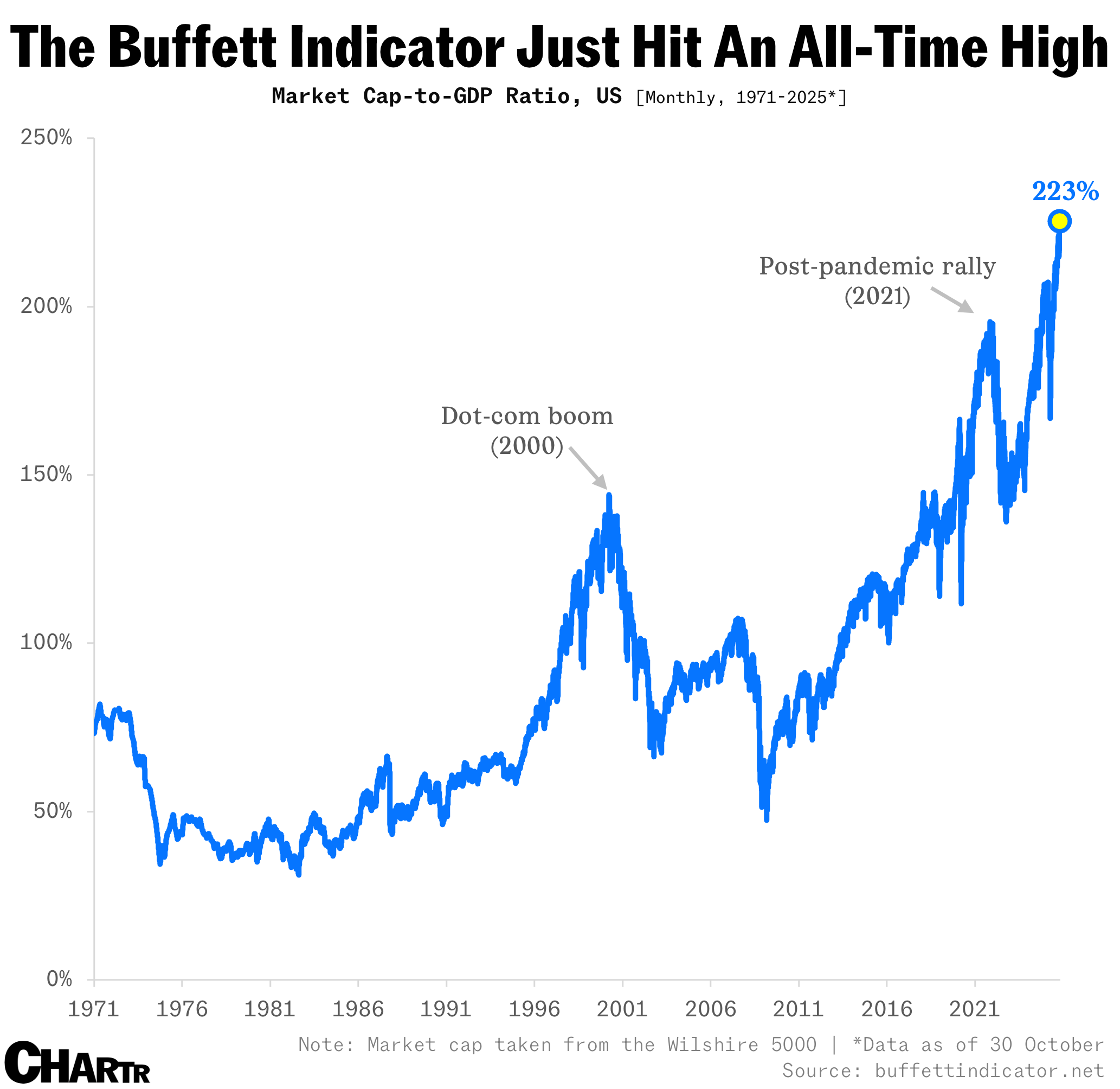
Once hailed by its namesake investor as “probably the best single measure of where valuations stand,” that indicator just hit an alarm-ringing 225% its highest level on record, adding to the growing chorus of market commentators who think we might be in for a correction.
buffett indicator 2
Sherwood News

Time to worry?

Alongside the Buffett Indicator, other metrics are flashing amber or red, too. Investors are paying record prices for every dollar of future S&P 500 revenue, and the market is increasingly concentrated in a handful of megacaps, with eight tech stocks now responsible for ~40% of the S&P 500 Index’s value.

Back in 2001, Buffett warned that the metric nearing 200% would mean “playing with fire.” But, parallel to the valid concerns, there are very legitimate reasons to ignore this particular alarm.

For starters, America’s corporate giants are simply more global than ever — which makes their value look inflated relative to a purely domestic GDP. In fact, nearly half of the Magnificent 7’s revenue comes from overseas, per Goldman Sachs.

Furthermore, today’s corporate giants have never been better at turning revenue into profit, with the S&P 500 enjoying record operating profit margins, north of 14% on a forward basis, the highest ever. That’s why profit-based valuation measures are a little less scary — and they become almost entirely unremarkable once adjusted for future growth. The market’s PEG ratio is in a very typical range, for example (though you have to believe the forecasts, of course, which is a separate discussion altogether).

With that backdrop, throw in a dash of falling interest rates, a sprinkling of finally stable inflation, and an absolute fistful of AI hopes and dreams, and you get the record stock market of 2025 — and a Buffett Indicator of 225%.

More Markets

See all Markets
markets

Report: Boeing could unveil 500-jet order from China during Trump’s visit later this month

Shares of Boeing are up nearly 4% on Friday afternoon, following a Bloomberg report that the company could be close to finalizing a deal to sell 500 planes to China.

The deal was first reported in August and would be one of Boeing’s largest ever.

According to Bloomberg’s sources, the deal could be officially unveiled when President Trump travels to China at the end of the month. That trip could be delayed given the war in Iran. The deal, sources say, could still fall apart — similar language to when it was first reported on more than six months ago.

Boeing has been on the outside of the Chinese market, in terms of new orders, since 2019 amid escalating US-China trade tensions.

According to Bloomberg’s sources, the deal could be officially unveiled when President Trump travels to China at the end of the month. That trip could be delayed given the war in Iran. The deal, sources say, could still fall apart — similar language to when it was first reported on more than six months ago.

Boeing has been on the outside of the Chinese market, in terms of new orders, since 2019 amid escalating US-China trade tensions.

markets

Why software shares are withstanding the war jitters

The outbreak of the war in Iran has clearly rattled investors and created a few clear winners — mostly energy stocks — and losers — consumer staples, airlines, and, well, more or else everything else.

But there is one interesting outlier to that Manichaean market dynamic.

Software shares — often the same companies that the market was giving up for dead just a few weeks ago due to overexpectations of an AI-driven disruption — have been holding up remarkably well.

These companies, including Intuit, ServiceNow, Datadog, Snowflake, IBM, Workday, and Oracle, have actually had a pretty decent run since the war started with a combined US-Israeli attack on Iran last weekend.

A new note from RBC Capital’s Rishi Jaluria suggests this isn’t just a fluke. Looking at the performance of software stocks during periods of geopolitical stress and market volatility over the last 10 and 25 years, his team found that software shares appear fairly well insulated when these broader shocks hit. RBC wrote:

“The defensive nature of SaaS models and the mission-critical nature of many core software systems at the enterprise level (e.g., in the absence of mass layoffs that may create seat-based headwinds, geopolitical uncertainty and/or market volatility typically will not cause an enterprise CIO to consider ripping out their ERP, CRM, Cyber systems, etc.”

I briefly got Jaluria on the phone yesterday, and he explained a bit more about why he thinks investors might see software as a decent place to hide out from the current chaos.

“With everything in the Middle East, you have to think about not just oil and gas input prices but also supply chains,” he said. “With software, you’re not really thinking about that.”

In other words, there is no equivalent of a closure of the Strait of Hormuz that software investors have to worry about.

Others suggested that the near-term profitability of these giant software companies — aside from concerns about potential long-term disruption from AI — may look different in the face of the economic uncertainty that seems to be growing with the war, especially after a sell-off that has left them relatively attractively valued.

Mark Moerdler, who covers software stocks for Bernstein Research, says that while the AI worries are clearly real, software companies continue to be highly productive cash cows.

“Everyone is afraid that AI is a massive disruptor, and all these articles you read talk about AI as massive disruptor or the world is ending or whatever,” he said. “You don’t see it in the fundamental numbers of the companies I cover. They are delivering GAAP profits, free cash flow, and they’re good investment ideas.”

Latest Stories

Sherwood Media, LLC produces fresh and unique perspectives on topical financial news and is a fully owned subsidiary of Robinhood Markets, Inc., and any views expressed here do not necessarily reflect the views of any other Robinhood affiliate, including Robinhood Markets, Inc., Robinhood Financial LLC, Robinhood Securities, LLC, Robinhood Crypto, LLC, or Robinhood Money, LLC.
