
Markets
Two Faces with Starry Eyes
(CSA Images/Getty Images)

The average American family is worth more than a million bucks

Elon Musk and I also have an average net worth of $233 billion.

Aided by a stock market boom, a private assets boom, an AI boom, and a still elevated — if a little bit frozen — housing market, America’s rich just keep getting richer.

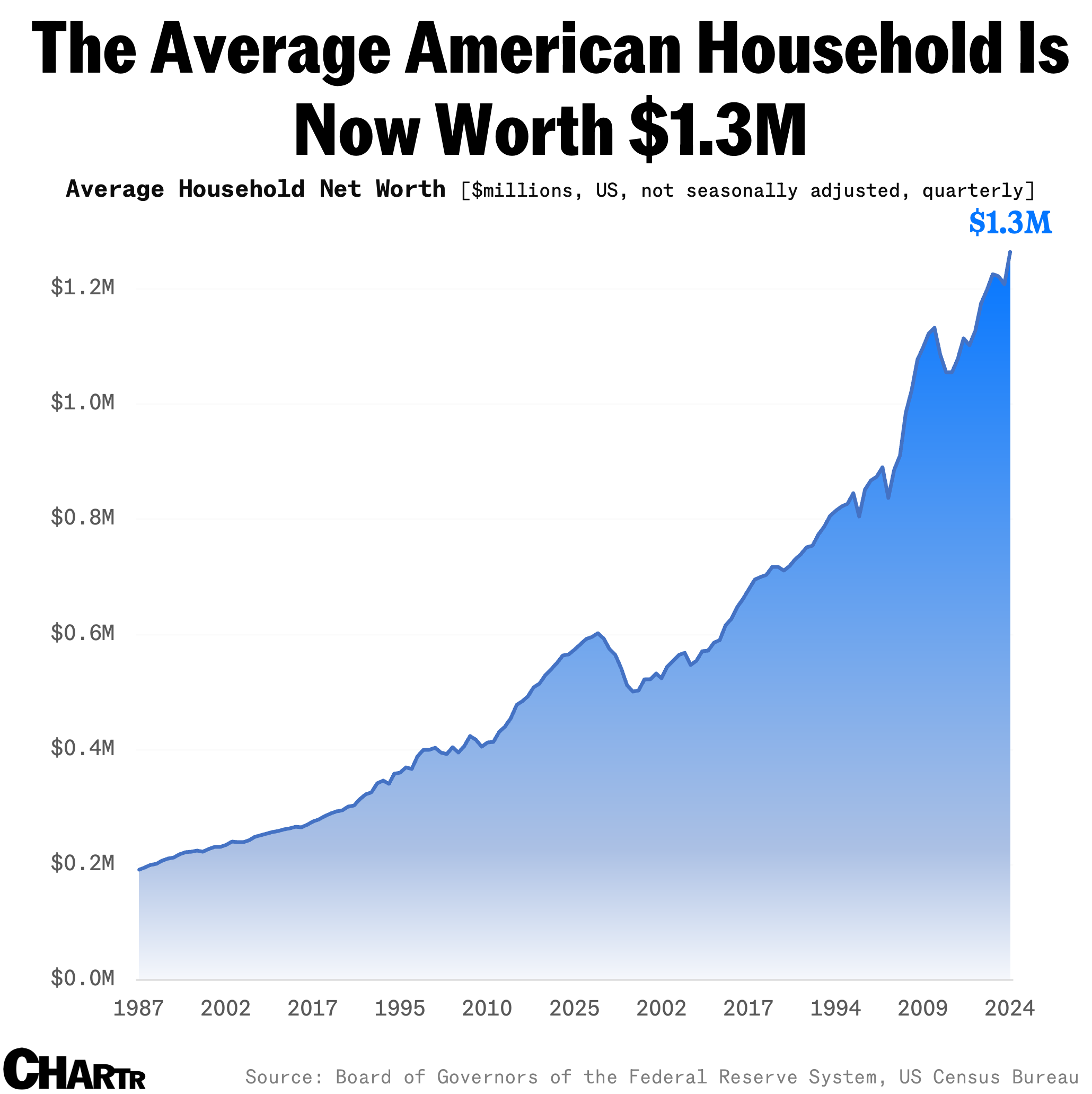
The average American household is now worth $1,264,000.

Indeed, per data from the Federal Reserve, America’s households now hold a whopping $167 trillion in wealth, as of the end of the second quarter. With the Census Bureau estimating that there are about 132 million households in America, that means the average US family is worth more than a million bucks — a fact that’s been going viral on social media in recent weeks.

Get this story and more with Snacks, your daily dose of financial news. Click here to subscribe for fresh takes on the financial news you need to start your day. Subscribe today.

But if that’s true, why doesn’t it feel that way for the average American?
Gap between mean and median household net worth
Sherwood News

For one, measures of economic confidence are still lingering below prepandemic levels, with rock-bottom ratings more common for families from the bottom two-thirds of income than during the 2008 financial crisis, the University of Michigan’s consumer sentiment survey found.

Top-heavy fractions

But, of course, the distribution of wealth is what matters most, with 14 of the 15 richest people in the world being American, per the Bloomberg Billionaires Index, helping push the nation’s average wealth up at a record pace.

According to the Federal Reserve, America’s top 1% now own $52 trillion as of the second quarter, nearly a third of the nation’s total wealth and as much as the whole of the bottom 90% (who own ~$54 trillion), thanks to skyrocketing stock market and home prices in the past few decades.

To put it simply: a simple mean average is not the best way to think about statistics when discussing populations that include very large outliers, such as the half-trillionaire Elon Musk. The median — if we lined every American household up in order of wealth and took the middle value — is much more accurate.

Unfortunately, good data on median household wealth is hard to come by. In 2022, however, Fed data estimated it at $193,000. That’s probably gone up a bit since then, but it suggests the true “typical” American household, at the 50th percentile of America’s wealth ladder, is worth closer to ~$200,000. And, for families further down the ladder, wealth tends to build via their home equity — which is typically much more illiquid and less likely to make them feel “richer,” even if it has appreciated.


More Markets

See all Markets
markets

AI “bottleneck” stocks are the big winners halfway through a tumultuous week

Memory stocks and chip machinery companies are bouncing Wednesday, following a strong Oracle earnings report that bolstered confidence in the durability of the AI data center build-out.

In fact, Sandisk is the top performer of the S&P 500 so far this week, rising more than 21% from Friday’s close, as of shortly after 2 p.m. ET. Memory chip maker Micron is second in line, up more than 13% in weekly gains, and hard disk drive maker Western Digital is also getting a lift.

Other big winners so far this week are some of the so-called semicap shares — makers of the ultraprecise machines that turn silicon into actual semiconductors — with Lam Research and KLA Corp both racking up gains of about 10% on the week. Applied Materials is up about 8% this week.

Thematically speaking, both memory stocks like Sandisk and Micron as well as semicap shares like KLA have been part of the “buy the bottleneck” trade, in which investors buy companies they believe sit at key pinch points in the AI supply chain and therefore have pretty tremendous pricing power. Through that lens, the stocks’ bounce might reflect some additional excitement about the durability of the data center boom after Oracle’s results, which included a larger-than-expected capex number as well as sales guidances that was higher than Wall Street was forecasting.

But the bounce also may be the less interesting market phenomenon of mean reversion rearing its head, as these stocks were also some of the most beaten down in the S&P 500 last week, when Sandisk lost 17% and Lam lost about 15%, for example. So, some snapback may merely be a market reflex.

Other big winners so far this week are some of the so-called semicap shares — makers of the ultraprecise machines that turn silicon into actual semiconductors — with Lam Research and KLA Corp both racking up gains of about 10% on the week. Applied Materials is up about 8% this week.

Thematically speaking, both memory stocks like Sandisk and Micron as well as semicap shares like KLA have been part of the “buy the bottleneck” trade, in which investors buy companies they believe sit at key pinch points in the AI supply chain and therefore have pretty tremendous pricing power. Through that lens, the stocks’ bounce might reflect some additional excitement about the durability of the data center boom after Oracle’s results, which included a larger-than-expected capex number as well as sales guidances that was higher than Wall Street was forecasting.

But the bounce also may be the less interesting market phenomenon of mean reversion rearing its head, as these stocks were also some of the most beaten down in the S&P 500 last week, when Sandisk lost 17% and Lam lost about 15%, for example. So, some snapback may merely be a market reflex.

markets

Papa John’s spikes following report of a $47-per-share take-private offer from Qatari investment fund Irth Capital

A few weeks after announcing it would close 300 stores by the end of next year, Papa John’s is drawing fresh take-private interest from Irth Capital, an investment fund backed by a member of the Qatari royal family.

Papa John’s shares were up 19% on Wednesday afternoon, on pace for their best day since February 2025.

According to The Wall Street Journal, Irth is offering $47 per share for PZZA, valuing the company at about $1.5 billion. The fund currently holds a roughly 10% stake in Papa John’s, per the report.

Irth has tried to take Papa John’s private before, offering $60 per share in a joint bid with Apollo Global in June of last year. In October, Apollo Global again offered to take the company private at $64 per share. That offer was later withdrawn.

Broadly, the pizza category is being increasingly dominated by Domino’s, which opened 700 stores globally last year and has a market cap 9x greater than Irth’s latest reported offer for Papa John’s.

According to The Wall Street Journal, Irth is offering $47 per share for PZZA, valuing the company at about $1.5 billion. The fund currently holds a roughly 10% stake in Papa John’s, per the report.

Irth has tried to take Papa John’s private before, offering $60 per share in a joint bid with Apollo Global in June of last year. In October, Apollo Global again offered to take the company private at $64 per share. That offer was later withdrawn.

Broadly, the pizza category is being increasingly dominated by Domino’s, which opened 700 stores globally last year and has a market cap 9x greater than Irth’s latest reported offer for Papa John’s.

Latest Stories

Sherwood Media, LLC produces fresh and unique perspectives on topical financial news and is a fully owned subsidiary of Robinhood Markets, Inc., and any views expressed here do not necessarily reflect the views of any other Robinhood affiliate, including Robinhood Markets, Inc., Robinhood Financial LLC, Robinhood Securities, LLC, Robinhood Crypto, LLC, or Robinhood Money, LLC.