
Markets
Vintage character design of a calendar
Getty Images
Sell me maybe

Stocks are sinking today — it’s surely the GDP numbers and not the fact that it’s the last day of April

It’s definitely not investors getting a jump start on “sell in May and go away.” Right?

David Crowther

After weeks of good news being bad and bad news being good for the stock market, this morning appears to be one of those rare days when market participants of all levels of sophistication get to say the rarest of phrases: I know why the market is doing what it’s doing.

Indeed, the cause of today’s market malaise, with the SPDR S&P 500 Trust Index still in the red despite staging a mini midmorning rally, seems easy to diagnose. As my colleague Luke Kawa put it:

“US stocks are sliding in early trading after the Bureau of Economic Analysis reported that the advance estimate of first-quarter GDP showed a 0.3% contraction in the economy compared to Q4.”

But, to quote Michael Scott, “I’m not super-stitious but I am a little stitious.” And today’s downturn in US stock markets just happens to come on the last trading day of April, giving ammunition to the small group of investors who espouse the old stock market adage that you should “sell in May and go away.”

As someone who typically puts as much faith in stock market voodoo as I put in my own ability to time the market (none), I’m hesitant to write about seasonal patterns. Though it might only be a very distant cousin of technical strategies like the “Inverse Head and Shoulders Pattern,” the “Broadening Bottom,” or the “Quasimodo Pattern,” the notion that what month it is matters is hard to swallow. But swallow it we must, because there is a substantial body of evidence confirming the fact that stock market returns tend to lag over May and the summer period that follows.

Per Fidelity’s research (emphasis ours):

“Since 1990, the S&P 500 has gained an average of about 2% from May through October. That compares with a roughly 7% average gain from November through April.”

It’s hard to tell at a glance, but even on a shorter, more modern time horizon, the monthly returns for the six-month period from the start of November to the end of April have averaged around 1%, while the May to October six-month swing has produced roughly half the returns, at 0.5%.
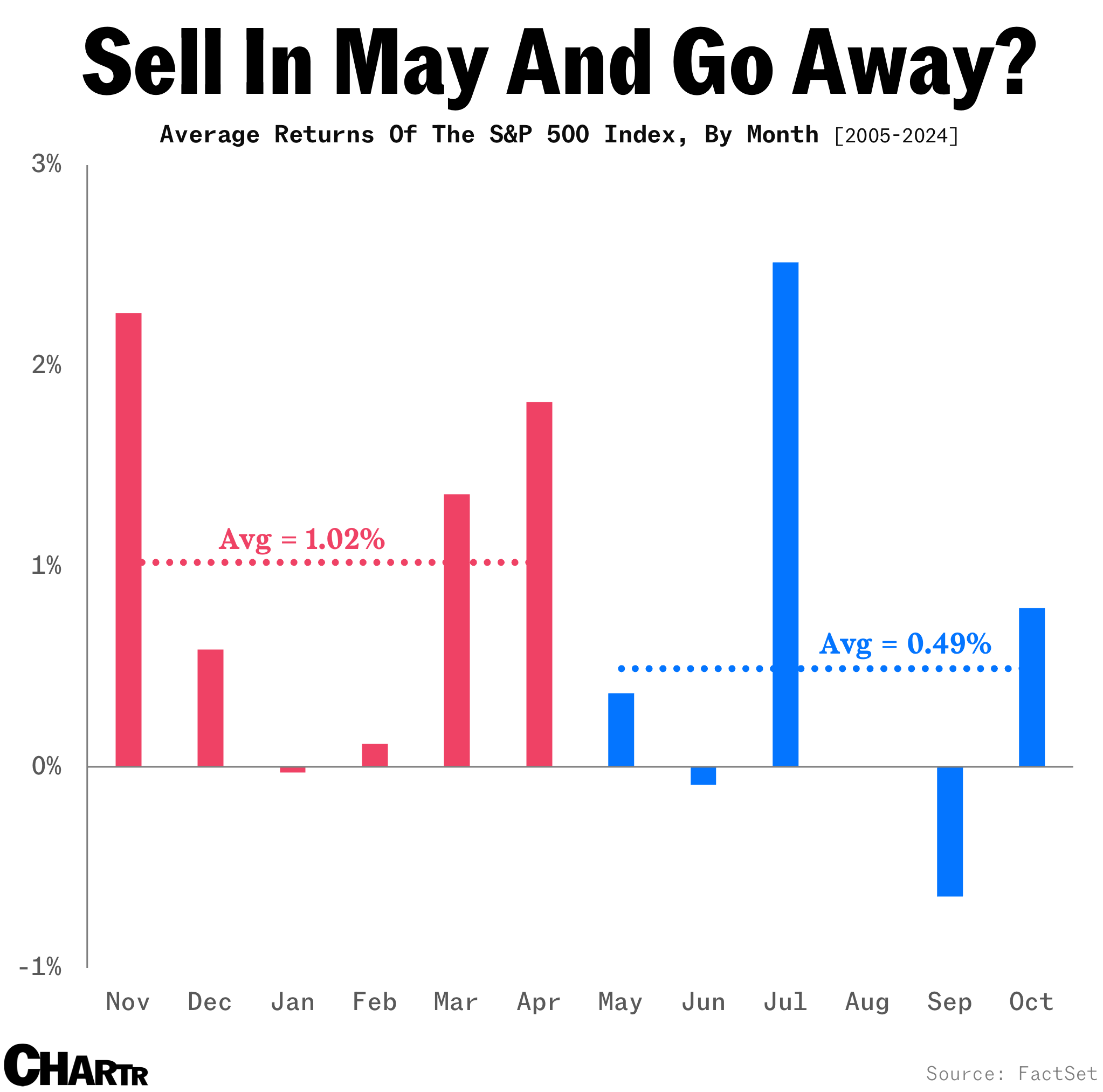
Monthly Returns SPX
Sherwood News

So, yeah, today’s downturn is almost certainly just the GDP numbers, tariff jitters, and the latest saga in the AI trade. But maybe — just maybe — there are a few folks out there hitting the sell button who are heading to a beach for the next six months. If that’s you, please get in touch.

More Markets

See all Markets
markets

United beats Q1 earnings and revenue estimates, lowers full-year profit guidance amid surging jet fuel prices

United Airlines reported its first-quarter earnings results after the bell on Tuesday. The carrier’s shares ticked down in after-hours trading.

For Q1, United reported:

  • Adjusted earnings of $1.19 per share, compared to the Wall Street estimate of $1.08 per share compiled by FactSet.

  • $14.6 billion in revenue, compared to the $14.39 billion consensus estimate.

In the first quarter, United’s fuel expense grew 12.6% from the same period last year to $3.04 billion.

For the second quarter, United expects adjusted earnings per share of between $1 and $2, shy of Wall Street expectations of $2.08. For the full year ahead, United said it expects earnings between $7 and $11 per share, compared to its prior guidance of between $12 and $14 per share.

“Guidance assumes United’s revenue recovers 40% to 50% of the fuel price increases in the second quarter, 70% to 80% of the fuel price increases in the third quarter and 85% to 100% of the fuel price increases in the fourth quarter 2026,” read the company’s investor update.

Earlier this month, United was among the first major US airlines to hike its bag fees amid higher fuel costs. Its shares have fallen more than 15% from a February high days before the war in Iran began.

United has also made waves this month following reports that CEO Scott Kirby had floated the idea of a merger with American Airlines to President Trump. A merger between two of the big four airlines would create a true US behemoth, controlling more than a third of the American market. American Air last week said it wasn’t interested in merging with United and hadn’t held talks on the idea. On Tuesday, Trump told CNBC that he doesn’t like the idea either.

markets

Hedge funds are following retail traders into the Magnificent 7

Hedge funds are following retail traders into the stocks the masses never stopped buying.

“As we kick off earnings for megacap tech stocks, this stood out: [hedge funds] have started buying Mag7 stocks again this month though positioning remains well below the peak levels seen in early 2016,” wrote Goldman Sachs’ Cullen Morgan.

Goldman PB Mag 7
Source: Goldman Sachs

In early April, JPMorgan strategist Arun Jain noted that retail investors had basically been selling everything but the Magnificent 7 stocks as part of a more cautious stance due to the Iran war.

(Apple has been a long-standing exception to this trend, presumably because retail traders arent fond of its hands-off approach to AI.)

JPM Retail flows

Last August, Jain discussed how retail activity tended to “crowd in” institutional buyers in meme stocks, while Goldman’s John Marshall advised clients to piggyback on stocks beloved by retail traders. Speculative, retail-geared assets proceeded to go on a tremendous run that soured in October.

But there are some early indications that a similar bout of speculative fervor is bubbling up once more.

markets

POET Technologies surges above $10 for first time in 4 years amid explosion in call volumes

POET Technologies is up nearly 40% this week as options market activity goes haywire in a faint echo of what got the stock on retail traders’ radars in October.

As of 11:12 a.m. ET, more than 10 calls have changed hands for every put traded. This bullish impulse has propelled the stock above the $10 threshold for the first time since March 2022.

Shares of the optical communications firm briefly dipped last week after Wolfpack Research said it was short the company because its investors would be exposed to an “IRS tax nightmare.”

The company responded that day saying it was taking measures for US shareholders that “should mitigate certain potential adverse US federal income tax consequences to it that could otherwise result from the Company’s status as a passive foreign investment company.”

Latest Stories

Sherwood Media, LLC produces fresh and unique perspectives on topical financial news and is a fully owned subsidiary of Robinhood Markets, Inc., and any views expressed here do not necessarily reflect the views of any other Robinhood affiliate, including Robinhood Markets, Inc., Robinhood Financial LLC, Robinhood Securities, LLC, Robinhood Crypto, LLC, Robinhood Derivatives, LLC, or Robinhood Money, LLC. Futures and event contracts are offered through Robinhood Derivatives, LLC.

