
Markets
Steve Ballmer
Steve Ballmer. (Icon Sportswire via Getty Images)
Weird Money

Steve Ballmer now richer than Bill Gates via time-honored strategy of refusing to diversify his holdings

“Diversification is for losers” - Steve Ballmer, probably

Jack Raines

In August 2014, Microsoft’s founder, Bill Gates, was worth approximately $78 billion. Meanwhile, Microsoft’s 30th employee-turned-CEO, Steve Ballmer, who was about to be replaced by Satya Nadella, was worth $20 billion.

In July 2024, Microsoft’s founder, Bill Gates, is worth $157 billion. Meanwhile, Microsoft’s 30th employee-turned-former CEO, Steve Ballmer, is worth slightly more than $157 billion, passing the company’s founder in net worth. How? While Gates diversified his wealth across several different investments and pledged to give away billions in philanthropic donations, Ballmer continued to YOLO Microsoft stock.

Bloomberg’s Billionaires Index tracks the portfolio’s of the world’s richest individuals, and 10 years after stepping down as CEO, more than 90% of Ballmer’s $157 billion is still invested in Microsoft stock. The rest is a few billion cash, as well as his stake in the Los Angeles Clippers and the team’s arena.
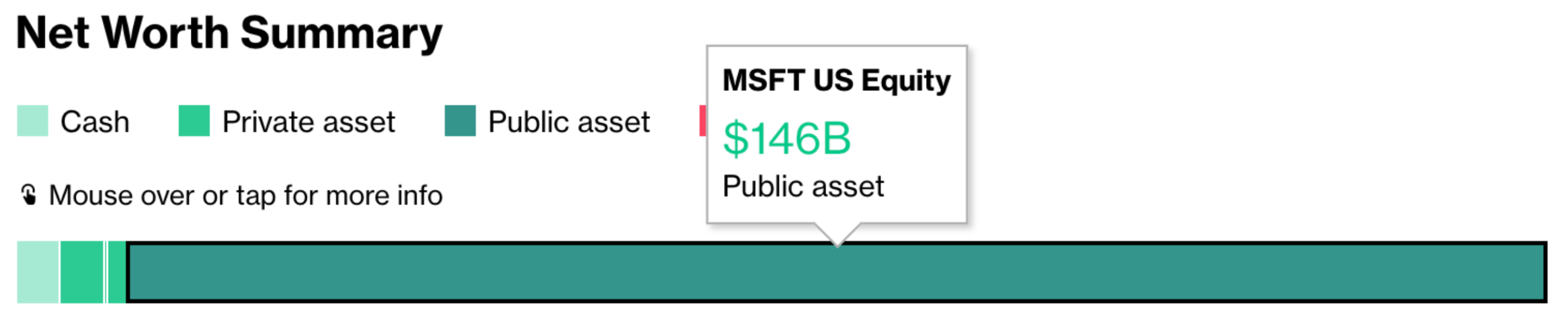
Ballmer Net Worth
Steve Ballmer's net worth breakdown, per Bloomberg

Compare this to Gates’ more diversified portfolio, which includes a $75 billion stake in his private investment firm, Cascade Investment, and just ~$30 billion in Microsoft.
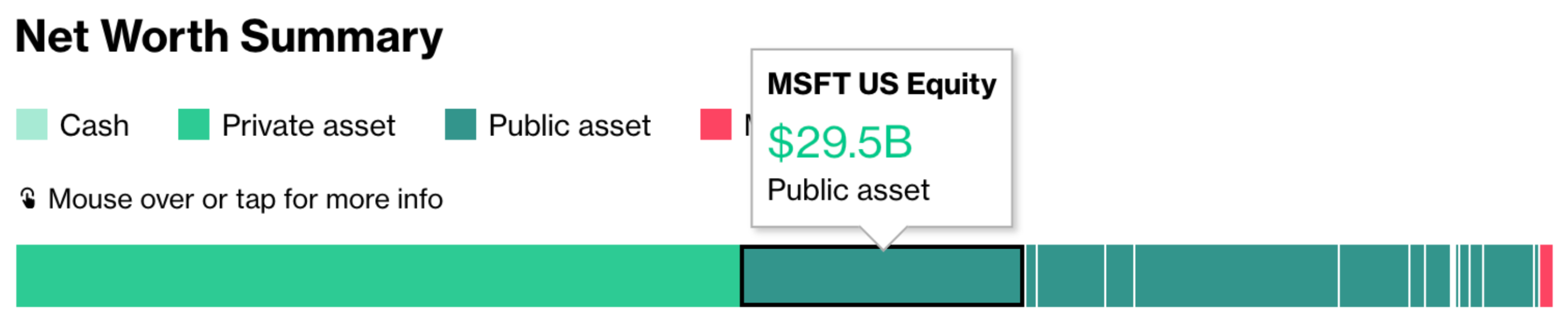
Bill Gates' Net Worth
Bill Gates' net worth breakdown, per Bloomberg

I love Ballmer’s refusal to invest in anything (other than a professional basketball team, of course) except for Microsoft’s stock. He won’t even sign Bill Gates’ Giving Pledge! Most people would, from a risk management standpoint if nothing else, diversify their investments at $20 billion, especially if they had just been replaced as the CEO, right? But Ballmer went all-in on the man who replaced him, making $137 billion in the process. I guess the takeaway here is that if someone is good enough to take your job as CEO, they’re good enough to invest in.

More Markets

See all Markets
markets

Health insurers surge after Medicare agrees to pay 2.48% more in 2027, a bigger-than-expected boost

Health insurance stocks are surging after the Centers for Medicare & Medicaid Services said it plans to boost Medicare Advantage and Part D payments by 2.48% in calendar year 2027.

The likes of CVS, Humana, UnitedHealth, Molina Healthcare, Oscar Health, and Elevance Health are gaining in postmarket trading.

Wall Street analysts had anticipated that rates for 2027 would go up between roughly 1% and 1.5%.

These stocks had gotten crushed in late January when the Trump administration proposed relatively flat federal payment rates.

Insurance companies that provide government-sponsored plans, like Medicare Advantage, faced headwinds from higher-than-expected costs in 2025.

markets

Iran war winners Dow, LyondellBasell downgraded by Bank of America

Dow, Inc. and LyondellBasell — two petrochemicals stocks that surged as markets priced in shortages due to the closure of the Strait of Hormuz — should decline as investors focus on the long-term outlook for normalized petrochemical prices once the war resolves, Bank of America analysts wrote in a note downgrading the two stocks Monday.

BofA moved its rating on the shares from “neutral” to “underperform,” writing:

“Over time, as chemical markets normalize, we expect 1) investor focus to shiſt back to ‘normal’ or ‘sustainable’ earnings profiles and 2) the conflict to resolve without material asset rationalization, both of which likely bias shares lower over the next twelve months.”

Analysts also lowered their stance on another petrochemicals and building materials stock, Westlake, to “neutral” from “buy.”

While cutting those ratings, BofA actually raised its more near-term price targets for the shares. It upped LyondellBasell to $68 from $55, and Dow to $35 from $31.

But those price targets still imply declines of more than 10% compared to where both shares were trading late Monday morning. Both stocks are up roughly 30% since the start of the Iran war.

markets

BNY and Robinhood to run “Trump accounts”

The Treasury Department named BNY as the financial agent to manage savings accounts for children established by the 2025 tax law, with the bank partnering with Robinhood Markets to serve as the brokerage and initial trustee. A custom “Trump accounts app” will be created as part of this venture.

The news was first reported by The Wall Street Journal.

(Robinhood Markets Inc. is the parent company of Sherwood Media, an independently operated media company subject to certain legal and regulatory restrictions.)

These so-called “Trump accounts” were part of the One Big Beautiful Bill Act, which sees the government contribute $1,000 toward an investment account for each child born in 2025 through 2028.

(Robinhood Markets Inc. is the parent company of Sherwood Media, an independently operated media company subject to certain legal and regulatory restrictions.)

These so-called “Trump accounts” were part of the One Big Beautiful Bill Act, which sees the government contribute $1,000 toward an investment account for each child born in 2025 through 2028.

markets

Memory stocks forget TurboQuant and remember how to rally

US memory stocks are forgetting about a negative catalyst and remembering what it’s like to lead major indexes.

Shares of Micron, Western Digital, Sandisk, and Seagate Technology Holdings are soaring in early trading on Monday.

Morgan Stanley reiterated its confidence in hard drive disk sellers on Monday, saying that recent channel checks “point to strengthening demand, elongating visibility, and most importantly, a much stronger pricing outlook.”

Analyst Erik Woodring boosted his price target on Seagate to $582 from $468 and on Western Digital to $380 from $369.

Aside from that, there’s no real news supporting their advance, so this looks to be a case of, “We now return to our regularly scheduled programming,” a world in which memory stocks benefit from a substantial supply/demand imbalance and enjoy ample pricing power thanks to the AI boom.

The group slumped in early March when the US-Israeli attacks on Iran began, as the war sparked an unwind of popular trades, and then sold off again late in the month after Google published details on its TurboQuant algorithm, which could decrease memory intensity in data center environments.

It’s worth noting that after March 25 was when the US stock market, in general, really hit the skids. So after that negative catalyst, the group was getting caught up in a tide of risk-off activity.

Wall Street analysts at Bernstein and Bank of America, among others, suggested the TurboQuant-inspired sell-off in the group was overdone.

“Despite TurboQuant, GOOGL capex still up +100% YoY,” wrote BofA analyst Vivek Arya, who added that Google “has been publishing similar techs over the last 18 months.”

With Monday’s early gains, these stocks (ex Micron) have now recovered all their post-TurboQuant declines.

Latest Stories

Sherwood Media, LLC produces fresh and unique perspectives on topical financial news and is a fully owned subsidiary of Robinhood Markets, Inc., and any views expressed here do not necessarily reflect the views of any other Robinhood affiliate, including Robinhood Markets, Inc., Robinhood Financial LLC, Robinhood Securities, LLC, Robinhood Crypto, LLC, Robinhood Derivatives, LLC, or Robinhood Money, LLC. Futures and event contracts are offered through Robinhood Derivatives, LLC.