

Markets
Fire breaks out in Shahran oil depot following US and Israeli attacks in Tehran
TEHRAN, IRAN - MARCH 8: Fire breaks out at the Shahran oil depot after attacks (Hassan Ghaedi/Getty Images)

Stock futures tumble as war drives oil above $100 for the first time since 2022

The Mideast war is causing escalating damage to oil supplies.

Oil futures broke above $100 per barrel on Sunday evening for the first time since 2022 as the escalating conflict in the Middle East exacerbates disruptions to this all-important commodity.

S&P 500 and Nasdaq 100 futures are both down more than 2% as of 10:30 p.m. ET on Sunday. Spiking oil prices threaten to weigh on consumer and business spending as well as undermine confidence, which could precipitate an economic downturn.

Tanker traffic through the Strait of Hormuz has become virtually nonexistent in the wake of the US-Israeli attacks against Iran, with the Gulf nation leveraging its ability to create havoc at this important chokepoint. That’s prompted oil-producing countries in the region, including Kuwait, the UAE, and Iraq, to curtail production because an inability to ship oil means there will soon be a lack of space to store it, as well. And both sides have struck energy infrastructure in the region, further contributing to supply stresses. Front-month Brent and West Texas Intermediate futures peaked near $120 as of the time of publishing.

“For now, consuming markets have not fully felt the shortage because pre‑escalation cargoes are still arriving: roughly 10 days to India, 21 to China, and 10 to Northwest Europe—temporarily masking disruptions as the buffer shrinks,” writes Natasha Kaneva, head of global commodities research at JPMorgan. “Within a week, as pre‑conflict cargoes are absorbed and new loadings stall, visible shortages could begin to emerge.”
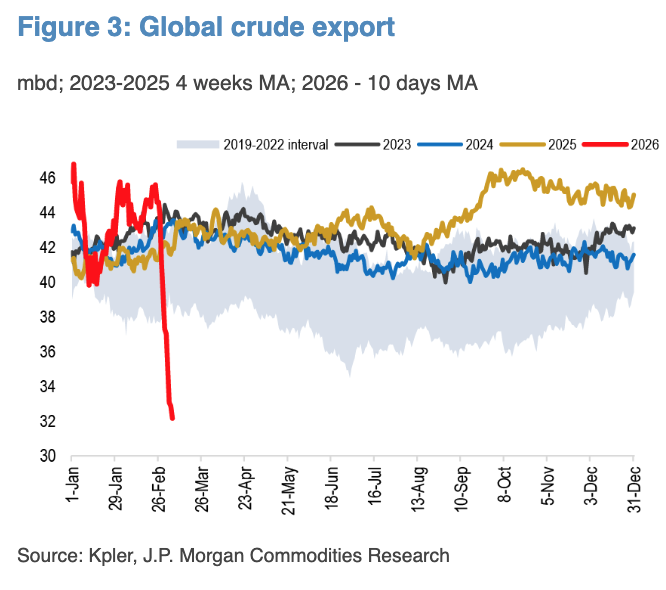

Global crude exports

More Markets

See all Markets
markets

US gas prices surge, with prediction markets implying >$4 per gallon by the end of March

Pain at the pump is intensifying as the ongoing war in the Middle East pressures supplies.

US average national gas prices rose to $3.45 per gallon on Sunday, according to data from the American Automobile Association, and are up more than 15% since the kinetic conflict started.

“Given Sunday evening’s data and the continued surge in oil prices, I believe there is roughly an 80% chance the national average price of gasoline reaches $4 per gallon within the next month- or sooner,” wrote Patrick De Haan, head of petroleum analysis at GasBuddy, in a post on Substack on Sunday evening. “In the immediate term, the national average of $3.45 per gallon could climb to roughly $3.75–$3.95 this week alone.”

Prediction markets currently expect prices to end the month around $4.30 to $4.50. On Friday, the prediction market-implied likely range for prices was between $3.60 and $3.70.

(Event contracts are offered through Robinhood Derivatives, LLC — probabilities referenced or sourced from KalshiEx LLC or ForecastEx LLC.)

markets

Report: Boeing could unveil 500-jet order from China during Trump’s visit later this month

Shares of Boeing are up nearly 4% on Friday afternoon, following a Bloomberg report that the company could be close to finalizing a deal to sell 500 planes to China.

The deal was first reported in August and would be one of Boeing’s largest ever.

According to Bloomberg’s sources, the deal could be officially unveiled when President Trump travels to China at the end of the month. That trip could be delayed given the war in Iran. The deal, sources say, could still fall apart — similar language to when it was first reported on more than six months ago.

Boeing has been on the outside of the Chinese market, in terms of new orders, since 2019 amid escalating US-China trade tensions.

According to Bloomberg’s sources, the deal could be officially unveiled when President Trump travels to China at the end of the month. That trip could be delayed given the war in Iran. The deal, sources say, could still fall apart — similar language to when it was first reported on more than six months ago.

Boeing has been on the outside of the Chinese market, in terms of new orders, since 2019 amid escalating US-China trade tensions.

markets

Why software shares are withstanding the war jitters

The outbreak of the war in Iran has clearly rattled investors and created a few clear winners — mostly energy stocks — and losers — consumer staples, airlines, and, well, more or else everything else.

But there is one interesting outlier to that Manichaean market dynamic.

Software shares — often the same companies that the market was giving up for dead just a few weeks ago due to overexpectations of an AI-driven disruption — have been holding up remarkably well.

These companies, including Intuit, ServiceNow, Datadog, Snowflake, IBM, Workday, and Oracle, have actually had a pretty decent run since the war started with a combined US-Israeli attack on Iran last weekend.

A new note from RBC Capital’s Rishi Jaluria suggests this isn’t just a fluke. Looking at the performance of software stocks during periods of geopolitical stress and market volatility over the last 10 and 25 years, his team found that software shares appear fairly well insulated when these broader shocks hit. RBC wrote:

“The defensive nature of SaaS models and the mission-critical nature of many core software systems at the enterprise level (e.g., in the absence of mass layoffs that may create seat-based headwinds, geopolitical uncertainty and/or market volatility typically will not cause an enterprise CIO to consider ripping out their ERP, CRM, Cyber systems, etc.”

I briefly got Jaluria on the phone yesterday, and he explained a bit more about why he thinks investors might see software as a decent place to hide out from the current chaos.

“With everything in the Middle East, you have to think about not just oil and gas input prices but also supply chains,” he said. “With software, you’re not really thinking about that.”

In other words, there is no equivalent of a closure of the Strait of Hormuz that software investors have to worry about.

Others suggested that the near-term profitability of these giant software companies — aside from concerns about potential long-term disruption from AI — may look different in the face of the economic uncertainty that seems to be growing with the war, especially after a sell-off that has left them relatively attractively valued.

Mark Moerdler, who covers software stocks for Bernstein Research, says that while the AI worries are clearly real, software companies continue to be highly productive cash cows.

“Everyone is afraid that AI is a massive disruptor, and all these articles you read talk about AI as massive disruptor or the world is ending or whatever,” he said. “You don’t see it in the fundamental numbers of the companies I cover. They are delivering GAAP profits, free cash flow, and they’re good investment ideas.”

Latest Stories

Sherwood Media, LLC produces fresh and unique perspectives on topical financial news and is a fully owned subsidiary of Robinhood Markets, Inc., and any views expressed here do not necessarily reflect the views of any other Robinhood affiliate, including Robinhood Markets, Inc., Robinhood Financial LLC, Robinhood Securities, LLC, Robinhood Crypto, LLC, or Robinhood Money, LLC.