

Markets
markets

Stocks really ain’t cheap

We’ve said it before, and we’ll say it again. The stock market’s post-election romp is increasingly untethered to investing fundamentals, as the gambling impulse — always present in the Jekyll-and-Hyde nature of trading markets — is clearly in control.

The WSJ spotlights the skimpy cushion expected earnings for the S&P 500 now provide, versus the guaranteed yields of US government bonds, as evidence that this rally is getting a bit unreasonable.

This so-called equity-risk premium shows that those buying the stock market are getting compensated virtually nothing for the risk they’re taking on at the moment, at least in terms of expected earnings.

A couple caveats here: first off, the post-election rise in stocks and bond yields at least partially reflects more optimism on the growth outlook. Sell-side analysts are never as nimble in adjusting their earnings estimates for companies as the stock and bond markets are in adjusting prices. So, expected profits are likely to see a boost as Wall Street plays catch-up.

Also, anchoring to the past 20 years — and especially the period following the global financial crisis — as a good gauge of what the ERP “should” be is difficult. That’s a period in which bond yields were very low relative to nominal economic growth; that is, stocks were a pretty good deal.

Of course, stock prices can — and, especially recently, have — run far ahead of those expected earnings. On an individual level stock level, this is pretty clear. Some of the year’s big winners like Palantir, Nvidia or CrowdStrike look insanely overvalued according metrics like price-to-sales ratios.

And that’s why the market is on track for its best two-year run since the dot-com boom of the 1990s, ERP be damned.

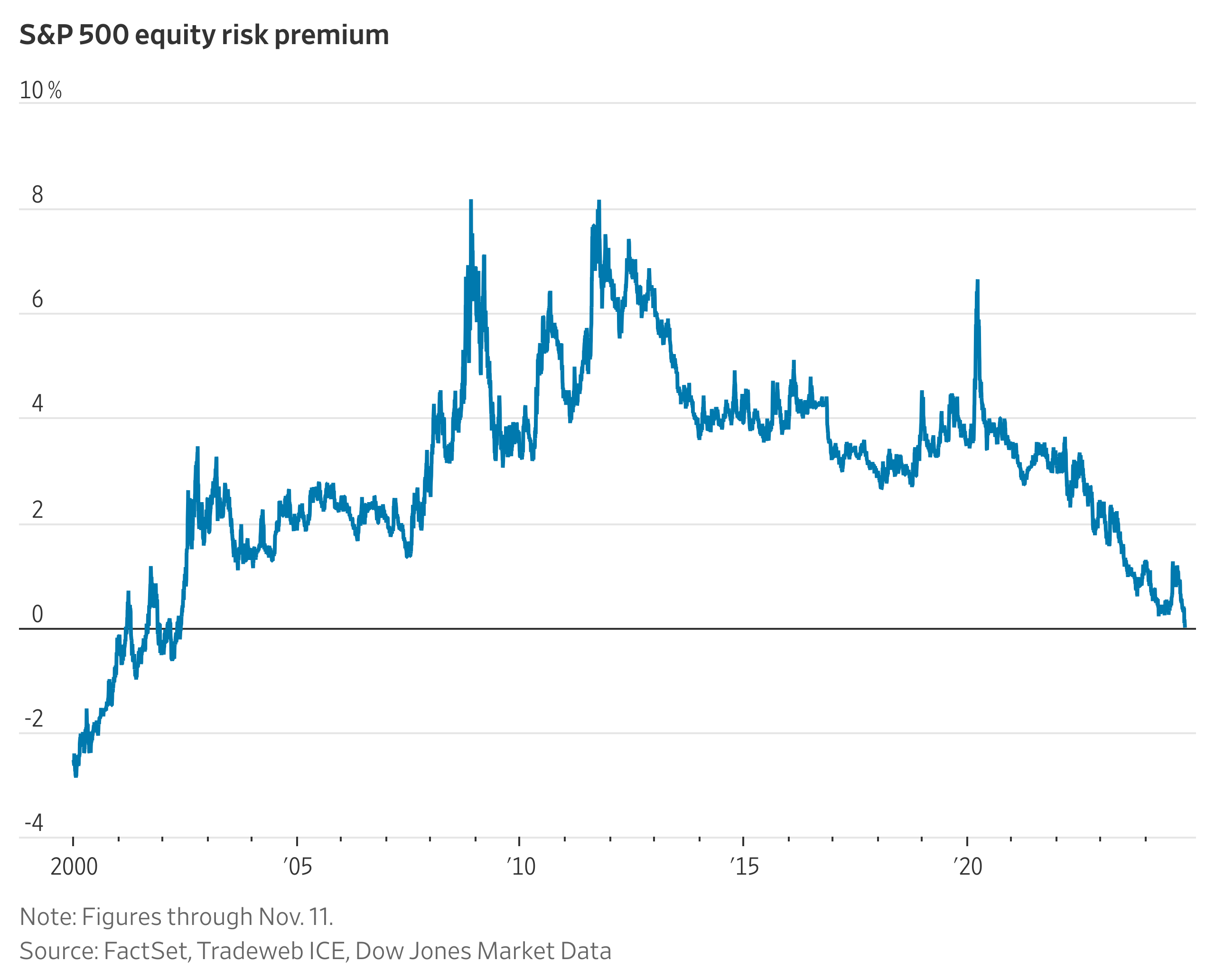
This so-called equity-risk premium shows that those buying the stock market are getting compensated virtually nothing for the risk they’re taking on at the moment, at least in terms of expected earnings.

A couple caveats here: first off, the post-election rise in stocks and bond yields at least partially reflects more optimism on the growth outlook. Sell-side analysts are never as nimble in adjusting their earnings estimates for companies as the stock and bond markets are in adjusting prices. So, expected profits are likely to see a boost as Wall Street plays catch-up.

Also, anchoring to the past 20 years — and especially the period following the global financial crisis — as a good gauge of what the ERP “should” be is difficult. That’s a period in which bond yields were very low relative to nominal economic growth; that is, stocks were a pretty good deal.

Of course, stock prices can — and, especially recently, have — run far ahead of those expected earnings. On an individual level stock level, this is pretty clear. Some of the year’s big winners like Palantir, Nvidia or CrowdStrike look insanely overvalued according metrics like price-to-sales ratios.

And that’s why the market is on track for its best two-year run since the dot-com boom of the 1990s, ERP be damned.

More Markets

See all Markets
markets

Spectrum owner Charter Communications is on pace for its worst day ever as broadband numbers and Q1 results disappoint

Cable and broadband company Charter Communications is on pace for its worst-ever trading day on Friday, as investors dump the stock following its Q1 results and forward guidance.

Charter, which owns Spectrum, reported adjusted earnings of $9.17 per share, below Wall Street estimates of $9.96 per share from analysts polled by FactSet. On the company’s earnings call, CFO Jessica Fischer appeared to lower its guidance for full-year revenue per user.

“It’ll be close either way in terms of whether we end up with net growth,” Fischer said.

The company lost 120,000 internet subscribers in the quarter, deeper than the expected 94,800 and double its loss from the same period last year. That news comes one day after Comcast’s earnings provided a bit of optimism for broadband as a category: the company reported Q1 losses of 65,000, significantly improving from 183,000 losses in the same quarter last year. Comcast is down more than 10%, on pace for its worst day since January 2025.

markets

Nvidia poised to snap longest run without a record close since the AI boom began

The stock price of the company responsible for the brains of the AI boom is finally showing some brawn again.

Nvidia, the world’s most valuable company, is poised to close at a record high for the first time since October 29, 2025, on Friday (if it ends above $207.04).

The AI chip trade is on fire, with the Philadelphia Semiconductor Index slated to deliver its 18th consecutive gain as Intel’s robust results and outlook juice the entire ecosystem. Hyperscalers report earnings next week, and their capex guidance can be thought of as the earnings guidance for Nvidia and other AI suppliers for the quarters to come.

This would end Nvidia’s longest stretch without a record close since the unofficial start of the AI boom (when the chip designer delivered blowout quarterly results in May 2023).

(Sorry if I jinx this!)

markets

Lilly slips after prescriptions for its weight-loss pill come in below expectations in second week

Eli Lilly fell on Friday after prescription data for its new weight-loss pill, Foundayo, showed that it’s having a significantly slower rollout than its top competitor.

The pill was prescribed about 3,700 times in its second week, according to IQVIA data cited by Deutsche Bank analysts, compared to the roughly 8,000 they were expecting. Novo Nordisk’s Wegovy pill, which came out in January, hit over 18,000 prescriptions in its second week.

The FDA approved Foundayo on April 1 and shipments began on April 9. Deutsche analysts noted that Lilly’s GLP-1 injections, which currently outsell Novo’s, also had a slower start.

Lilly fell more than 4% after the numbers were released. Novo Nordisk rose more than 5%.

Latest Stories

Sherwood Media, LLC produces fresh and unique perspectives on topical financial news and is a fully owned subsidiary of Robinhood Markets, Inc., and any views expressed here do not necessarily reflect the views of any other Robinhood affiliate, including Robinhood Markets, Inc., Robinhood Financial LLC, Robinhood Securities, LLC, Robinhood Crypto, LLC, Robinhood Derivatives, LLC, or Robinhood Money, LLC. Futures and event contracts are offered through Robinhood Derivatives, LLC.
