
Markets
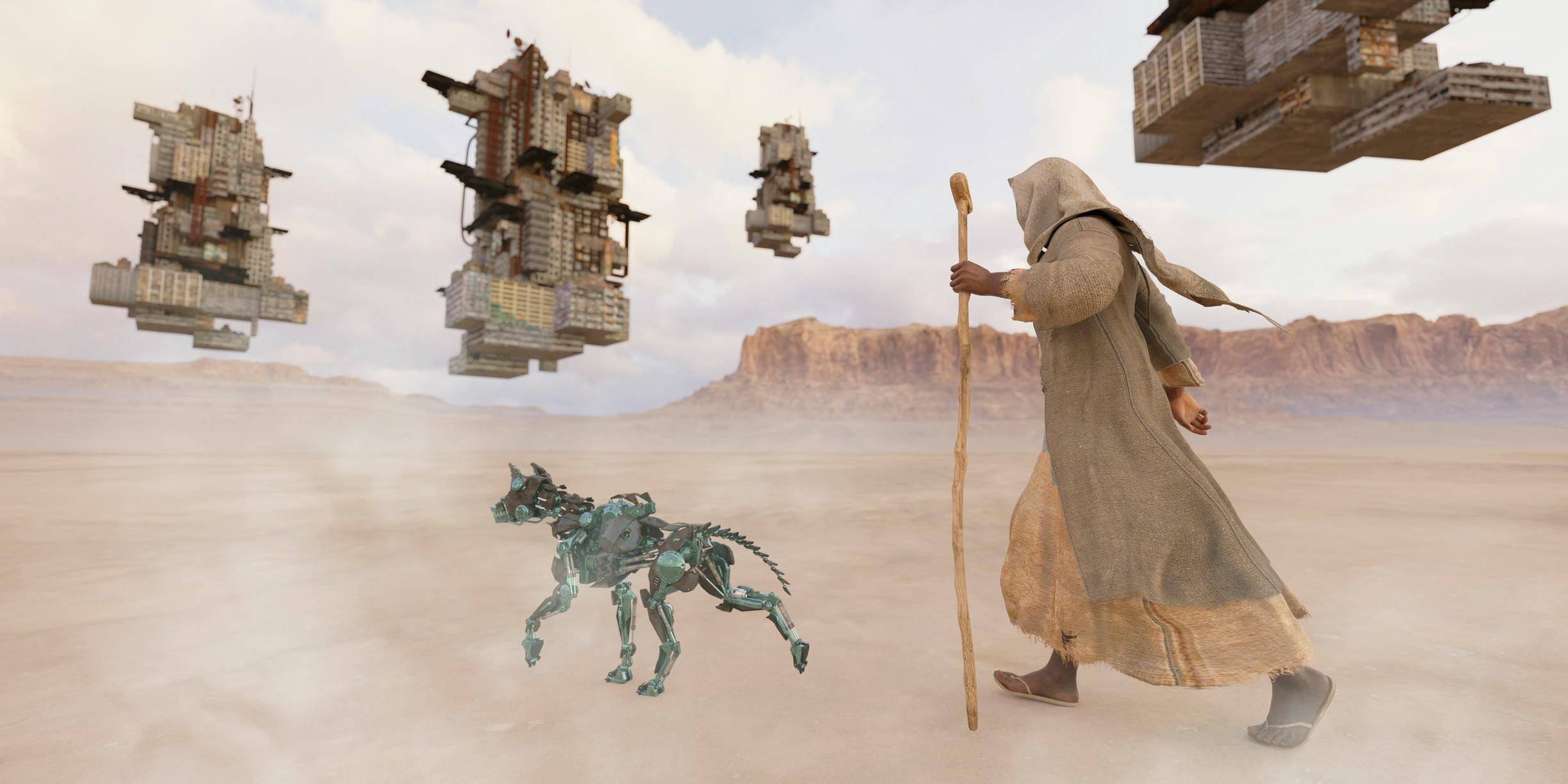
Man in desert with robodog and floating tower blocks
This is what you get when you search ‘dystopia’ in Getty Images. (Getty Images)

Software stocks crater as independent research piece details potential AI dystopian scenario

The lowlights in this dystopian not-too-distant future: unemployment high despite elevated nominal growth and productivity, and the stock market tumbling as credit stress from companies laid low by AI metastasizes.

Luke Kawa

Software stocks are getting shellacked as a post published by Citrini Research and Lotus Technology Management managing partner Alap Shah has sharpened attention on the magnitude and breadth of losers from the AI boom.

The piece, titled “The 2028 Global Intelligence Crisis,” is a hypothetical scenario analysis exploring the left-tail risks in two years’ time in a world where there’s an aggressive AI build-out and adoption of AI agents.

“What follows is a scenario, not a prediction,” the authors wrote. “Hopefully, reading this leaves you more prepared for potential left tail risks as AI makes the economy increasingly weird.”

The original tweet with a link to the piece from Citrini Research, which was founded by James van Geelen, has received 4.5 million views, been retweeted 2,100 times, and bookmarked 12,000 times, per X. Van Geelen’s profile is also among the top two most viewed on the Bloomberg Terminal over the past hour, as of 11 a.m. ET, recently surpassing baseball legend Yogi Berra (?!?).

“What if our AI bullishness continues to be right... and what if that’s actually bearish?” they wrote.

The lowlights in this dystopian not-too-distant future: unemployment high despite elevated nominal growth and productivity, and the stock market tumbling as credit stress from companies laid low by AI metastasizes.

The hypothetical pain points for the software industry include:

  • Software-as-a-service companies forced to offer steep discounts to customers for 2027 renewals to avoid being displaced by new AI tools;

  • And “systems of record” like ServiceNow issuing dire results and job cuts as the potential for in-house builds weigh on growth and pricing.

CrowdStrike, DocuSign, AppLovin, Atlassian, GitLab, Workday, Datadog, Asana, Salesforce, Oracle, Adobe, ServiceNow, and Palantir are among the names getting crushed on Monday.

A future in which AI agents thoroughly conquer e-commerce, handling transactions on behalf of humans, could also leave payments companies vulnerable, the authors added.

Mastercard, Visa, American Express, Synchrony Financial, and Capital One are stocks that are all suffering from severe selling pressure on Monday which were flagged in the scenario analysis as facing headwinds from agents looking to avoid fees and white-collar workers being displaced.

Do read the entire piece here. It’s often remarked that a lack of discipline is a surefire sign of a poor investor, but in my opinion — and personal experience! — a lack of imagination can be just as much of a shortcoming. Having the open-mindedness and creativity to envision what could happen while developing and stress-testing your assumptions can often be a very helpful way to identify opportunities in financial markets.

More Markets

See all Markets
markets

Report: Boeing could unveil 500-jet order from China during Trump’s visit later this month

Shares of Boeing are up nearly 4% on Friday afternoon, following a Bloomberg report that the company could be close to finalizing a deal to sell 500 planes to China.

The deal was first reported in August and would be one of Boeing’s largest ever.

According to Bloomberg’s sources, the deal could be officially unveiled when President Trump travels to China at the end of the month. That trip could be delayed given the war in Iran. The deal, sources say, could still fall apart — similar language to when it was first reported on more than six months ago.

Boeing has been on the outside of the Chinese market, in terms of new orders, since 2019 amid escalating US-China trade tensions.

According to Bloomberg’s sources, the deal could be officially unveiled when President Trump travels to China at the end of the month. That trip could be delayed given the war in Iran. The deal, sources say, could still fall apart — similar language to when it was first reported on more than six months ago.

Boeing has been on the outside of the Chinese market, in terms of new orders, since 2019 amid escalating US-China trade tensions.

markets

Why software shares are withstanding the war jitters

The outbreak of the war in Iran has clearly rattled investors and created a few clear winners — mostly energy stocks — and losers — consumer staples, airlines, and, well, more or else everything else.

But there is one interesting outlier to that Manichaean market dynamic.

Software shares — often the same companies that the market was giving up for dead just a few weeks ago due to overexpectations of an AI-driven disruption — have been holding up remarkably well.

These companies, including Intuit, ServiceNow, Datadog, Snowflake, IBM, Workday, and Oracle, have actually had a pretty decent run since the war started with a combined US-Israeli attack on Iran last weekend.

A new note from RBC Capital’s Rishi Jaluria suggests this isn’t just a fluke. Looking at the performance of software stocks during periods of geopolitical stress and market volatility over the last 10 and 25 years, his team found that software shares appear fairly well insulated when these broader shocks hit. RBC wrote:

“The defensive nature of SaaS models and the mission-critical nature of many core software systems at the enterprise level (e.g., in the absence of mass layoffs that may create seat-based headwinds, geopolitical uncertainty and/or market volatility typically will not cause an enterprise CIO to consider ripping out their ERP, CRM, Cyber systems, etc.”

I briefly got Jaluria on the phone yesterday, and he explained a bit more about why he thinks investors might see software as a decent place to hide out from the current chaos.

“With everything in the Middle East, you have to think about not just oil and gas input prices but also supply chains,” he said. “With software, you’re not really thinking about that.”

In other words, there is no equivalent of a closure of the Strait of Hormuz that software investors have to worry about.

Others suggested that the near-term profitability of these giant software companies — aside from concerns about potential long-term disruption from AI — may look different in the face of the economic uncertainty that seems to be growing with the war, especially after a sell-off that has left them relatively attractively valued.

Mark Moerdler, who covers software stocks for Bernstein Research, says that while the AI worries are clearly real, software companies continue to be highly productive cash cows.

“Everyone is afraid that AI is a massive disruptor, and all these articles you read talk about AI as massive disruptor or the world is ending or whatever,” he said. “You don’t see it in the fundamental numbers of the companies I cover. They are delivering GAAP profits, free cash flow, and they’re good investment ideas.”

Latest Stories

Sherwood Media, LLC produces fresh and unique perspectives on topical financial news and is a fully owned subsidiary of Robinhood Markets, Inc., and any views expressed here do not necessarily reflect the views of any other Robinhood affiliate, including Robinhood Markets, Inc., Robinhood Financial LLC, Robinhood Securities, LLC, Robinhood Crypto, LLC, or Robinhood Money, LLC.
