

Markets
markets

Shopify overtakes RBC to become Canada’s most valuable public company

Thanks to an impressive quarter that sent Shopify shares soaring on Wednesday, the e-commerce platform has become Canada’s most valuable company, beating the Royal Bank of Canada to the top spot.

After its earnings call, Shopify surged on an optimistic outlook for the next quarter, as it expects revenue to grow at a mid- to high 20s percentage rate on a year-over-year basis. The numbers were astonishing — an absolute blowout quarter, said Mike Archibald, a portfolio manager at AGF Investments, via Reuters.

The platforms climb also sent the entire Toronto stock market briefly to a new record high, bringing the S&P/TSX composite index up 1.3% on Wednesday from the day before.
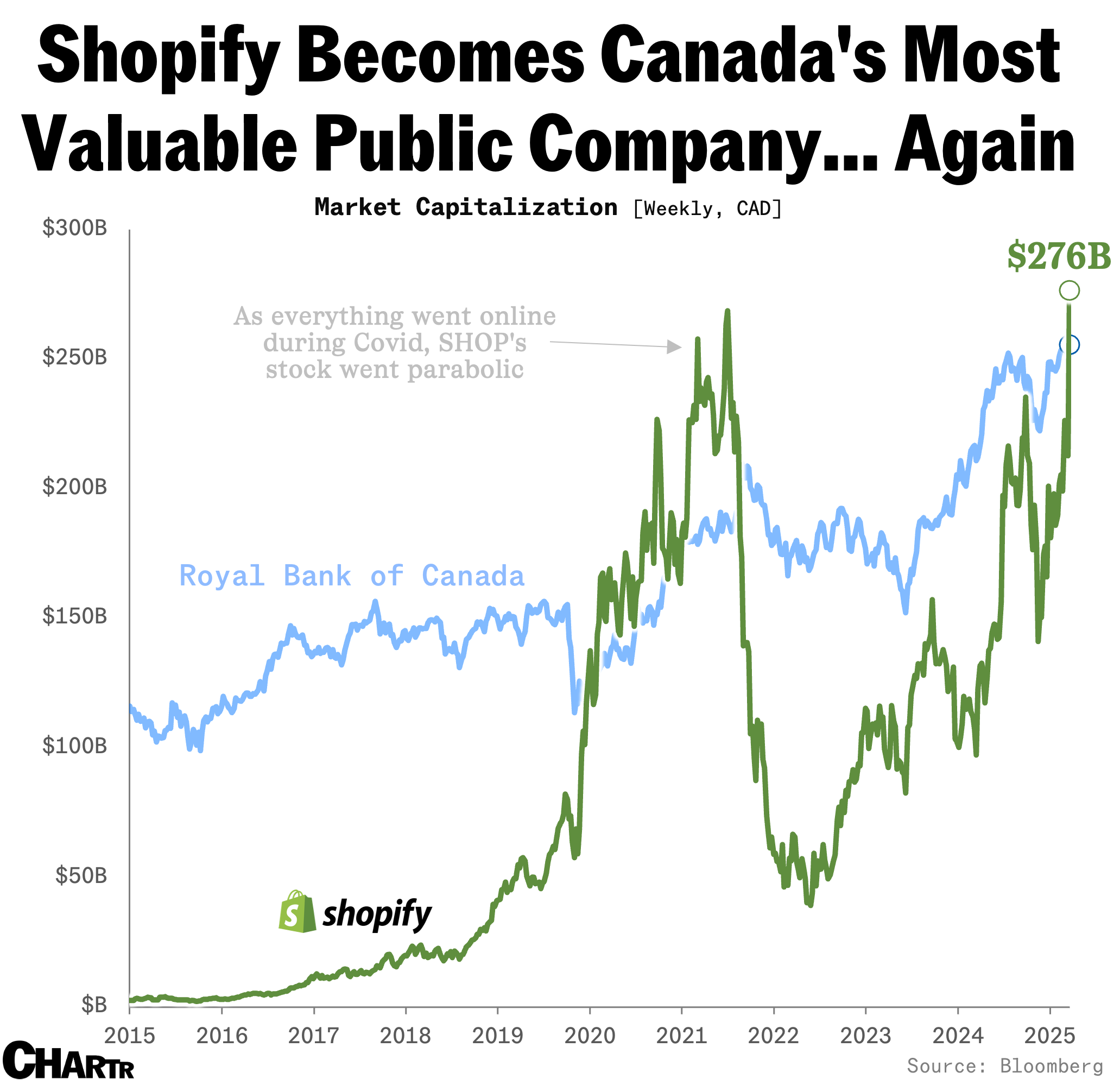
Shopify is now the biggest Canadian company
Sherwood News

Shopify previously edged past RBC in 2020, when e-commerce enthusiasm exploded during the pandemic. Unfortunately, that excitement soon evaporated, with Shopify losing the crown after two years. As noted by Bloomberg, that’s given further fuel to the idea of the Canadian market curse, in which rocket-like companies such as Blackberry and Nortel Networks Corp. have ended up dramatically collapsing in value after beating the nation's biggest bank. Maybe this time it’s different with SHOP?

More Markets

See all Markets
markets

Rivian announces R2 will start at $59,485 at launch, with lower cost trims set to arrive in 2027

EV maker Rivian on Thursday announced that its highly anticipated R2, which CEO RJ Scaringe has called “maybe the most important thing we’ve launched to date,” will start at $59,485 at launch.

The company is prioritizing pricier trims at first, with a lower-range $46,495 base model set to arrive in late 2027.

The nearly $60,000 launch price, and the timeline for the base model’s arrival, seem to be slightly different than what investors were hoping for, and Rivian shares are down 4% intraday on Thursday.

Rivian’s R2 is a midsize SUV, smaller than its R1S predecessor. The launch model will have an estimated range of 330 miles.

Rivian has said it expects R2 deliveries to begin in the second quarter of this year. The company has implied that it expects to make between 20,000 and 25,000 R2 deliveries in 2026.

The nearly $60,000 launch price, and the timeline for the base model’s arrival, seem to be slightly different than what investors were hoping for, and Rivian shares are down 4% intraday on Thursday.

Rivian’s R2 is a midsize SUV, smaller than its R1S predecessor. The launch model will have an estimated range of 330 miles.

Rivian has said it expects R2 deliveries to begin in the second quarter of this year. The company has implied that it expects to make between 20,000 and 25,000 R2 deliveries in 2026.

markets

Why the war in Iran put these four chemical stocks on top of the S&P today

They’re not the most glamorous stocks in the market, but chemical-slash-fertilizer companies CF Industries, Mosaic Co. , Dow, Inc., and LyondellBasell are the belles of the ball in Thursday trading, topping the list of S&P 500 performers shortly before 12 p.m. ET.

Natural gas is a crucial input for the chemical and fertilizer industries, and the closure of the Strait of Hormuz is basically cutting off supply from the region, which European and Asian chemical companies depend on.

That leaves these US giants — with access to abundant stateside gas supplies — able to produce and take advantage of pricing power in the absence of robust global competition.

Here’s how Citi analysts put it today in a note upgrading LyondellBasell and Dow to “buy” from “neutral”:

“While the duration of the conflict remains uncertain, we believe the disruptions and shutdowns across the upstream LNG plants to downstream crackers in Asia and Europe could provide months of supply-driven pricing uplift.”

Good times for them. (And their shareholders.)

Some of these companies like Dow, Mosaic, and CF Industries are also major suppliers of fertilizers, which influence food prices. And that suggests the world economy is experiencing growing inflationary pressures stemming from the less than 2-week-old war, which could eventually become a problem for the market.

markets

Never-ending stream of private credit conniptions weighs on financials

The steady drip of negative news on private credit is exacerbating the sell-off in stocks tied to the asset class and the broader financial sector.

Asset manager Blue Owl Capital is trading at its lowest level since October 2022, the month the S&P 500 bottomed. Its business development company, Blue Owl Capital Corp. — effectively its private credit arm — is likewise sinking, with a price-to-book ratio below 0.8. That suggests investors don’t think its loans are worth what the company has reported they’re worth (or are worried that they’ll be marked down in the future).

Glendon Capital Management is leveling that direct charge against the firm and others in the industry. In a presentation seen by the Financial Times, Glendon alleged that “private credit funds managed by Blue Owl and many of its rivals had ‘misrepresented’ loss rates in their portfolios and were sitting on ‘larger losses than reported.’"

This news comes after JPMorgan reportedly curbed some of its lending to private credit funds and reduced the estimated value of software loans in those portfolios, according to Bloomberg.

Other lowlights in financials:

  • Deutsche Bank, which revealed a $30 billion exposure to private credit in its annual report, is down nearly 8% as of 11:10 a.m. ET, on track for its biggest one-day loss since April 2025.

  • With this week’s losses, the SPDR S&P Regional Banking ETF has erased its year-to-date gains, which were in excess of 13% as of early February.

  • Jon Turek, founder of JST Advisors, flagged that the Financial Select Sector SPDR Fund is poised to deliver a Q1 drop in excess of 10%. Other years in which that fund tumbled by 10% or more in the first three months include 2001, 2008, 2009, and 2020 — a nearly comprehensive list of the most tumultuous periods for global markets in the 21st century.

markets

Bumble soars on better-than-expected Q4 and strong first-quarter profit outlook

Bumble surged more than 20% in premarket trading on Thursday after the dating app operator posted better-than-expected Q4 results and provided Q1 profit guidance that also beat estimates, powered by its ongoing turnaround efforts.

For the quarter ended December 31, 2025, the company reported:

  • Revenue of $224.2 million — down 14% year on year, but above the Wall Street consensus estimate of $221 million (per data compiled by Bloomberg).

  • Adjusted EBITDA of $71.6 million, beating analyst expectations of $63.5 million.

For the first quarter of fiscal 2026, Bumble forecasts:

  • Adjusted EBITDA of $76 million to $80 million, well ahead of analysts’ consensus estimate of $57.7 million.

  • Revenue in the range of $209 million to $213 million, roughly meeting Wall Street expectations of $210 million.

Since founder Whitney Wolfe Herd returned to the top job around a year ago, Bumble has been undergoing a broad turnaround plan, featuring the introduction of new AI-enabled features to compete with stiff competition in the dating app market.

In the company’s press release, Wolfe Herd commented on its strategic overhaul: “With the heavy lift of our quality reset behind us, we are accelerating product innovation and prioritizing member experience enhancements. We are building from a stronger base and positioning Bumble for its next chapter of product-led growth.”

Latest Stories

Sherwood Media, LLC produces fresh and unique perspectives on topical financial news and is a fully owned subsidiary of Robinhood Markets, Inc., and any views expressed here do not necessarily reflect the views of any other Robinhood affiliate, including Robinhood Markets, Inc., Robinhood Financial LLC, Robinhood Securities, LLC, Robinhood Crypto, LLC, or Robinhood Money, LLC.