
Markets
New York Stock exchange
(David Dee Delgado/Getty Images)

“Retail traders are breaking all records,” says JPMorgan

Sentiment among individual stock traders hits the highest on record.

Deep attachment to the AI boom and bets that Big Tech’s ties to the Trump administration will pay off have chummed the waters for the increasingly involved ranks of retail stock traders, with their activity now surpassing even the meme-stock mania of January 2021.

In a note published Wednesday titled “Retail Traders are Breaking all Records,” JPMorgan analysts paint the picture of extreme levels of trading centered on the biggest technology companies — the so-called Magnificent 7. They wrote:

Retail traders are on track to break all records. Their daily inflow exceeded $2B twice last week — a level reached only 9 times (as of last Friday) in the past 3 years with 5 times occurring this year after the Inauguration...

Unlike previous weeks when the net inflows were dominated by broad-market ETFs, the past two days saw minimal ETF inflows with interests evenly split between Fixed Income and Equities (top picks: iShares 0-3 Month Treasury Bond ETF, iShares Bitcoin Trust, SPDR Gold Shares ETF, Vanguard S&P 500 Value ETF, SPDR S&P 500 Trust).

Within single stocks, they set records with a net imbalance of $3.2B on Tuesday, ~$1B more than the second largest in March 2020. ~70% inflows went to Mag7, the largest on record. Nvidia led the inflows with a $1.3B net purchase, slightly lower than last June’s level following the stock split. Demand for Tesla remained strong at $632Mn (99th %ile over the past 5Y).

For the record, imbalance is the dollar-based metric — essentially shares multiplied by price — that JPM analysts use to try to assess traders’ stance on a company. A positive imbalance means retail traders, as a group, are buyers, while a negative imbalance suggests they are sellers, on the whole. By comparing these imbalances to historical levels, they try to assess how bullish or bearish retail traders seem to be. At the moment they’re off-the-charts bullish. Here’s a snapshot from the note.
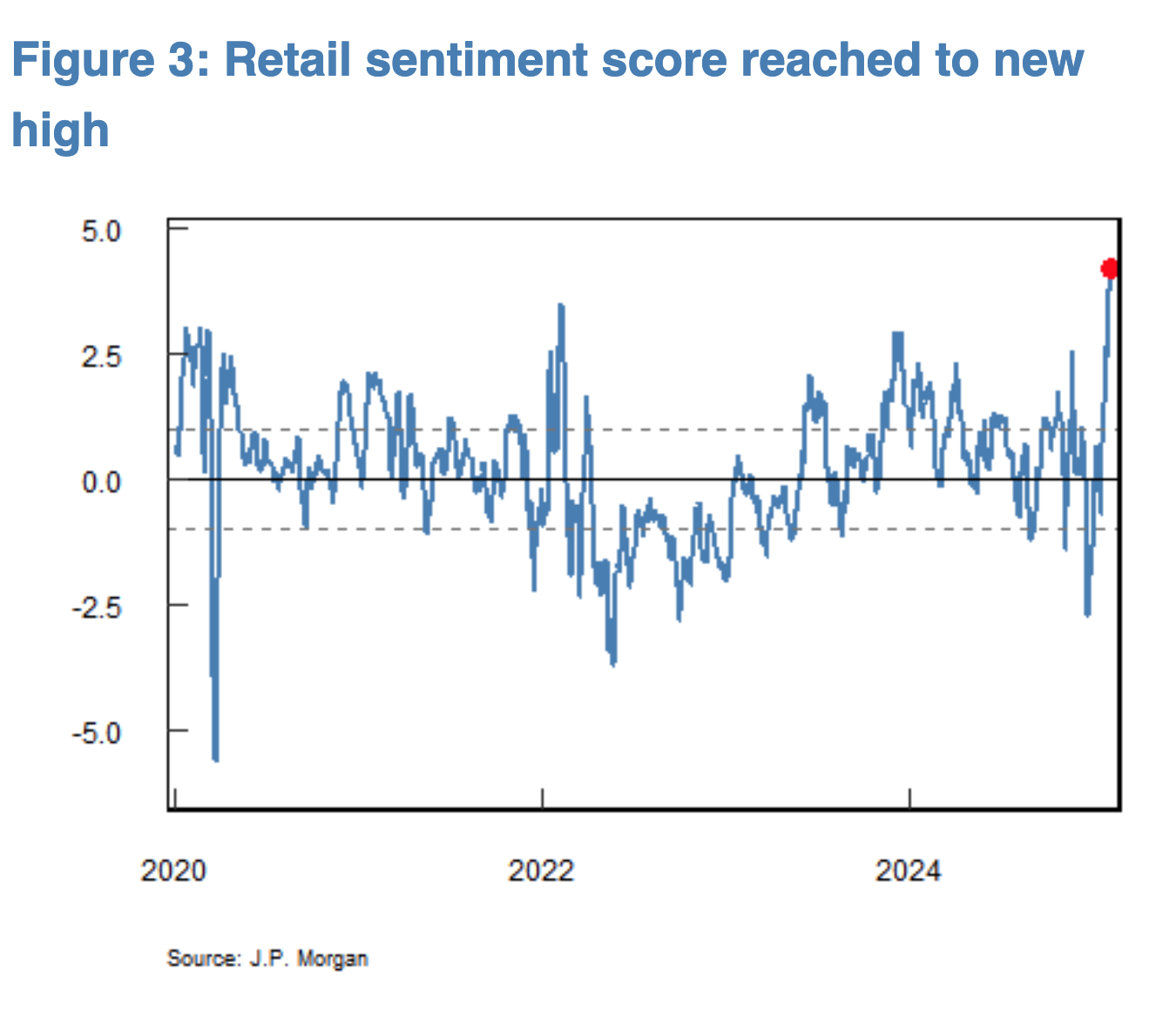
JPM Retail trading sentiment analyst chart

Is this a good thing? On Wall Street, such levels of retail ebullience would traditionally be seen as a contrarian indicator suggesting a downturn might be in the future, as buying power has been largely spent. But JPM analysts argue that actually, extreme levels of retail buying tend to portend an upturn in the markets over the near term.

“We find market generally outperforms following extreme retail buying and underperforms after extreme retail selling in short-term,” they wrote.

More Markets

See all Markets
markets

Spectrum owner Charter Communications is on pace for its worst day ever as broadband numbers and Q1 results disappoint

Cable and broadband company Charter Communications is on pace for its worst-ever trading day on Friday, as investors dump the stock following its Q1 results and forward guidance.

Charter, which owns Spectrum, reported adjusted earnings of $9.17 per share, below Wall Street estimates of $9.96 per share from analysts polled by FactSet. On the company’s earnings call, CFO Jessica Fischer appeared to lower its guidance for full-year revenue per user.

“It’ll be close either way in terms of whether we end up with net growth,” Fischer said.

The company lost 120,000 internet subscribers in the quarter, deeper than the expected 94,800 and double its loss from the same period last year. That news comes one day after Comcast’s earnings provided a bit of optimism for broadband as a category: the company reported Q1 losses of 65,000, significantly improving from 183,000 losses in the same quarter last year. Comcast is down more than 10%, on pace for its worst day since January 2025.

markets
Luke Kawa

Nvidia poised to snap longest run without a record close since the AI boom began

The stock price of the company responsible for the brains of the AI boom is finally showing some brawn again.

Nvidia, the world’s most valuable company, is poised to close at a record high for the first time since October 29, 2025, on Friday (if it ends above $207.04).

The AI chip trade is on fire, with the Philadelphia Semiconductor Index slated to deliver its 18th consecutive gain as Intel’s robust results and outlook juice the entire ecosystem. Hyperscalers report earnings next week, and their capex guidance can be thought of as the earnings guidance for Nvidia and other AI suppliers for the quarters to come.

This would end Nvidia’s longest stretch without a record close since the unofficial start of the AI boom (when the chip designer delivered blowout quarterly results in May 2023).

(Sorry if I jinx this!)

markets

Lilly slips after prescriptions for its weight-loss pill come in below expectations in second week

Eli Lilly fell on Friday after prescription data for its new weight-loss pill, Foundayo, showed that it’s having a significantly slower rollout than its top competitor.

The pill was prescribed about 3,700 times in its second week, according to IQVIA data cited by Deutsche Bank analysts, compared to the roughly 8,000 they were expecting. Novo Nordisk’s Wegovy pill, which came out in January, hit over 18,000 prescriptions in its second week.

The FDA approved Foundayo on April 1 and shipments began on April 9. Deutsche analysts noted that Lilly’s GLP-1 injections, which currently outsell Novo’s, also had a slower start.

Lilly fell more than 4% after the numbers were released. Novo Nordisk rose more than 5%.

Latest Stories

Sherwood Media, LLC produces fresh and unique perspectives on topical financial news and is a fully owned subsidiary of Robinhood Markets, Inc., and any views expressed here do not necessarily reflect the views of any other Robinhood affiliate, including Robinhood Markets, Inc., Robinhood Financial LLC, Robinhood Securities, LLC, Robinhood Crypto, LLC, Robinhood Derivatives, LLC, or Robinhood Money, LLC. Futures and event contracts are offered through Robinhood Derivatives, LLC.

