
Markets
Elon Musk In Krakow, Poland
Elon Musk, owner of Tesla and X, formerly Twitter (Beata Zawrzel/Getty Images)

Retail investors are getting smoked because they keep buying the dip in Tesla

This Tesla buying streak is the biggest in at least a decade, as investors pour into the Magnificent 7.

Luke Kawa

It turns out continuing to pile into the S&P 500’s biggest loser of the year is not a winning strategy.

Retail traders have been accumulating Tesla for 12 straight days to the tune of $7.3 billion in net purchases, per JPMorgan, “the highest magnitude among all past ‘buying streaks’ in over a decade.”
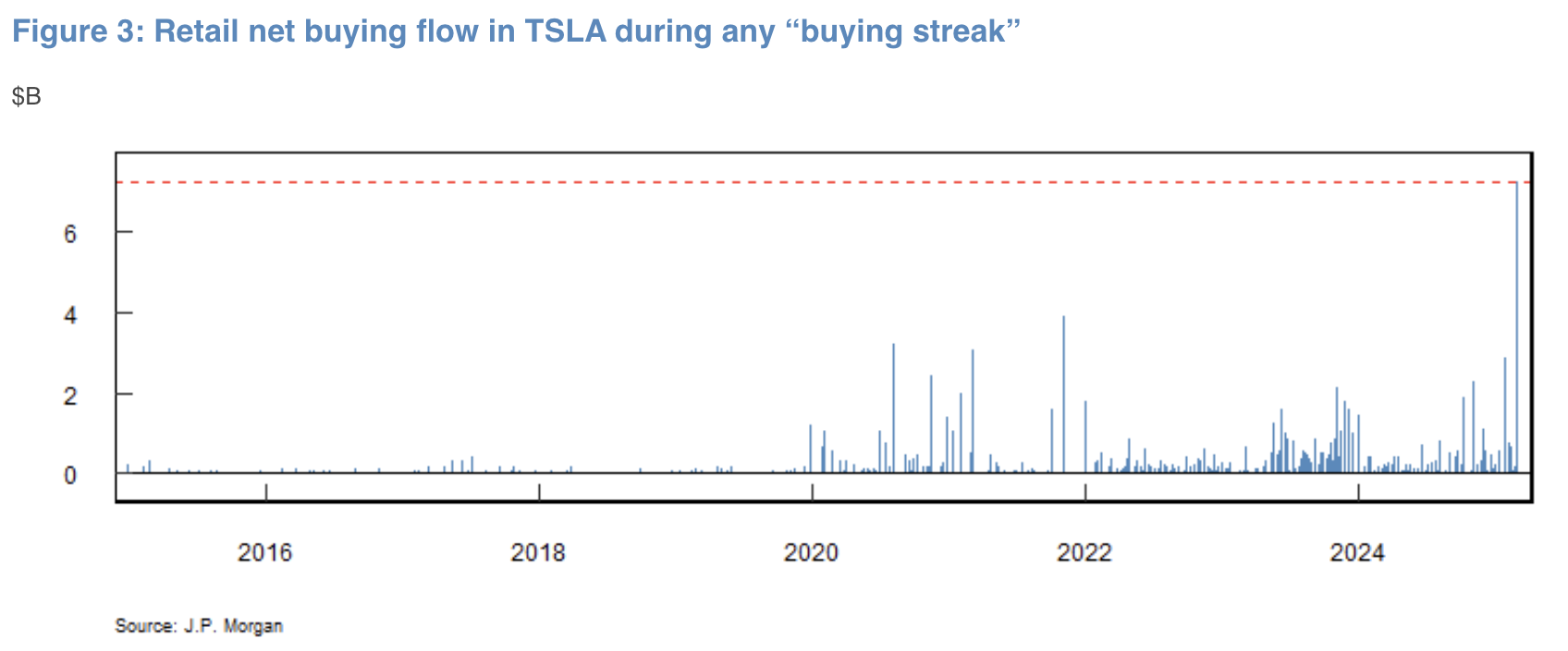
JPM Tesla buying

Shares of the Elon Musk-led auto company are down 17.1% over this period, which has included selling by Tesla insiders, analysts cutting delivery targets as early-year sales figures disappoint, progress by rivals on autonomous driving as well as EV charging, and deteriorating public perception of the brand.

According to JPM quantitative strategist Emma Wu, nearly 75% of the $8.3 billion that retail traders have put to work in single stocks over the past week has gone to the members of the Magnificent 7, led by Tesla and Nvidia. This group has generally faced heavy selling pressure amid a breakdown in momentum stocks, particularly those levered to AI.

“We estimate retail investors’ performance is down by 7% year-to-date (vs. -3.3% loss in S&P),” she wrote. “Most of the drawdown came from March as they increased their holdings in Tech.”
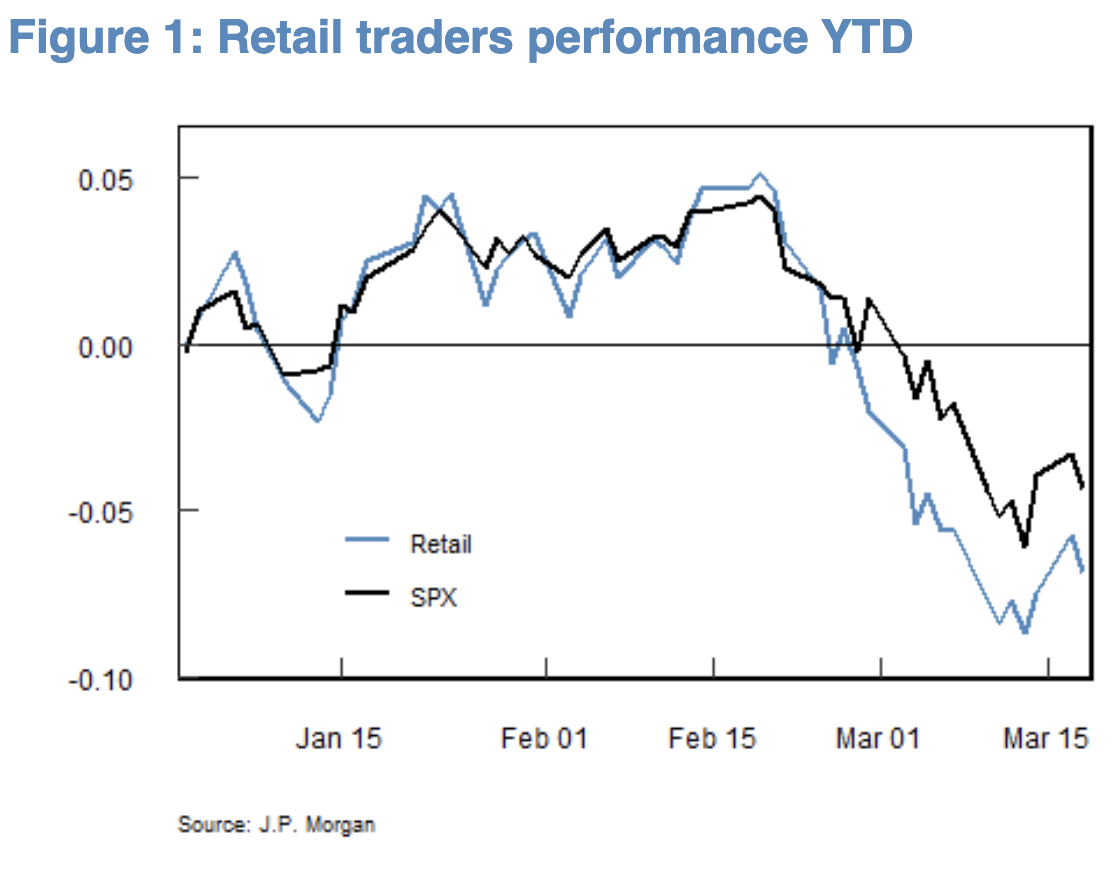
JPMretail performance

Heavy retail buying when stocks go down has been the rule, not the exception, she observed:

“They broke the $2-billion threshold for the past four days in a row. It’s worth noting that this level that is more easily reached in a ‘down’ year than in an ‘up’ year: it was rarely seen in 2023/24 (4 times in total), when S&P produced double-digit returns, but occurred 10 times in 2022, concentrated in Feb during the Russia-Ukraine war, and has already happened 16 times this year. The correlation between S&P returns and subsequent retail net imbalance was up to 60% in 2022 and this year, vs. ~20% in 2023/24. This suggests their ‘buy-the-dip’ mentality from another perspective.”

Not only is Tesla the worst-performing S&P 500 constituent year-to-date (down 41.6%), but it’s also posted the largest drop since the S&P 500’s February 19 record close (down 34.6%).

More Markets

See all Markets
markets

Oil tumbles below $80 to 3-month low on US-Iran deal

Oil prices slid to their lowest levels in more than three months today after a preliminary ceasefire agreement between the US and Iran raised expectations that more crude could return to global markets and key shipping routes through the Strait of Hormuz could reopen.

Brent crude fell below $78 a barrel while West Texas Intermediate dropped to $73.31, extending losses as traders priced in lower geopolitical risk premiums tied to Middle East supply disruptions.

The preliminary pact announced by President Donald Trump and Iranian leaders establishes a 60-day ceasefire to end the active hostilities that have choked the Middle East since late February. A formal memorandum of understanding is scheduled to be officially signed in Switzerland this Friday, according to Bloomberg report.

Trump said on Sunday that the Strait of Hormuz would be opened when the agreement is signed in Switzerland on Friday, writing on Truth Social, “Ships of the World, start your engines. Let the oil flow!

US Energy Department data, meanwhile, showed that Americas strategic oil stockpiles sank last week to their lowest level since 1983, indicating sustained demand to rebuild them even if the Mideast conflict ends.

Stocks that moved lower:

markets

Eos Energy surges on commercial launch of second battery production line

Eos Energy Enterprises is surging in early trading after announcing the official start of commercial production at its second automated battery manufacturing line.

In a statement, the company said this milestone positions it to scale production of its proprietary zinc-based long-duration energy storage systems to meet rising commercial demand.

Management touted the enhanced efficiency of this facility, with design upgrades slashing raw material travel by 86% and shortening the physical production line length by 40% compared to Line 1.

“Battery Line 2 demonstrates our ability to continuously improve as we scale,” said John Mahaz, Chief Operating Officer of Eos. “It validates that our manufacturing system can be replicated and scaled with discipline.”

The battery energy storage company confirmed that while subassemblies will continue coming online through the early third quarter, full production capacity is targeted for the fourth quarter of 2026. The ultimate goal is to hit an aggregate 4 gigawatt-hours of annual manufacturing capacity by the end of 2026. Management also highlighted that Battery Line 1 already surpassed its full-year 2025 output within the first 164 days of 2026.

Today’s announcement builds on recent operational momentum for Eos, which posted better-than-expected Q1 sales and announced a joint venture with Cerberus Capital Management in May. However, shares are still down 37% year to date.

For the full year, Eos still expects to achieve revenues between $300 million and $400 million, in line with its previously provided guidance.

markets

Qualcomm reportedly in talks to acquire AI chip design company Tenstorrent

Qualcomm is in talks to acquire AI chip design firm Tenstorrent for $8 billion to $10 billion, according to The Information.

This transaction, if completed, would be another concrete signal of the San Diego-based chip company’s attempt to carve out a niche in the upstream AI space (data centers), rather than focusing on end-user devices.

Qualcomm’s key business of handset chips has fallen on hard times, particularly in China, due to the memory chip shortage.

Less than eight weeks ago, the chip company was the lowlight in the Philadelphia Semiconductor Index, down about 20% year to date.

Shares proceeded to surge over 60%, buoyed by optimism that the rising AI tide will lift all boats. With the release of Q2 earnings, CEO Cristiano Amon said that initial shipments of AI chips to a “leading hyperscaler” were on track for later this year, and to expect more on the company’s AI growth plans at its investor day on June 24 (next week). Last month, Bloomberg reported that Qualcomm is poised to sell “millions” of AI chips to TikTok parent ByteDance.

Established AI chip giants and hyperscalers alike have reached agreements with or gobbled up burgeoning AI chip companies as the boom rolls on. In December, Nvidia announced a major licensing deal with AI inference specialist Groq, while Meta bought AI chip startup Rivos in September.

Latest Stories

Sherwood Media, LLC and Chartr Limited produce fresh and unique perspectives on topical financial news and are fully owned subsidiaries of Robinhood Markets, Inc., and any views expressed here do not necessarily reflect the views of any other Robinhood affiliate, including Robinhood Markets, Inc., Robinhood Financial LLC, Robinhood Securities, LLC, Robinhood Crypto, LLC, Robinhood Money, LLC, Robinhood U.K. Ltd, Robinhood Derivatives, LLC, Robinhood Gold, LLC, Robinhood Asset Management, LLC, Robinhood Credit, Inc., Robinhood Ventures DE, LLC and, where applicable, its managed investment vehicles.

