Markets
Spotify Hosts a "Now Playing" Creator Day at its Los Angeles Campus
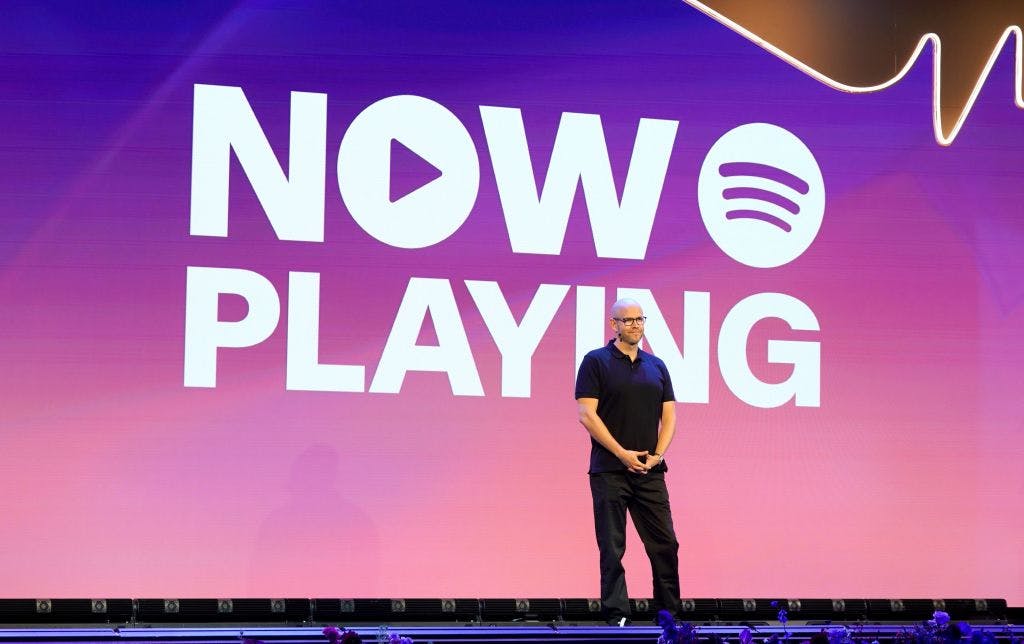
Daniel Ek, cofounder and CEO of Spotify (Presley Ann/Getty Images)

Profits tripled, paid subscribers up 12%, and record Q1 free cash flow — so why is Spotify sinking?

Spotify’s earnings had a lot to like, but near-term “noise” might be dampening investors’ appetite for the music streaming stock.

This morning, Spotify reported that it had 678 million monthly active users at the end of Q1, making 1 in 12 people on earth a user of the green streaming machine.

Paid subscribers to the music platform also rose 12% to some 268 million, helping drive the company’s operating profit to €509 million — more than triple the figure notched in the same quarter a year ago, as the company’s continued focus on profitability nearly makes up for years of consistent losses.

And yet, Spotify’s stock is down sharply in early premarket trading as traders ditch SPOT after comments made by the company’s CEO and a weaker user growth forecast.

In the press release detailing the Q1 results, cofounder Daniel Ek said that “the short term may bring some noise, but we remain confident in the long-term story, and the direction we’re heading in feels clearer than ever.” That comment, coupled with a forecast for monthly active users to hit 689 million in Q2, appears to be enough to shake confidence in the growth story at Spotify. Indeed, Wall Street estimates compiled by FactSet reveal that analysts were expecting Spotify to get to ~695 million monthly active users by the end of Q2.

That may not seem like a huge difference, but Spotify’s guidance implies just 2% MAU growth relative to where things were at the end of last year — a less exciting trajectory than Wall Street had anticipated.

On Monday, Spotify announced that it had already paid out more than $100 million to creators in the first quarter of 2025. Taking a leaf out of the YouTube playbook, Spotify has been doubling down on incentivizing creators to publish on the platform with revenue-sharing agreements.

More details are expected on the earnings conference call at 8 a.m. ET.

More Markets

See all Markets
markets

GameStop jumps in after-hours trading after CEO Ryan Cohen purchases another 500,000 shares

Ryan Cohen is putting his money where his mouth is.

The GameStop CEO bought another 500,000 shares of company stock for $10.8 million on Wednesday, per a filing.

The stock was trading higher on Wednesday thanks to Cohen’s purchase of 500,000 shares for roughly $10.6 million on Tuesday, and extended these gains in the after-hours session on this news.

“The Reporting Person believes that it is essential for the Chief Executive Officer of any public company to purchase shares of such company in the open market with his or her own personal funds in order to further strengthen alignment with stockholders,” per the filing. “The Reporting Person believes that any Chief Executive Officer who fails to do so should be fired.”

Cohen is poised to become even more financially enmeshed with GameStop’s stock and operating performance should shareholders approve a package that would tie his pay completely to ambitious targets for the company’s earnings and market cap.

The CEO now owns about 8.56% of shares outstanding.

markets

AppLovin tumbles; company dismisses negative report as “false, misleading, and nonsensical”

AppLovin managed to finish Tuesday well off its lows after initially getting clobbered in the wake of an incendiary report published by CapitalWatch.

Nonetheless, shares are getting torched on Wednesday, ending down nearly 6%. An AppLovin spokesperson forcefully denied the allegations made by CapitalWatch, which included calling the ad tech firm “the ultimate monument to 21st-century new-type transnational financial crime.”

Per an emailed statement:

We categorically reject the claims made in this report, which is rife with false, misleading, and nonsensical allegations. AppLovin’s public filings transparently disclose our material investments, global operations, and information regarding significant shareholders.

Claims that AppLovin facilitated money laundering or its products are used for unauthorized downloads are patently false. AppLovin functions within a broader ecosystem that includes major app stores, operating systems, and payment providers, and the apps monetized through our platform must be publicly available on the major app stores and subject to their independent review and enforcement. Economically, the money laundering theory is implausible: publishers receive only a portion of advertiser spend, meaning any attempt to launder funds would require forfeiting a substantial share while creating a highly visible, auditable transaction trail across multiple independent companies. Accepting the report’s premise would therefore imply a systemic failure across the broader mobile advertising and app-store ecosystem, for which the report provides no evidence.

Nonetheless, shares are getting torched on Wednesday, ending down nearly 6%. An AppLovin spokesperson forcefully denied the allegations made by CapitalWatch, which included calling the ad tech firm “the ultimate monument to 21st-century new-type transnational financial crime.”

Per an emailed statement:

We categorically reject the claims made in this report, which is rife with false, misleading, and nonsensical allegations. AppLovin’s public filings transparently disclose our material investments, global operations, and information regarding significant shareholders.

Claims that AppLovin facilitated money laundering or its products are used for unauthorized downloads are patently false. AppLovin functions within a broader ecosystem that includes major app stores, operating systems, and payment providers, and the apps monetized through our platform must be publicly available on the major app stores and subject to their independent review and enforcement. Economically, the money laundering theory is implausible: publishers receive only a portion of advertiser spend, meaning any attempt to launder funds would require forfeiting a substantial share while creating a highly visible, auditable transaction trail across multiple independent companies. Accepting the report’s premise would therefore imply a systemic failure across the broader mobile advertising and app-store ecosystem, for which the report provides no evidence.

markets

Intel soars amid retail engagement, analyst chatter

Intel ripped toward a new 52-week high Wednesday, amid a flurry of activity in the options market and a couple of positive analyst assessments ahead of its earnings report due tomorrow.

Shortly after 11 a.m. ET, call options activity was roughly equivalent to the full-day average over the past 10 sessions. Bets on stock swings using call options have become a highly popular retail trade, suggesting that retail investors are getting interested in the shares ahead of the report from the partially nationalized American chip icon.

(That interpretation is buttressed by what we’re seeing on social sentiment-monitoring sites like SwaggyStocks, which at about 11:30 a.m. listed Intel as the fifth-most-mentioned stock on Reddit’s r/WallStreetBets forum over the past 24 hours.)

Wall Street analysts are also chattering about the stock, with RBC and Bernstein Research both writing about it in the last 24 hours.

RBC — which has a “sector perform” (or neutral) rating on Intel — said it expects a “slight beat and largely inline outlook” when the company reports after the close Thursday.

Bernstein’s Intel watchers — who have a “market perform” (also neutral) rating on the stock — seemed a bit more cautious, writing, “Overall numbers going forward still looking high to us. Fundamentals and valuation keep us sidelined.”

Latest Stories

Sherwood Media, LLC produces fresh and unique perspectives on topical financial news and is a fully owned subsidiary of Robinhood Markets, Inc., and any views expressed here do not necessarily reflect the views of any other Robinhood affiliate, including Robinhood Markets, Inc., Robinhood Financial LLC, Robinhood Securities, LLC, Robinhood Crypto, LLC, or Robinhood Money, LLC.