
Markets
President Trump Delivers An Announcement From The Oval Office
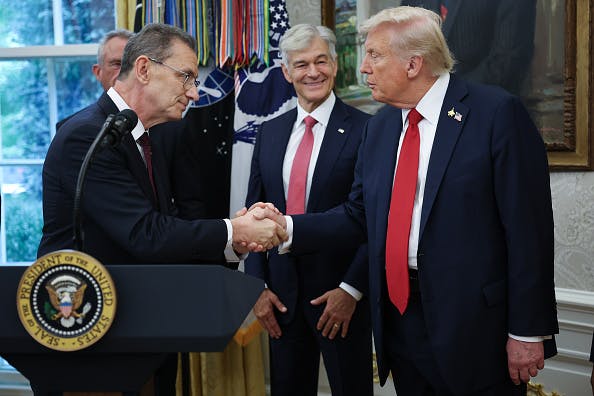
Pfizer CEO Albert Bourla shakes hands with US President Donald Trump on September 30, 2025, in the Oval Office (Win McNamee/Getty Images)

Pharma largely unfazed as Greenland tariffs roil markets

Drugmakers, which have spent the past six months reaching tariff deals with Trump, seem to expect some immunity from a new batch of tariffs on European countries.

President Trump’s threats to slap tariffs on European countries as the US intensifies efforts to acquire Greenland have put the US stock market into panic mode. Drugmakers, which are some of the most valuable companies in Europe, have so far avoided the worst of it. 

Trump said in a Saturday social media post that the US would impose 10% tariffs on eight European countries — Denmark, Norway, Sweden, France, Germany, the United Kingdom, the Netherlands, and Finland — by February 1 unless they reach a deal to allow the purchase of Greenland. That rate would rise to 25% by June 1 if an agreement isn’t reached.

By noon on Tuesday, the first trading day since the proclamation, the S&P 500 had fallen 1.2%. The NYSE Arca Pharmaceutical Index, meanwhile, fell by just 0.5%. 

Drugmakers — many of them European, such as Novo Nordisk, or with a large manufacturing presence in the continent, such as Eli Lilly — spent the latter half of 2025 striking deals with the Trump administration that make them immune to tariffs, usually in exchange for a mix of commitments to lower drug prices and invest in the US. 

Novartis CEO Vas Narasimhan told CNBC on Monday that he expects the company’s deal with the administration, announced last month, to protect it from tariffs. Either way, by the middle of the year he expects the company to have fully domestic manufacturing for its US market. 

“We also have an agreement with the US government that excludes us from any tariffs we think, but in case that were not to be the case, we’re also future-proofed in the other direction as well,” Narasimhan told the network at the World Economic Forum.

European countries predominantly export branded drugs, which are of higher dollar value but represent a smaller proportion of prescription drugs compared to generics, which are often produced in Asia. They also represent the most expensive drugs Americans pay for, as the administration shifts its domestic policy focus toward reducing the cost of living. 

Diederik Stadig, an economist at European bank ING, said that while it’s difficult to know without details from the White House, he expects the deals reached with drugmakers to hold up. 

“The deals he has struck with pharma companies mean that [Trump] gets his wish: they have committed to manufacturing and investing more in the US and will be exempt from tariffs in exchange,” he said. “I would therefore doubt that this 10% would apply to pharmaceutical companies that struck a deal with Trump.”


If the 10% tariffs do apply to pharmaceuticals, the hardest-hit countries would be Germany, the Netherlands, and the UK, Stadig noted. Still, the tariff rate on paper is typically much higher than the effective tariff rate “because this administration has instituted tariffs but not invested in enforcement.”

“The more specific tariffs are, the harder they are to enforce,” he said.

More Markets

See all Markets
markets

POET Technologies nears multiyear high on strong call demand after flagship product wins award

POET Technologies is surging on heavy volumes and high call demand after announcing that it won a Product Innovation Award at China’s Infostone awards.

The honor went to the optical communications company’s flagship product, the Teralight, which uses light to move data between chips.

“Unveiled less than a year ago at the 2025 OFC Conference, POET Teralight has driven commercial interest in the Company because of its highly integrated design and complete optical system-on-chip architecture that simplifies module development,” per the press release.

This award may be the latest excuse to buy the stock, which is up over 40% year to date.

Call activity is elevated, with nearly 37,000 having changed hands as of 10:55 a.m. ET, well above the 20-day average of 28,030 for a full session. Shares are approaching their multi-year high of $9.41.

markets

Intel bucks market slump after Wall Street upgrades

While the market slid early Tuesday, Intel soared as the American chipmaker received a pair of upgrades:

  • HSBC analysts lifted their rating on the stock to “hold” — essentially “neutral” — from “reduce,” Wall Street-speak for “sell.” The analysts nearly doubled their price target for the shares to $50 from $26. (That’s essentially where the stock is currently trading.)

  • Seaport Global also boosted its rating to “buy” from “neutral,” with a $65 price target.

Improving demand for CPUs — Intel’s bread-and-butter processors — is behind HSBC’s newfound enthusiasm for the shares. Analysts at the bank wrote:

“We had been cautious on Intel mainly given overall uncertainty on customer pipeline and execution headwinds in their foundry business while the core business was also lacking visibility on growth drivers. However, we now turn more positive as we expect the traditional servers (DCAI) to get back on a growth trajectory. We expect there is an overwhelmingly increasing demand for server CPUs driven by rising agentic AI... While the stock has moved up 19% YTD (vs S&P 500 up 1%), we believe there is further [data center and AI group] upside still not fully priced in. Hence, we upgrade Intel from Reduce to Hold.”

HSBC seems to be slightly understating the extent of the gains for the stock so far in 2026, as its share price has risen nearly 30% since the end of last year. But the gains are even more impressive if you date them to the partial nationalization of the ailing American chip giant, which was announced on August 22. Almost a month later, Nvidia announced a strategic partnership with the company, giving it a massive shot in the arm. Since then the stock is up more than 90%.

markets

ImmunityBio surge continues on sign its drug may be approved to treat a broader range of bladder cancers

Once you start squeezing, you can’t put the toothpaste back in the tube.

Shares of ImmnuityBio are flying higher once again, up more than 30% in early trading Tuesday after having been down as much as 10% in the premarket. A little more than half an hour into the regular trading day, more than 46 million shares have changed hands, more than 3x the 20-day average for this point in the session.

Last week, we discussed how a number of positive press releases from the company touting the progress of its treatments helped send shares skyward, making the heavily shorted company a hot topic of discussion on the r/ShortSqueeze subreddit.

The positive press parade continues this morning, with ImmunityBio announcing that the FDA asked for more information about the ability of its ANKTIVA drug to treat a certain type of bladder cancer, though it doesn’t need to do any new clinical trials. Management said they would provide this information within 30 days.

Share are up nearly 200% over the past six sessions.

On Monday, the company published a podcast appearance by Dr. Patrick Soon-Shiong, founder, executive chairman, and global chief medical and technology officer, on “The Sean Spicer Show,” which was provocatively titled, “Is the FDA BLOCKING Life Saving Cancer Treatments?”

markets

AppLovin craters after report from CapitalWatch alleges it’s a money-laundering operation for “transnational criminal kingpins”

AppLovin is tumbling in premarket trading on Tuesday after financial research agency CapitalWatch published a report on Monday calling the company “the ultimate monument to 21st-century new-type transnational financial crime.”

“AppLovin serves as the ultimate exit for asset laundering/diversion by transnational criminal kingpins,” the authors wrote, alleging that the growth of its advertising business comes in part from illicit cryptocurrency funds routed through its platform.

AppLovin did not immediately respond to a request for comment from Sherwood News.

This is far from the first report to question AppLovin’s business practices.

Fuzzy Panda Research and Culper Research announced short positions in the ad tech firm last February in research reports alleging that AppLovin’s operating performance was a function of “systematic exploitation of app permissions” as well as taking data and gaming the ad platforms of other tech giants, particularly Meta. In October, reports surfaced that the SEC was investigating AppLovin’s data collection practices, as were a number of state regulators.

The allegations raised by CapitalWatch are a whole different kettle of illegal fish.

Anything is possible. But if I were hypothetically trying to launder a bunch of money, I likely would not try to do so through a publicly traded entity domiciled in the United States that’s subject to much more regulatory oversight and scrutiny than the average global firm.

Latest Stories

Sherwood Media, LLC produces fresh and unique perspectives on topical financial news and is a fully owned subsidiary of Robinhood Markets, Inc., and any views expressed here do not necessarily reflect the views of any other Robinhood affiliate, including Robinhood Markets, Inc., Robinhood Financial LLC, Robinhood Securities, LLC, Robinhood Crypto, LLC, or Robinhood Money, LLC.
