

Inside Pfizer’s reset
Pfizer’s CFO on building a post-Covid future and how it won the fight for Metsera
In an exclusive interview, Pfizer’s Dave Denton explains how 2025 became a “watershed” moment for the pharmaceutical giant.
Pfizer is trying to prove it can grow again.
After a year of cost-cutting and strategic deals, the drugmaker’s $10 billion purchase of Metsera is just one part of a larger reset, CFO Dave Denton told Sherwood News in an interview.
The pharmaceutical giant is working to reignite growth after demand for its COVID-19 products has waned and as some of its biggest moneymakers get nearer to the end of their patents’ lives. It’s betting on growth in cancer treatments and staking its future in the booming obesity market with the Metsera acquisition — a deal that GLP-1 incumbent Novo Nordisk attempted, but failed, to intercept.
“I feel like 2025 was a watershed moment where we set our pathway forward,” Denton said.
Denton, who joined Pfizer in 2022, said the company still has an appetite for smaller, targeted acquisitions. As Pfizer brings new products to market, they could face a new pricing regime shaped by pressure from the Trump administration.
In a conversation with Sherwood, Denton discussed how the Metsera deal fits into Pfizer’s broader push beyond Covid-era products, drug pricing, how AI can aid drug discovery, and why he believes the company’s future growth will depend as much on smart dealmaking as on internal research.
This interview has been edited for clarity and length.
Sherwood News: Let’s start with Metsera. Now that the deal is completed, what’s the first thing you want investors to understand about what Pfizer has here?
Dave Denton: Before I get into that specifically, let me step back and talk about Pfizer in general for a moment, and then I’ll come back to obesity and the Metsera transaction. If you look at 2025, it was a really interesting and important year for us.
First, we reorganized and promoted Chris Boshoff to lead research and development. R&D is the lifeblood of any big pharma company, and he put in place a structure focused on four therapeutic areas: Immunology & Inflammation, internal medicine, vaccines, and oncology. The Metsera transaction fits squarely within internal medicine.
Second, we rightsized the organization to focus on productivity and efficiency. By the end of this year, we will have taken out about $4.5 billion in costs on the way to $7.7 billion.
And third, we executed two important business development transactions — one in oncology with 3SBio and the other in obesity with Metsera. I feel like 2025 was a watershed moment where we set our pathway forward. Over the next several years, we have products losing patent protection, but we’re squarely focused on driving new growth by 2029 and 2030.
Specifically on Metsera, we spent almost a year looking across the landscape of obesity assets before determining Metsera was the asset for us. It’s a portfolio of mid- and early-stage obesity assets — both GLP-1s and amylins — and potentially combinations of both.
There are three reasons why I think Pfizer has the right to win in this space: one, we have comprehensive manufacturing capacity, both in the US and abroad, that can immediately plug these products into our infrastructure without tremendous investments. Secondly, we have a world-class primary care field force globally that we can leverage. Third, our R&D and science have been well rounded in cardiometabolic areas.
What we didn’t have was a set of products. Metsera brings to us a set of products where we can compete in a growing marketplace and leverage the assets that we have within Pfizer to be successful. We’re especially excited about the potential for a monthly GLP-1 product, which could really differentiate us.
Sherwood: You mentioned R&D being the lifeblood of pharma, but two of the main milestones this year were acquisitions. It feels like across the industry, the cost base is moving from R&D to M&A. Would you say that’s structurally true?
Denton: I’d say it’s partially true. This year we’ve spent about $11.5 billion on external business development; we’re going to spend around $11 billion on internal R&D. It’s balanced. The deals get a lot of airtime, but people sometimes forget that we have roughly 110 internal projects in our pipeline, progressing from preclinical through Phase 3 trials. We have a big, robust lifeblood of internal R&D as well.
Sherwood: You said Pfizer spent about a year looking at GLP-1 companies. Was that search accelerated after April, when Pfizer discontinued its own oral GLP-1 pill trials?
Denton: For sure, but even before that we were aggressively looking at the marketplace. In big franchises like obesity, not one product will typically carry the weight. This market is going to be large and complicated, and there’s going to be segmentations within the market for different patient needs. You can see that with Eli Lilly and Novo Nordisk — they’re both building portfolios, not just single products. We intend to do the same.
Sherwood: Can you walk me through what happened when you found out Novo Nordisk put in a new bid after September?
Denton: We had the right to match under our agreement with Metsera. We really liked the asset and were willing to pay more for it — still within a range where we see a very high return if the products are successful. We were a little surprised, frankly, because Novo as an incumbent has overlap issues from a trade commission standpoint. We also thought their interest in buying essentially replacement products for their existing portfolio was unexpected. Once we learned of their bid, we quickly pulled together our deal team, assessed how to counter, and spent about two weeks going back and forth before finally securing the asset.
Sherwood: Pfizer disclosed a $6 billion bond issuance to help fund the deal. Can you describe Pfizer’s debt position right now, and how you decide when to use debt versus equity to finance deals?
Denton: From a capital structure perspective, our indebtedness peaked after the Seagen acquisition at a little over 4x leverage. We’ve been very focused on improving business performance and cash flow, such that we have de-levered down to about 2.7x. Now we issued a bit of debt to compensate for raised cash needed to support the Metsera transaction, so leverage will tick up a bit, probably into the 2.8x to 2.9x area.
When we do business development, we prefer to use cash or leverage in the balance sheet because we do have some capacity there. We will work to always try to do that versus issuing equity unless we really need to.
Sherwood: After this wave of deals, does Pfizer still have an appetite for another acquisition?
Denton: We still have some appetite. When I entered 2025, I thought I had about $15 billion of firepower earmarked for business development. I’m now down to probably having $5 billion or $6 billion, so I’m probably at a point where I’m not doing as much going into 2026. We’ll continue to be very selective and very focused in our business development work.
Sherwood: If you had to choose, would you look more at oncology next, or do you think that there’s still room for growth in your GLP-1 portfolio?
Denton: There’s opportunity in both areas. In oncology, we have a very rich pipeline and we’re adding opportunistically where we see a nice fit. With Metsera and what we have in our internal medicine pipeline, we’re pretty well set. Could we add some smaller, more niche assets? Absolutely, but those would be targeted rather than large acquisitions.
In vaccines, we have a strong internal engine for development, and the external landscape is pretty thin — there aren’t many opportunities out there — so we don’t expect to do much in that space.
In I&I, though, we have two promising tri-specific assets in our pipeline, and I think we need more there. That’s where we’d likely look to supplement through business development over time.
Sherwood: Where do you see Metsera’s pricing landing once those products hit the market? The two incumbents have high list prices with lower cash-pay prices.
Denton: When we contemplated entering obesity — even with our internal programs — we expected it to be a large but very competitive market, because you have two large incumbents but a lot of investment surrounding this space. We expected that prices were going to go down. The prices that have been discussed recently between the president and both Novo and Lilly have been informative to the market and largely in line with our expectations.
This will be a price-sensitive market. We also think there will be a component of the market that will be insurance-led and a part of the market that’s consumer-led.
Sherwood: It’s going to be a crowded market, but one leg up you see for Metsera’s product is that it’s potentially once a month versus weekly?
Denton: Correct. It's going to be a competitive market in the fact that Pfizer has played in these markets before and we’ve played the direct-to-consumer game, and we understand the consumer dynamics as well as the large field force and infrastructure that we have in place. I think that will allow us to be a really formidable competitor in this area.
That will be good for patients. More competition drives prices down and expands the reach of products.
Sherwood: Pfizer was also the first company to reach a pricing agreement with the Trump administration. From your perspective, what’s the main driver of high US drug costs — pharmacy benefit management, distribution markups, or R&D — and does that deal meaningfully address it?
Denton: I think it does over time. The issue is that there are middlemen between us and the consumer, and those middlemen are rewarded for higher prices. The higher the list price, the greater the rebate yield they can generate — and the more of that rebate they can either keep or pass along to their clients. That structure incentivizes higher prices. Taking that pressure point out of the system would be helpful, at least from a rebate perspective.
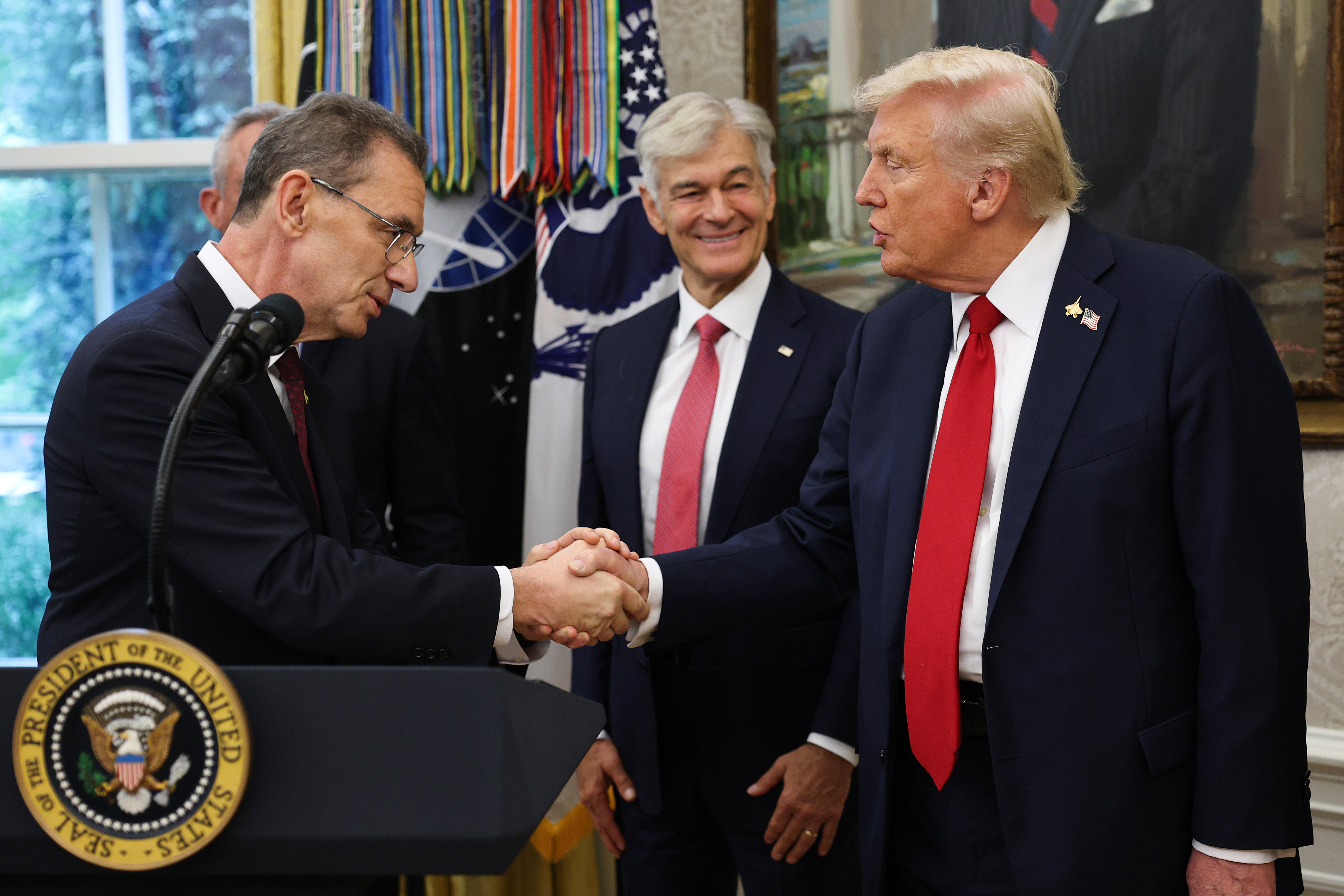
The deal Pfizer and CEO Albert Bourla led with the president at least sets the framework for how US and non-US pricing can get more equalized over time. We agreed to most-favored-nation pricing in Medicaid but, importantly, to an MFN structure for all newly launched products. What that means, in essence, is that US prices will be informed by the prices that are set in international markets.
No longer can a company launch a product overseas — say in the UK or Europe — at a fraction of the US price without the US price being tainted by that. That should put pressure on other governments to pay their fair share, over time. It’s early days, but the infrastructure for this change has been laid out. The idea is that countries will gradually adjust as new products launch, rather than by raising prices across all existing drugs at once.
Sherwood: We’ve seen companies like Novo and Lilly cut prices by selling directly to consumers. But that doesn’t seem practical for many hospital-administered drugs like oncology treatments. Are there limits to cutting out the middlemen?
Denton: Absolutely. For some drugs and some categories, direct-to-consumer marketing makes a lot of sense; for others, it doesn’t. The oncology market, for example, is very physician-led. If you have cancer, you rely on your doctor to determine which treatment best suits your needs. That’s different from, say, making sure patients know there’s a drug for migraines like Nurtec, or a vaccine they should get for Covid. All of those are direct-to-consumer campaigns that I think are very impactful to the consumer and appropriate versus maybe the oncology drugs.
Sherwood: On MFN pricing, how do you ensure this doesn’t just result in prices rising in Europe rather than falling in the US?
Denton: What we’re trying to do is a balance between all of that. We’ll have to work hard to make sure that we launch in the US appropriately, but also ensure that European countries follow along at GDP-adjusted level. So, ultimately, the pressure will be to get European prices up while putting pressure on the US prices down, so we can meet in the middle there. And I think the groundwork for that has been laid down.
Sherwood: In May you struck a licensing deal with 3SBio, a Chinese biotech firm. There’s growing enthusiasm for Chinese biotech but also rising geopolitical tension. How do you balance those forces?
Denton: It’s not the first time that’s been the case. We’ve been in China for 20 years, and we’ve been navigating up and down different pressure points over that time.
I think we just have to make sure that at the end of the day, we’re solving patients’ needs. And whether we’re solving patients’ needs in China or more globally, if we can always keep that the center of our focus, I think that’s job one. Two is just being very transparent with the administrations on both sides of the ledger, whether it be US or China, to understand what we’re doing and how we’re operating, and being good business partners to both of them.
If we stay true to that and true to our mission, I think we can solve these political ups and downs over time.
Sherwood: One of your peers, Eli Lilly, just hit a $1 trillion valuation, even as AI dominates headlines. Do you think Wall Street is gravitating back toward pharmaceuticals?
Denton: I think we’re starting to see that rotation. For the past six or eight months, the pharma sector has had a big policy overhang — uncertainty about pricing and tariffs.
Now some of the risk associated with that government policy is in the rearview mirror, as Big Pharma companies continue to come through the White House and come up with agreements with the administration. I think that risk is being put to the side a little bit, and now you’re seeing funds that over the last year or so have been hesitant to put money into the sector now thinking pharma is a safer bet, given that that risk and overhang is now behind us.
Sherwood: Still, pharma has underperformed the broader market for years. Are there other overhangs?
Denton: Yes. Aside from Novo and Lilly, many companies face significant patent expirations. Investors couldn’t see how those gaps would be filled.
And many of us have been trying to solve for that headwind going into the back half of the decade. It was uncertain how people were going to solve for that. Fortunately for us, I think we’ve now solved that through an enriched pipeline, in our business development work, but we solved it for ’29 and ’30. Others in the marketplace are still trying to solve for their growth algorithms in the out years.
When you can’t see growth or you can’t see how these products are going to be replaced over time, it gives the investors pause. And I think that pause kind of filtered with the policy risk onto all of pharma, for the most part.
Sherwood: Many retail investors discovered Pfizer during the pandemic. Now that Covid products are a smaller part of the portfolio, what should they know about Pfizer today?
Denton: Pfizer is investing for growth through the end of the decade. We have a rich pipeline across oncology, internal medicine, I&I, and vaccines. Profitability and cash flow are improving. We pay a very high dividend, so retail investors can be rewarded from both yield and upside as our portfolio matures.
Sherwood: Last question — is there something another company, either in your sector or elsewhere, is doing that’s caught your eye?
Denton: I think we’re on the cusp of AI allowing the biopharma sector to improve dramatically, though we’re still in the early stages of that. The good news is that companies like ours, which have been in this business a long time, have a really rich history of data. Think about it — the clinical trials or lab tests that produce positive results all get published, so there’s no secret sauce there. But we’ve also run hundreds of thousands of trials and tests that didn’t produce positive outcomes. Embedded in all that is a kernel of knowledge and information.
If we can leverage the data we already have within our infrastructure, I’m sure we can identify new drugs. A good example: about 20 years ago, Pfizer had its own GLP-1. I bet, somewhere in those clinical trial results, it probably showed that one of the side effects was that people lost weight. That would’ve been really interesting to know. And now, 15 or 20 years later, we’re in a completely different place. So I think using data and applying new technology to it will be the next generation of improvement in our sector.
More in our Final Boss series of exec interviews:
Lyft’s CEO on the economics of robotaxis, how to end surge pricing, and reviving his company
How CEO Jason Wilk took Dave Inc. from near disaster to one of 2024’s top performers
Frank Holmes, executive chairman of HIVE Digital Technologies, on the overlap between bitcoin and AI
Upstart Holdings CEO Dave Girouard on the rise of the AI lender
A talk with Charlie Youakim, CEO of the stock market’s favorite buy now, pay later company, Sezzle




