
Markets
Palantir tumbles after delivering spectacular results
(Roy Rochlin/Getty Images)

Palantir’s exceptional earnings receive ugly reaction

The valuation agita hitting high-flying stocks overshadowed the AI and intelligence software company’s blowout quarterly update.

Palantir dove Tuesday as an outbreak of investor anxiety over sky-high valuations overshadowed an objectively stellar quarter for the software giant.

Palantir trounced Q3 expectations and sharply raised its full-year guidance when it reported on Monday, as sales growth accelerated, gross profit margins expanded, and cash coursed into its coffers.

Even so, the stock stumbled badly, dropping nearly 10% soon after the start of trading in New York, though the bleeding has slowed a little since then.

“Palantir’s results were impressive by any measure and exceeded any expectation. If shares go lower today, that would be a reflection on AI trade fatigue, not the company’s performance,” said Gil Luria, head of technology research at brokerage DA Davidson & Co.

It’s true that high-flying AI stocks are having a particularly bad day on Tuesday.

Goldman Sachs’ TMT AI basket of themed stocks — of which Palantir is a member — was down 1.9% recently, with its heaviest weighting, bellwether Nvidia, down more than 2%.

IT hardware stocks like Seagate Technology Holdings, Western Digital, and Micron, which have risen on the prospect of seemingly endless demand from AI data centers and have become some of the best performers in the S&P 500 so far this year, were also down, as were AI-linked energy plays like Oklo, Bloom Energy, and Vistra.

A cascade of warnings from high-profile figures seems partly to blame for the outbreak of jitters. Michael Burry, of “The Big Short” fame, unveiled a massive options-based bet against Nvidia and Palantir. Separately, the CEOs of Goldman Sachs and Morgan Stanley have both warned of the potential for a drawdown in the market given high-altitude valuations.

Exhibits include: an S&P 500 forward price-to-earnings multiple that’s regularly topping 23x. A market-to-GDP ratio, the so-called Buffett Indicator, at an all-time high. And a CAPE ratio (a longer-term version of price-to-earnings ratios) that is at levels unseen except for the daffiest days of the late 1990s dot-com mania.

To be clear, it might not be the case that valuations are the problem here. It may just be that the market — and particularly Palantir, which closed at a record high yesterday and is still up more than 150% for the year — needs a bit of a breather.

On the other hand, if valuations are suddenly becoming a fixation for investors — and there’s no guarantee that they are — it could be a problem for Palantir, which remains the most richly valued stock in the S&P 500, looking quite unhinged.

For example, the company had a forward price-to-sales ratio of more than 90x at the close of New York trading yesterday. After the early plunge Tuesday, it was around 78x. (The index is at 3.3x).

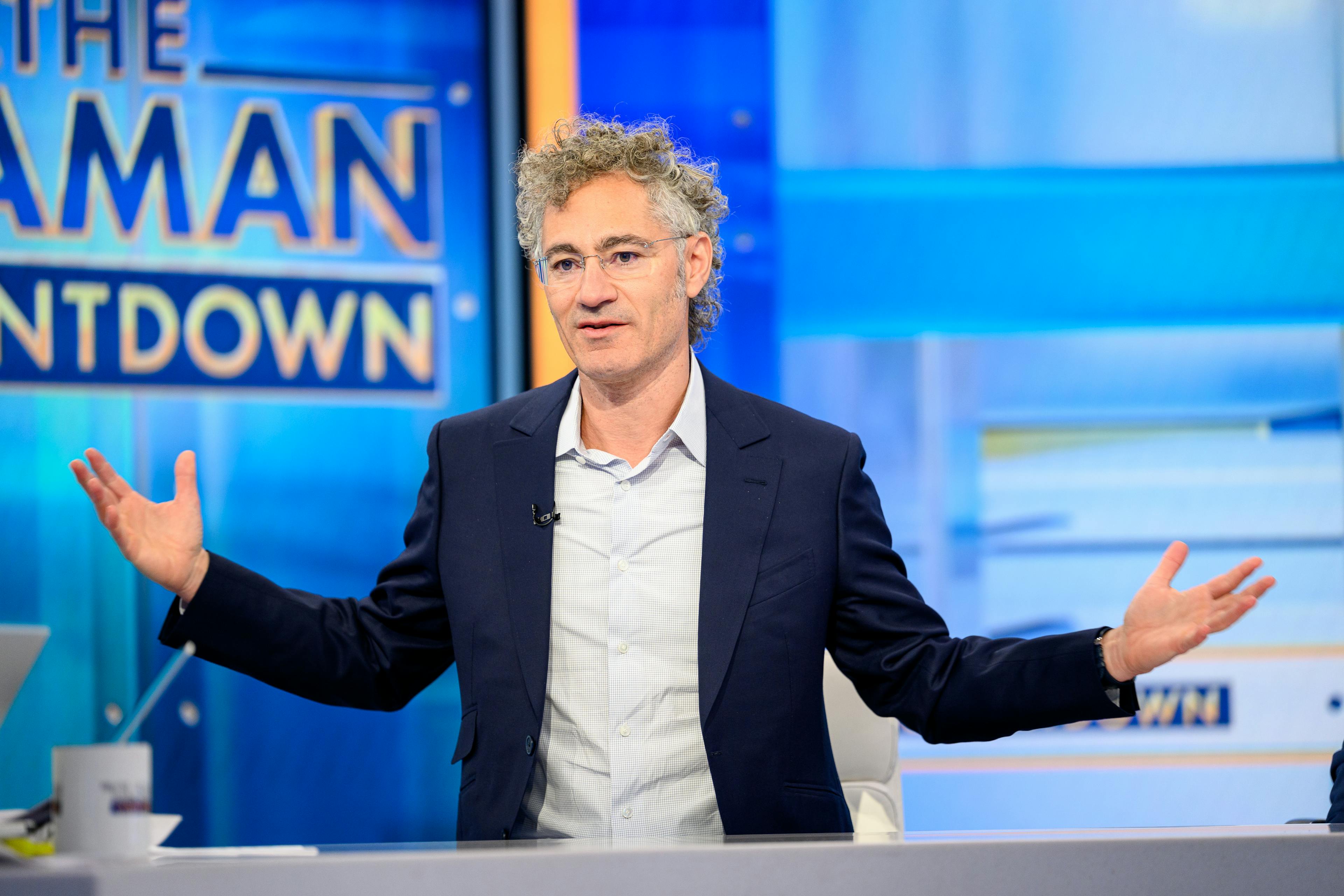
Such valuations are testament to the showmanship of CEO Alex Karp, whose brash approach created an army of retail shareholders willing to shrug off traditional rules of thumb as the share price climbed and created hundreds of billions of equity wealth.

But such high valuations also represent a big disconnect between the company’s performance and its stock price, analysts say, which could make for interesting days to come.

“At these very high valuations, shares of PLTR are likely to continue to be volatile,” said Luria of DA Davidson, adding, “regardless of the strong fundamental performance.” Luria has a “neutral” rating on the stock with a price target of $215.

More Markets

See all Markets
markets

Southwest reports lower-than-expected Q1 earnings and revenue, declines to offer full-year profit update

Southwest Airlines reported its first-quarter earnings after the bell on Wednesday. Its shares fell more than 6% in after-hours trading.

For the first quarter, Southwest reported:

  • Adjusted earnings of $0.45 per share, compared to the $0.47 per share expected by Wall Street analysts polled by Factset.

  • Revenue of $7.25 billion, compared to estimates of $7.27 billion.

The carrier guided for adjusted earnings of between $0.35 and $0.65 per share for its second quarter, a range whose midpoint is below analyst estimates of $0.53 per share. Regarding its full-year 2026 earnings estimate of “at least” $4 per share, Southwest declined to give an update “given the ongoing macroeconomic uncertainty.”

“Achieving this outcome would require lower fuel prices and/or stronger revenue performance to offset higher fuel expense,” Southwest said.

Southwest introduced bag fees last year, ending a more than five-decade-long “bags fly free” policy. Earlier this month, less than a year after the change, it joined its major US rivals in hiking its bag fees by $10 amid surging jet fuel prices.

Southwest, which discontinued its fuel-hedging program last year, said it spent $1.36 billion on fuel and related taxes in the first quarter, up 8.6% year over year.

markets

ServiceNow dives after reporting sequential decline in profit margins

Cloud software giant ServiceNow — which has been something of a poster child for the AI-related software sell-off — saw its shares fall sharply after delivering Q1 results that included a quarter-on-quarter decline in profit margins.

The company reported:

  • Revenue of $3.77 billion, higher than the $3.75 billion analyst consensus estimate published by FactSet.

  • Diluted adjusted earnings of $0.97 per share, on point with the $0.97 analysts had expected.

  • Subscription revenue of $3.67 billion vs. the $3.65 billion predicted.

  • Non-GAAP gross margins of 79.5%, down from 80.5% in Q4.

ServiceNow issued guidance for Q2 subscription revenues of between $3.815 billion and $3.820 billion, compared to the $3.75 billion FactSet consensus estimate.

ServiceNow shares have been at the epicenter of the software sell-off driven by the fear that such companies are at risk of being rendered obsolete by AI. The stock was down 33% for the year through the end of the New York trading session on Wednesday.

markets

IBM falls despite posting better-than-expected Q1 results

Big Blue fell in after-hours trading despite reporting better-than-expected Q1 results, as it didn’t include in the release an internal metric it typically discloses to track the progress of its AI business. IBM reported: 

  • Q1 revenue of $15.92 billion vs. the $15.63 billion FactSet consensus estimate.

  • Adjusted earnings per share of $1.91 vs. the $1.81 consensus expectation.

  • Sales of $7.05 billion at its key, high-margin software segment vs. a $6.98 billion consensus of nine analyst estimates.

  • Sales of $3.33 billion in its infrastructure unit, which houses its growing AI mainframe business, vs. a $3.13 billion consensus estimate.

Unlike recent earnings statements, the company made no mention of an internal metric it used to track its progress in AI, which it called its “generative AI book of business.” That metric stood at $12.5 billion at the end of 2025, per the company.

The infrastructure business is of acute interest to the market, after AI giant Anthropic announced in February that Claude Code could efficiently modernize code bases in the COBOL programming language, which serves as a cornerstone of IBM’s enterprise mainframe business. The language is still widely used in certain industries, such as airlines and finance. (ATMs, for instance, run almost entirely on COBOL.) 

Anthropic’s COBOL announcement cut the legs out from under IBM. The stock plunged 13% on February 23, the day of the announcement — its worst daily drop in more than 25 years. And it was down roughly 15% for the year through the end of trading Wednesday.

Latest Stories

Sherwood Media, LLC produces fresh and unique perspectives on topical financial news and is a fully owned subsidiary of Robinhood Markets, Inc., and any views expressed here do not necessarily reflect the views of any other Robinhood affiliate, including Robinhood Markets, Inc., Robinhood Financial LLC, Robinhood Securities, LLC, Robinhood Crypto, LLC, Robinhood Derivatives, LLC, or Robinhood Money, LLC. Futures and event contracts are offered through Robinhood Derivatives, LLC.

