

Markets
Man Looking at His Watch
(Getty Images)

Older Americans haven’t returned to work — and they may stay out longer

Millions left the job market early during Covid. That surge has normalized, but the 55 and older group isn’t coming back.

The pandemic scrambled the US labor market in countless ways — from empty offices to the work-from-home shift — but one of the stickiest changes might be the exodus of workers. In early 2020, the labor force participation rate (the share of workers and job seekers out of the total working age population) plunged to a 50-year low, and still hasnt fully recovered to prepandemic levels.

Many workers, across all age groups, left the job market during Covid, whether from health concerns, childcare hurdles, or sheer burnout. But one cohort in particular hasn’t returned to the workforce like others: older Americans.

According to the St. Louis Fed’s analysis, prime-age workers (aged 25-54) have fully bounced back, with their participation rate now even higher than prepandemic levels. Those 55 and older, however, remain about 2 percentage points below their pre-Covid participation rate.

The Great Retirement Boom

Older Americans’ mass exit was first triggered by what economists call “excess retirements.” Over 2 million extra retirees left the workforce during 2020-22, above what demographic trends would have predicted — accounting for more than half of the rise in total retirements during those years, according to Federal Reserve Board researchers.

Many of those early exits came from lower-income workers pushed out by job losses, who ended up relying on expanded unemployment benefits and stimulus checks. At the other end of the spectrum, wealthier baby boomers rode the 2020-21 asset boom — stocks surged and home values jumped nearly 20% — giving many the means to match their mindset to retire sooner.

In fact, however, “excess retirements” had faded by early 2025 toward more normal levels. But broader demographic trends are now the drag: nearly a third of the 55 and older workforce is now 65 or older, as boomers are aging into retirement en masse — while the younger population isn’t growing fast enough to offset it.
2025-08-27-LFPR
Sherwood News

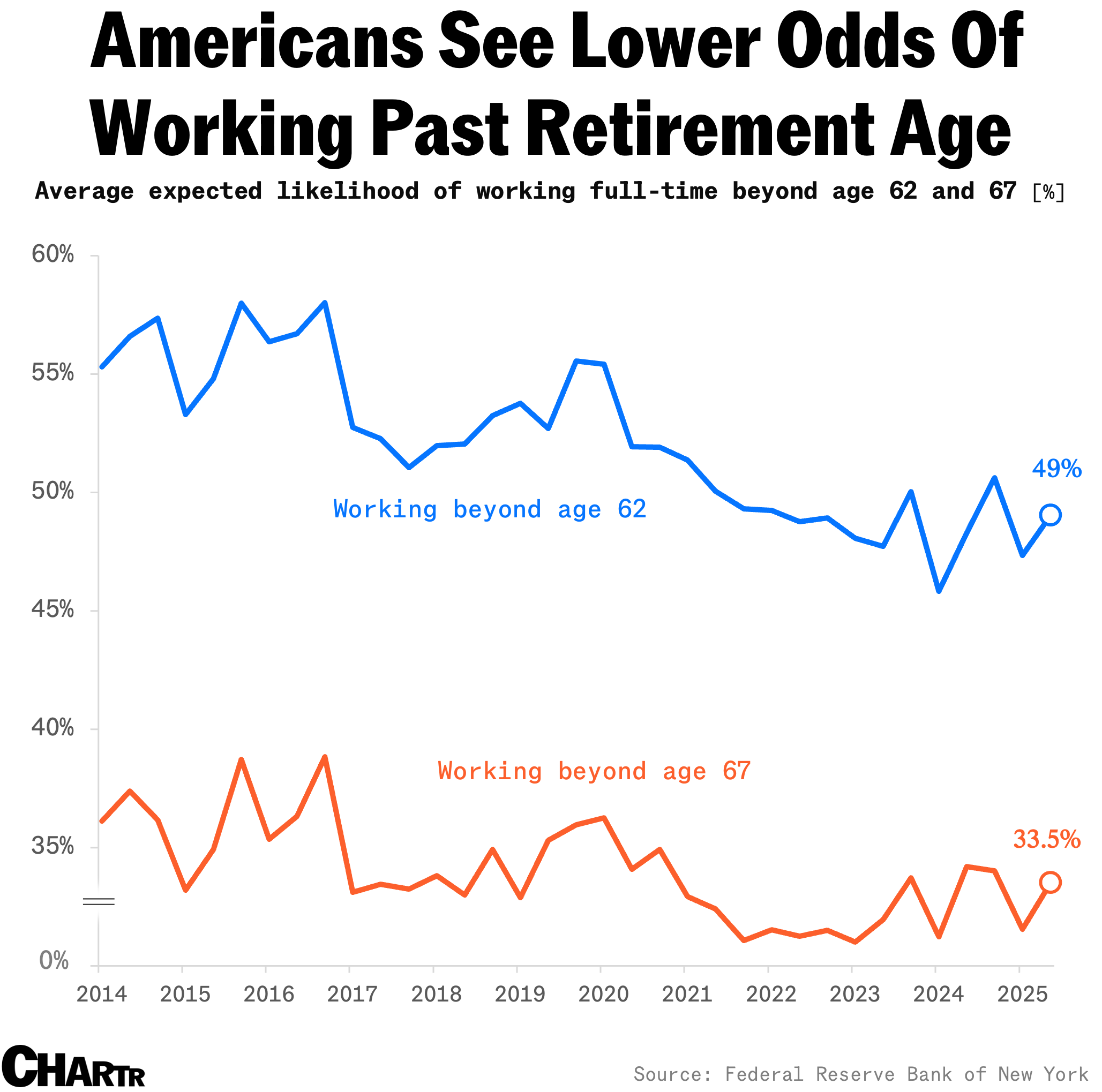
The shift isn’t just pandemic-driven: it’s been building gently for years. The latest New York Fed survey shows Americans’ expectations of working full-time past 62 have fallen from 55% in mid-2015 to 49% in mid-2025. While the reasons aren’t clear — it could be wealth effects, part-time preferences, or simply a rethink of work — the line has been bending lower for at least the past decade.

More Markets

See all Markets
markets

Boeing reports better-than-expected Q1 earnings, revenue

Plane maker Boeing reported its first-quarter earnings before the market opened on Wednesday. Its shares climbed more than 3% in premarket trading.

For Q1, Boeing reported:

  • An adjusted loss of $0.20 per share, compared to the loss of $0.68 per share expected by Wall Street analysts polled by FactSet.

  • Revenue of $22.22 billion, compared to estimates of $21.85 billion.

Boeing reported -$1.45 billion in free cash flow in Q1, compared to the -$2.34 billion expected by Wall Street. Prior to Wednesday, Boeing had reported two consecutive quarters of positive FCF following six straight quarters of negative results. The company is still guiding for full-year FCF of between $1 billion and $3 billion.

Earlier this month, Boeing announced it had delivered 143 commercial jets in Q1, up 10% from the same period last year and ahead of rival Airbus, which delivered 114. This was Boeing’s first time outdelivering Airbus since 2018.

markets

GE Vernova, top AI energy play, rises after Q1 report

GE Vernova, a maker of power plant equipment that’s seen orders tied to data centers surge, rose early Wednesday after posting strong Q1 results and lifting full-year sales guidance. The GE spin-off reported:

  • Adjusted EBITDA of $896 million vs. the $772 million estimate from analysts polled by FactSet.

  • Total revenue of $9.34 billion vs. the $9.25 billion consensus expectation from analysts polled by FactSet.

  • Full-year 2026 sales guidance that was lifted to between $44.5 billion and $45.5 billion from prior guidance of between $44 billion and $45 billion, vs. the consensus estimate of $44.64 billion.

“In the quarter, our electrification segment booked $2.4 billion in equipment orders to support data centers, more than all of last year,” said CEO Scott Strazik.

GE Vernova is up some 600% over the last two years through Tuesday’s close, but the majority of those gains were booked by August 2025. After being largely range-bound for months, the stock busted out following the company’s last earnings report, lifting the shares up nearly 50% in 2026.

markets

Vertiv drops after offering uninspiring Q2 guidance, overshadowing solid Q1 beat

Shares of Vertiv Holdings dropped as much as ~6% in early trading on Wednesday after the data center equipment maker’s better-than-expected Q1 numbers were overshadowed by uninspiring guidance.

For the quarter ended March 31, 2026, Vertiv reported:  

  • Q1 adjusted earnings per share of $1.17 vs. the $1.00 consensus expectation from analysts surveyed by FactSet.

  • Sales of $2.65 billion vs. the $2.64 billion expectation (compiled by FactSet).

For Q2, Vertiv expects adjusted earnings per share of between $1.37 and $1.43, coming in below the $1.43 consensus estimate at its midpoint. It guided for net sales of $3.25 billion to $3.45 billion in Q2, compared to Wall Street’s call for $3.40 billion.

Vertiv, which listed in February 2020 as a result of GS Acquisition Holdings Corp., a so-called blank check company, merging with private equity-owned Vertiv Holdings, has soared over 300% over the last year through Tuesday’s close, as investors have rushed to snap up shares of companies poised to collect some of the hundreds of billions of dollars in spending that the hyperscalers are pouring into the data center build-out. 

markets

Adobe rises on $25 billion stock buyback

Adobe was up as much as 3.5% in early trading on Wednesday after the company announced a share repurchase plan worth up to $25 billion, signaling to investors that company management sees retiring shares as a prudent use of capital at these levels. The stock has been down more than 60% since February 2024, largely on concerns that AI tools will disrupt the company’s business.

The new authorization, which Adobe detailed will extend through April 30, 2030, “is a direct expression of confidence in our robust cash flow and the long-term value we are delivering to investors,” CFO Dan Durn said in a press release.

Indeed, fears that new agentic models could affect demand compounded when Anthropic unveiled Claude Design last week, sending the company’s shares down on the announcement. Adobe released a series of AI-enabled customer service functions shortly after. Rival Figma, which Adobe was set to acquire before the deal was blocked by regulators, has also been under pressure.

Adobe is also not the only spooked software company proposing new buyback plans to bring investors back, joining Salesforce, which actually issued debt to buy back shares in a program of the same size ($25 billion).

markets

United beats Q1 earnings and revenue estimates, lowers full-year profit guidance amid surging jet fuel prices

United Airlines reported its first-quarter earnings results after the bell on Tuesday. The carrier’s shares ticked down in after-hours trading.

For Q1, United reported:

  • Adjusted earnings of $1.19 per share, compared to the Wall Street estimate of $1.08 per share compiled by FactSet.

  • $14.6 billion in revenue, compared to the $14.39 billion consensus estimate.

In the first quarter, United’s fuel expense grew 12.6% from the same period last year to $3.04 billion.

For the second quarter, United expects adjusted earnings per share of between $1 and $2, shy of Wall Street expectations of $2.08. For the full year ahead, United said it expects earnings between $7 and $11 per share, compared to its prior guidance of between $12 and $14 per share.

“Guidance assumes United’s revenue recovers 40% to 50% of the fuel price increases in the second quarter, 70% to 80% of the fuel price increases in the third quarter and 85% to 100% of the fuel price increases in the fourth quarter 2026,” read the company’s investor update.

Earlier this month, United was among the first major US airlines to hike its bag fees amid higher fuel costs. Its shares have fallen more than 15% from a February high days before the war in Iran began.

United has also made waves this month following reports that CEO Scott Kirby had floated the idea of a merger with American Airlines to President Trump. A merger between two of the big four airlines would create a true US behemoth, controlling more than a third of the American market. American Air last week said it wasn’t interested in merging with United and hadn’t held talks on the idea. On Tuesday, Trump told CNBC that he doesn’t like the idea either.

Latest Stories

Sherwood Media, LLC produces fresh and unique perspectives on topical financial news and is a fully owned subsidiary of Robinhood Markets, Inc., and any views expressed here do not necessarily reflect the views of any other Robinhood affiliate, including Robinhood Markets, Inc., Robinhood Financial LLC, Robinhood Securities, LLC, Robinhood Crypto, LLC, Robinhood Derivatives, LLC, or Robinhood Money, LLC. Futures and event contracts are offered through Robinhood Derivatives, LLC.

