Markets
US-TECHNOLOGY-AI-HUANG
NVIDIA's CEO Jensen Huang (Photo by Josh Edelson /Getty Images)

Nvidia had the 2nd-largest stock decline, ever

Where does Nvidia's recent plunge rank in the steepest stock crashes?

Jack Raines

Stocks don’t always go up, even recent top performers like Nvidia.

The high-flying chipmaker was down 10% on Friday, likely related to Super Micro Computer (SMCI) dropping 23% after declining to provide preliminary revenue results before earnings.

Nvidia’s market capitalization, which had recently passed $2 trillion, declined by $212 billion, or 6.8 Delta Airlines, on Friday’s drop.

Elon Musk referred to this drop as “rookie numbers,” but Nvidia’s decline was actually bigger, in market capitalization terms, than any Tesla decline.

In fact, Nvidia just suffered the second biggest market capitalization decline by any company ever. How does Nvidia’s decline size up against the biggest market cap declines by the rest of the “Magnificent Seven” stocks?

  1. On February 2, 2022, Meta fell 26% on a poor earnings report that offered weak revenue guidance, and the social media giant lost a record $252 billion in market cap.

  2. Nvidia’s 10%, $212 billion decline last Friday.

  3. Amazon’s stock fell 14%, shedding $206 billion of market value, on April 29, 2022 on a disappointing earnings report showing an e-commerce slowdown as pandemic tailwinds slowed.

  4. Apple fell 8%, losing $182 billion in market value on September 3, 2020, in a broader tech sector sell off.

  5. Microsoft lost $177 billion in a 15% decline on March 16, 2020, as the entire market collapsed at the beginning of the Covid-19 outbreak.

  6. Alphabet lost $166 billion in market value on October 25, 2023, after the stock slid 9% on news that the company’s Google Cloud unit missed analyst estimates.

  7. Tesla shares lost $140 billion in market value after falling 12% on November 9th, 2021, after Elon Musk published a Twitter poll asking his followers if he should sell 10% of his Tesla stock.

Far from "rookie numbers," Nvidia's recent decline was around $70 billion greater than any Tesla decline in history, nearly setting the all-time record for an individual stock.

More Markets

See all Markets
markets

Infleqtion targets revenue growth of 23% in 2026, up from 12% in 2025

Quantum computing firm Infleqtion said it’s aiming to book $40 million in sales this year as it released its 2025 results after the close on Wednesday.

That would be an increase of roughly 23% compared to the $32.5 million in revenues the company generated in 2025, and would mark an acceleration from growth of 12% last year.

The seller of quantum sensors and computers went public via a SPAC in February after carrying a pre-money valuation of $1.8 billion (well below other pure-play peers like Rigetti Computing, IonQ, and D-Wave Quantum).

“We did $29 million in revenue in 2024, and then we announced that we did $50 million of booked and awarded business in 2025. I think that sets a good foundation for significant revenue growth going forward,” CEO Matthew Kinsella told us in February. “I’ve always deeply believed that we need to develop that muscle of commercialization.”

markets

Retail traders are selling everything but the Magnificent 7, per JPMorgan

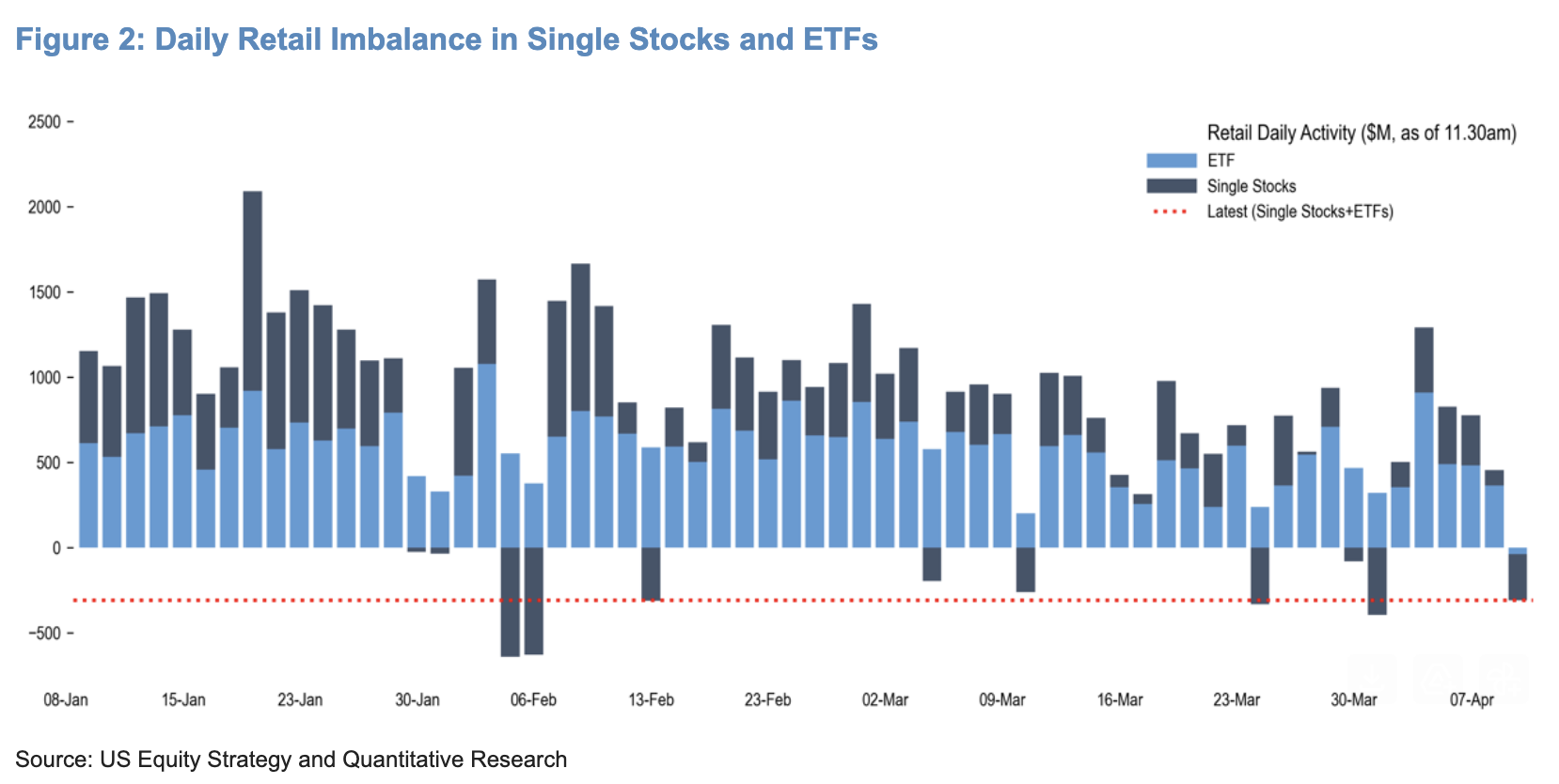
JPMorgan strategist Arun Jain with the skinny on retail trading activity through 11:30 a.m. ET today:

“Retail investors are selling into today’s strength in both ETFs and Single Stocks. In ETFs, they are trimming their broad-based exposure — a major departure from their typical pattern.”

The SPDR S&P 500 ETF and ProShares UltraPro QQQ suffered particularly large outflows, per Jain.

The exceptions to the selling pressure are the Magnificent 7 stocks, he wrote, with Nvidia, Tesla, Meta, and Microsoft enjoying “small net purchases,” while Micron, TSMC, Exxon, and Chevron were the most dumped names.

Retail trading 4/8

Last week, Jain noted that retail traders had been “skipping the dips, selling into rallies, and positioning more defensively” with markets jittery amid the ongoing Mideast war.

markets

Avis shorts facing $1.1 billion in losses as car rental company racks up 155% gains in its recent rally

Whatever traders are doing with Avis — buying, or just renting — it’s causing short sellers an immense amount of pain.

Shares of the car rental company have traded violently on Wednesday, from up nearly 7% at their highs to down almost 4% at their lows, after a face-ripping rally of 155% over the previous 11 sessions.

Per exchange data, roughly half the shares were sold short as of mid-March. S3 Partners, which tracks higher-frequency measures, said that short interest as a share of float had recently been trimmed to about 43%, down from as high as 53% at the start of the year.

Per Matthew Unterman, managing director at S3, Avis shorts are down $1.1 billion on paper over the past 30 days.

This isn’t Avis’ first rodeo: shares went parabolic in Q4 2021 as part of a meme stock moment in which it briefly became the most valuable company in the Russell 2000 small-cap index.

In any event, cheers to u/Bright_Leopard_4326, who admonished other members of the r/ShortSqueeze subreddit for not paying enough attention to the potential for a boom in the stock 10 days ago, when shares were trading below $150.

AVIS short squeeze
Source: r/ShortSqueeze

Latest Stories

Sherwood Media, LLC produces fresh and unique perspectives on topical financial news and is a fully owned subsidiary of Robinhood Markets, Inc., and any views expressed here do not necessarily reflect the views of any other Robinhood affiliate, including Robinhood Markets, Inc., Robinhood Financial LLC, Robinhood Securities, LLC, Robinhood Crypto, LLC, Robinhood Derivatives, LLC, or Robinhood Money, LLC. Futures and event contracts are offered through Robinhood Derivatives, LLC.