
Markets
President Trump Holds Press Conference With Elon Musk in White House's Oval Office
(Kevin Dietsch/Getty Images)
ROUGH STUFF

Musk thinks Tesla has some “rough quarters” ahead, as it waits (and waits) for autonomy

Tesla shares dropped about 5% in aftermarket trading as Musk pondered the company’s significant challenges on the Q2 earnings call.

Jon Keegan

Maybe Elon Musk should say less sometimes

The news wasn’t great. Despite a few bright notes from Tesla’s second quarter — a largely successful, limited robotaxi launch in Austin, Texas, and essentially meeting analyst earnings-per-share expectations — auto revenue was down 16% from the same period last year to $16.6 billion, making it two consecutive quarterly drops (year on year) for the electric automaker.

Earlier in the month, Tesla saw its biggest quarterly drop in deliveries ever, selling 60% fewer cars from the same period the year prior.

Initially, investors seemed to be absorbing the news of the less-than-stellar second-quarter earnings report, with shares wobbling a little, but not really reacting too much. 

But then shortly after 5:30 p.m. ET, an hour and a half after the company released earnings, CEO Elon Musk started talking on the Tesla earnings call. After 19 minutes of rambling “opening remarks,” the stock had dropped 2%, and by the end of the call it had lost 5% of its value since the start of the call.
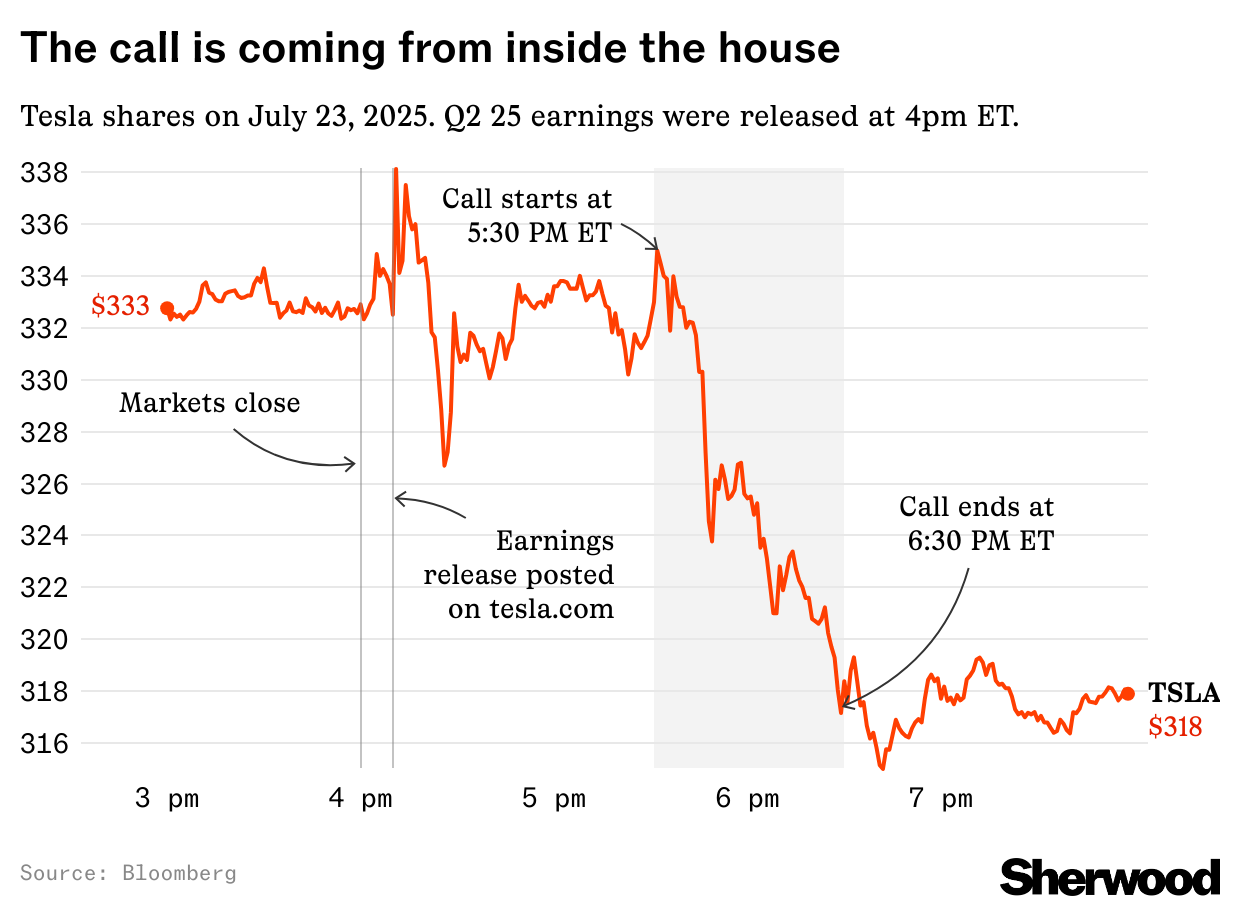
The call is coming from inside the house

What did Musk say that investors didn’t like? 

The call was pretty low energy, and Musk and other executives spent a lot of time talking about the many obstacles Tesla faces to achieve Musk’s futuristic vision of Tesla as the most valuable company in the world (worth $25 trillion), selling the most successful product in the history of the world (the Optimus humanoid robot) and people making money while their Teslas drive around as for-hire robotaxis (exactly zero people as of today). 

Musk has been promising that a lot of these things are just around the corner for many years now, but the truth is that a Tesla dealership lot today doesn’t look a whole lot different than it did five years ago. And a lot of things have popped up that are having negative effects on Tesla that Musk did not foresee. 

Caution and hard problems

Musk spent a lot of time talking about how difficult the things were that Tesla was trying to do. 

Things that Musk said were tough:

  • 🤖 Optimus robot engineering: “It’s a very hard problem to solve. You have to design every part of it, from physics’ first principle, principles. There’s nothing that’s off the shelf that actually works. So you’ve got to design every motor, gearbox, power electronics, control electronics, sensors, the mechanical elements.”

  • 🚗 Full Self-Driving software: “This is actually a very tricky thing to do, because you, as you increase the parameter count, you get, you get choked onto memory bandwidth, but we currently think we can 10x the parameter count from what people are currently experiencing.”

  • 🇪🇺 EU regulatory approvals: “I think we’re close to getting approval with the Netherlands; then it’s going to go to the EU. It’s quite Kafkaesque. In fact, Kafka had no idea that something like the EU could exist. Beyond comprehensible, the challenges with bureaucracy.”

  • 🇨🇳 Regulatory challenges in China.

  • 🚢 Headwinds from tariffs and supply chain challenges.

Musk emphasized that while he is extremely confident that Tesla will overcome significant technical challenges like Full Self-Driving, the company is being cautious: 

“I think we’ll probably have autonomous ride-hailing in like, half the population of the US by the end of the year… But we are being very cautious.”

Goodbye $7,500 tax credit, hello vehicle shortages

Musk’s beef with President Trump got pretty ugly over the past few months, and one of the main reasons was Musk’s dislike of his “big, beautiful bill.” Musk hated it because it will likely hurt Tesla’s car business hard. 

At the end of this quarter, the $7,500 EV tax credit from former President Biden’s Inflation Reduction Act expires, which effectively slaps a huge price increase on all of Tesla’s cars. Tesla is preparing for a burst of buyers seeking their last shot at the incentive, but it isn’t well prepared for the surge.

Tesla CFO Vaibhav Taneja said on the call:

“Given the abrupt change, we have limited supply of vehicles in the US this quarter, as we have already thin lead times to auto parts to build cars.”

Another painful side effect of Trump’s tax bill will be a steep reduction in sales of regulatory credits to other carmakers that aren’t selling enough EVs.

Even before the effects of the tax bill really hit, this easy money is drying up. Tesla saw regulatory credit sales of $439 million in Q2, less than half the $890 million the company made from the sales in the same period a year prior. The loss of the credit sales could imperil half of Tesla’s profits, according to JPMorgan.

“Rough quarters” ahead

While reflecting on the painful loss of regulatory incentives in the US and the lingering challenges of achieving “autonomy” for Tesla’s cars and robots, Musk declared that the company was in a “weird transition period.” You could almost feel the other executives in the room tense up as Musk expanded on this:

“Does that mean, like, we could have a few rough quarters? Yeah, we probably could have a few rough quarters. I’m not saying we will, but we could, you know, Q4, Q1, maybe Q2. But once you get to autonomy at scale in the second half of next year — certainly by the end of next year — I’d be surprised if Tesla economics are not very compelling.”

Despite all of Tesla’s obstacles, Musk’s optimism for the future Tesla he imagines is indefatigable. “I’d be surprised if at the end of five years, 60 months from now, if we are not roughly making 100,000 Optimus robots a month, I would be shocked.”

More Markets

See all Markets
markets

Qualcomm reportedly in talks to acquire AI chip-design company Tenstorrent

Qualcomm is in talks to acquire AI chip design firm Tenstorrent for $8 billion to $10 billion, according to The Information.

This transaction, if completed, would be another concrete signal of the San Diego-based chip company’s attempt to carve out a niche in the upstream AI space (data centers), rather than focusing on end-user devices.

Qualcomm’s key business of handset chips has fallen on hard times, particularly in China, due to the memory chip shortage.

Less than eight weeks ago, the chip company was the lowlight in the Philadelphia Semiconductor Index, down about 20% year-to-date.

Shares proceeded to surge over 60%, buoyed by optimism that the rising AI tide will lift all boats. With the release of Q2 earnings, CEO Cristiano Amon said that initial shipments of AI chips to a “leading hyperscaler” were on track for later this year, and to expect more on the company’s AI growth plans at its investor day on June 24 (next week). Last month, Bloomberg reported that Qualcomm is poised to sell "millions" of AI chips to TikTok parent ByteDance.

Established AI chip giants and hyperscalers alike have reached agreements with or gobbled up burgeoning AI chip companies as the boom rolls on. In December, Nvidia announced a major licensing deal with AI inference specialist Groq, while Meta bought AI chip startup Rivos in September.

markets

It’s still the “you gotta spend money to make money” stock market

A major theme of this year is that American companies are once again becoming major sellers of stocks.

For years, companies did the exact opposite: buying back trillions of dollars worth of shares, a practice that juiced earnings and was seen as a safe option for management teams that had run out of good-enough projects to allocate their capital to. Just look at Google, which is wiping out more than two years’ worth of buybacks with an $85 billion offering, while Meta reportedly mulls an equity raise of its own.

Now, the mantra is that investment opportunities in AI — particularly as suppliers to the arms race — are a source of future returns that are also key to sustaining higher growth. In short, capex is king, and buybacks are admitting that you don’t have enough investment opportunities that allow you to benefit from the AI boom. Raise debt, raise equity, raise anything — just make sure youre spending, and the market will reward you. A Goldman Sachs basket of companies with elevated capex relative to peers is besting stocks with the strongest buyback yields by some 30% — the most ever.

This is leading to some major divergences in accrual-based profit measures, like net income and free cash flow (which takes capex into account), for companies like Oracle.

Of course, the rest of the AI complex doesnt care whether the cash spent on the next data center was raised via debt or equity. More funding for the AI build-out is more funding for the AI build-out. Indeed, if we took capex to a bazillion dollars, that spending would still be accretive for aggregate earnings in the first year (assuming all the recipients of the capex binge were public stocks). Yes, eventually the depreciation on those assets starts to be felt and we’d normalize lower, but in the short term, it’s a boon to the stock markets bottom line.

This is why Oracle’s chart is actually just a more extreme version of the wider market; free cash flow used to be about 90% of aggregate net income, and now it’s hovering around 75%, per estimates compiled by Bloomberg.

markets

Fox to acquire Roku in $22 billion deal to create streaming and live content powerhouse

Fox said it struck a deal to buy Roku in a cash-and-stock transaction valued at about $22 billion.

The deal values Roku at $160 a share, a 34% premium to where the stock had closed before reports surfaced Friday that Roku was exploring a sale, sending shares 20% higher on Friday.

On Monday, the stock edged lower to around $140, as investors digested the risk profile and timeline of the deal. The unseasonably elevated cost of funding equity positions amid elevated issuance and growth of leveraged ETFs may also be dampening the appeal of merger arbitrage strategies.

Fox stock dropped 17%, putting it at down roughly 25% so far this year.

The deal, expected to close in the first half of calendar year 2027, will expand Fox’s digital footprint as traditional cable continues to shrink. The merger would give Fox direct access to more than 100 million streaming households globally. Once the transaction closes, existing Fox shareholders will hold a roughly 73% stake in the combined company, with Roku shareholders owning the remaining 27%.

Fox has spent the past several years building out its streaming strategy through Tubi and, more recently, FOX One, its direct-to-consumer sports and news product. Just last week, Roku added FOX One as a premium subscription inside its Roku Channel, expanding distribution ahead of the FIFA World Cup.

Roku, meanwhile, has been trying to prove it can turn its scale into consistent profits. Roku generated $613 million in ad revenue in its latest quarter, up 27% year over year.

Roku had surged during the pandemic as investors piled into streaming winners and Roku was one of the beneficiaries of the stay-at-home boom. But it has given back much of those gains.

Fox CEO Lachlan Murdoch called the acquisition “a defining moment” that combines Fox’s strength in live content with Roku’s streaming scale and platform reach. “This combination will transform the scope of our company into high-growth verticals and yield a step change in our overall growth profile,” he said in the announcement.

Roku CEO Anthony Wood said the deal would help accelerate Roku’s long-term growth while maintaining its position as an open platform.

Latest Stories

Sherwood Media, LLC and Chartr Limited produce fresh and unique perspectives on topical financial news and are fully owned subsidiaries of Robinhood Markets, Inc., and any views expressed here do not necessarily reflect the views of any other Robinhood affiliate, including Robinhood Markets, Inc., Robinhood Financial LLC, Robinhood Securities, LLC, Robinhood Crypto, LLC, Robinhood Money, LLC, Robinhood U.K. Ltd, Robinhood Derivatives, LLC, Robinhood Gold, LLC, Robinhood Asset Management, LLC, Robinhood Credit, Inc., Robinhood Ventures DE, LLC and, where applicable, its managed investment vehicles.

