Markets
Another 2026 outlook Steve Sosnick Chief Strategist Interactive Brokers
(CSA Archive/Getty Images)

Interactive Brokers’ chief strategist sees reasons for caution in ’26

With the looming shift in Fed leadership and growing concern about the AI trade, Interactive Brokers’ chief strategist is penciling in modest losses for stocks next year.

When it comes to markets, stock and options watcher Steve Sosnick is, by nature, a bit cautious.

It’s a characteristic that stems from his years working as a risk manager on options market-making desks, a job that essentially forced him to spend an undue amount of time worrying about what could go wrong with the algorithmic models at the heart of the company’s operations. The experience has left him with something of a bias.

“That bias is toward looking for the monsters under the bed,” said Sosnick, chief strategist for Interactive Brokers, in an interview Monday, after he published his 2026 market outlook, which compared to the mostly bullish forecasts from around Wall Street seems pretty meh.

While stressing that he doesn’t consider himself especially bearish, Sosnick sees the S&P 500 ending 2026 at 6,500, implying a 5% pullback from where the blue chips ended Monday.

That’s the lowest official prediction we’ve seen from Wall Street’s scribes so far during the end-of-year outlook season.

(Previously, the most lackluster forecast we’d seen was Bank of America’s call for stocks to end next year at 7,100, which would be a modest gain of about 4%.)

“As a natural contrarian, if everybody is zigging, perhaps there’s a reason to think about zagging,” he said. “I think there’s room for a bit of retrenchment based on the various factors.”

One major one: depending on President Trump’s choice to lead the US central bank after current Chairman Jerome Powell’s term expires in May, there’s a risk that long-term interest rates could rise, he said.

Powell’s heir apparent is reportedly White House economist Kevin Hassett, whose closeness to the administration and public support for the low-rate policies the president has pushed the previously independent Federal Reserve for has prompted some to worry that longer-term rates could rise if the Fed is seen as insufficiently concerned about inflation.

“Markets have an interesting way of testing new Fed chairs,” Sosnick said. He sees US 10-year yields rising to 4.45% by the end of next year (they’re currently at 4.16%), and suggests that a sharp rise in rates could cause some volatility for stocks.

“In theory, high rates should pressure stock prices,” he said. “In reality it’s not always so cut and dry.”

That’s because the path of the stock market will also depend on other factors, like the state of the US economy and its key growth driver: the AI investment boom.

But there, too, Sosnick sees reason for caution, suggesting investors have become increasingly worried that the investment boom from AI hyperscalers might not pay off for shareholders any time soon.

“It’s only normal, and actually desirable, for investors to get concerned with return on investment,” he said. “This whole AI trade only makes sense if at some point there are bottom-line results.”

And while AI technology clearly has potential for huge economic benefits, its still up in the air which companies will ultimately dominate the space.

“If it was 1998 or 1999, we would all be using Netscape browsers and searching on Yahoo, while connecting via AOL,” Sosnick said, adding, “What it means to me is we dont know who the winners are going to be.”

More Markets

See all Markets
markets

Budget airline stocks dip as Spirit pilots ratify contract that’ll help the carrier stay afloat

Low-cost airlines JetBlue and Frontier are trading lower on Thursday following the news that Spirit Airlines pilots ratified modifications to their labor contract that will lower costs for the carrier, which filed for bankruptcy in August.

According to the Air Line Pilots Association (ALPA), Spirit pilots approved a deal that included “temporary reductions to pay rates and retirement contributions.” Beginning January 1, hourly pay will be reduced 8% and retirement contributions will drop by half from 16% to 8%.

"Spirit pilots made a difficult choice that provides the Company with what it needs from labor to secure financing and complete its restructuring,” said Captain Ryan P. Muller, chairman of the Spirit Airlines Master Executive Council.

Wall Street sees Jetblue and Frontier as the biggest beneficiaries to Spirit’s woes, and both carriers have attempted to purchase Spirit in recent years.

markets

Planet Labs rips on strong earnings report

Satellite services company Planet Labs was on track for a new record closing high after rising more than 35% in early afternoon trading on Thursday.

The roughly $5 billion company posted better-than-expected quarterly results and guided toward higher-than-expected sales for the current quarter after the close of trading Wednesday.

“AI continues to be a major tailwind as the company is seeing significant demand through enhanced capabilities for its advanced satellite data solutions,” wrote Wedbush tech analyst Dan Ives, adding “We continue to believe the PL is well-positioned at the intersection of Space and AI.” He has an “outperform” — basically a “buy” — rating and a price target of $20 on the stock.

Other satellite services AST SpaceMobile and Rocket Lab also enjoyed a bump on Thursday, seemingly riding the momentum of Planet Labs’ numbers.

“AI continues to be a major tailwind as the company is seeing significant demand through enhanced capabilities for its advanced satellite data solutions,” wrote Wedbush tech analyst Dan Ives, adding “We continue to believe the PL is well-positioned at the intersection of Space and AI.” He has an “outperform” — basically a “buy” — rating and a price target of $20 on the stock.

Other satellite services AST SpaceMobile and Rocket Lab also enjoyed a bump on Thursday, seemingly riding the momentum of Planet Labs’ numbers.

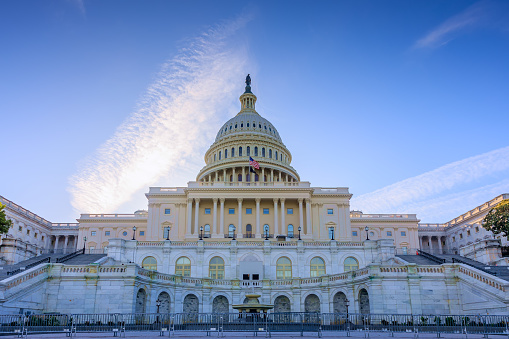
The East Side of the US Capitol Building in the early morning, Washington DC, USA.

Health insurers rise after the Senate rejects competing healthcare plans

The Democratic plan would have extended tax credits, while the GOP plan would have replaced them with HSAs.

markets

Rivian sure picked a bad time for its AI Day as investors dump tech stocks

The event coordination team at Rivian is probably having a bad one, as investors dumped the stock ahead of its “Autonomy and AI Day” amid a broader AI trade sell-off.

Heading into the event that began at noon ET, Rivian shares were down 5%, following a strongly negative reaction to Oracle’s earnings results. The stock began climbing as Rivian’s event started, but remains in the red on the day.

A year flush with tariffs and the end of the EV tax credit has pushed Rivian to pitch a techier version of its future. During Thursday’s event, Rivian said its forthcoming vehicles would ditch Nvidia chips for its own AI chips produced by Taiwan Semiconductor.

The vehicles will feature lidar sensors, enabling “level 4” autonomous driving (similar to Google’s Waymo), the company said. According to CEO RJ Scaringe, the updates will allow Rivian to “pursue opportunities in the rideshare space,” hinting at future robotaxi plans, which rivals Tesla and Lucid have already begun.

Wall Street appears skeptical of Rivian, with Morgan Stanley this week downgrading the stock to “underweight” and dropping its price target to $12. Lucid, which in October announced it’s planning a privately owned autonomous car built with Nvidia tech, also received a downgrade.

A year flush with tariffs and the end of the EV tax credit has pushed Rivian to pitch a techier version of its future. During Thursday’s event, Rivian said its forthcoming vehicles would ditch Nvidia chips for its own AI chips produced by Taiwan Semiconductor.

The vehicles will feature lidar sensors, enabling “level 4” autonomous driving (similar to Google’s Waymo), the company said. According to CEO RJ Scaringe, the updates will allow Rivian to “pursue opportunities in the rideshare space,” hinting at future robotaxi plans, which rivals Tesla and Lucid have already begun.

Wall Street appears skeptical of Rivian, with Morgan Stanley this week downgrading the stock to “underweight” and dropping its price target to $12. Lucid, which in October announced it’s planning a privately owned autonomous car built with Nvidia tech, also received a downgrade.

markets

Robinhood tumbles after November trading volumes post monthly drop across equities, options, and crypto

Robinhood Markets is getting crushed today, and not just because it’s the place where people go to buy AI stocks (which are under big pressure after Oracle’s earnings report). As stocks retreated in November, activity on the platform did, too.

(Robinhood Markets Inc. is the parent company of Sherwood Media, an independently operated media company subject to certain legal and regulatory restrictions.)

The brokerage reported that November trading volumes fell across equities, options, and crypto compared to October. Equity notional volumes were down 37% month on month, options contracts traded were off 28%, and crypto notional volumes fell double digits. The bright spot: its prediction markets business is still in boom mode, with 3 billion contracts traded, up 20% versus the prior month.

Cantor Fitzgerald analyst Brett Knoblauch trimmed his price target on the shares to $152 from $155 following this release, noting that this monthly decline was somewhat expected.

Latest Stories

Sherwood Media, LLC produces fresh and unique perspectives on topical financial news and is a fully owned subsidiary of Robinhood Markets, Inc., and any views expressed here do not necessarily reflect the views of any other Robinhood affiliate, including Robinhood Markets, Inc., Robinhood Financial LLC, Robinhood Securities, LLC, Robinhood Crypto, LLC, or Robinhood Money, LLC.