Markets
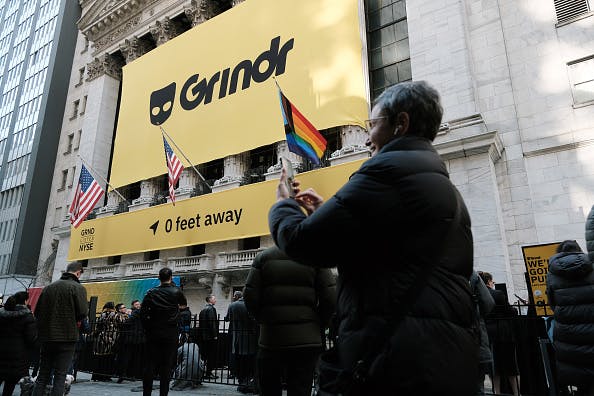
LGBTQ Dating App Grindr Goes Public On The NYSE
(Spencer Platt/Getty Images)

Grindr discloses buyout proposal at $18 per share

While two huge shareholders are hoping to buy out Grindr stock at a premium, it was above $20 as recently as July.

J. Edward Moreno

Grindr soared on Friday after it disclosed a take-private proposal that would value the company at $18 per share.

James Lu and Raymond Zage, who together already own more than 60% of the gay dating app, proposed to buy the remaining shares of the company and delist it from the New York Stock Exchange. The premium would be more than 50% from where the stock was trading before rumblings of the proposal were first reported.

Lu and Zage are requesting a response from the board by October 31.

The investors first informed Grindr’s board that they were exploring taking the company private on October 13. The next day, Semafor reported that a take-private deal was in the works, sending the stock climbing higher.

According to Semafor, Zage and Lu had pledged nearly all of their Grindr stock for personal loans. The loans became undercollateralized following the stock’s recent slide, which led their lender to seize and sell some of their shares in Grindr.

While they are buying out Grindr shares at a premium, the stock was above $20 as recently as July. The company has generally performed better than its peers, though its most recent revenue numbers disappointed Wall Street.

In a recent interview with Sherwood News, Grindr CEO George Arison described the company’s push toward AI and its goal to build a suite of products that cater to the audience on its flagship app. It hasn’t always been easy to communicate that to Wall Street, he said.

“Most investors don’t use our product at all,” he said. “We are very big in a certain set of users, but everybody else does not know our product at all.”

In the proposal, Lu and Zage said they “are firmly aligned with management and have no intentions of making any changes to the leadership” if the deal were to close.

Lu and Zage acquired Grindr in 2020 from the Chinese firm Kunlun. The move came after the Committee on Foreign Investment in the United States determined it was a national security risk for a company with sensitive data to be Chinese-owned. The investors also led Grindrs initial public offering in 2022.

Grindr declined to comment on the buyout proposal. In a statement, Lu and Zage said they have “received considerable initial interest from both debt and equity investors in participating in this opportunity.”


More Markets

See all Markets
markets

Oil-sensitive stocks and companies relying on middle-class spending are getting crushed

Sometimes there’s a singular story driving the markets. With US benchmark crude oil prices topping $100 a barrel, Monday is one of those days.

Oil-sensitive stocks are getting clobbered, with airlines foremost among them. JetBlue, United Airlines, and Alaska Air are all tumbling.

But the pain is more widespread than that, with industries where oil prices are a major input, such as chemical manufacturers (Eastman Chemical), industrial machinery makers (Illinois Tool Works), and building products (Owens-Corning), also getting shellacked.

More ominous — economically speaking — is the performance of companies catering to America’s middle class, including Macy’s, Kohl’s, Best Buy, and Texas Roadhouse. The drop suggests that investors and traders expect the rising cost of fuel to eat away at disposable income, potentially setting the stage for an economic slowdown.

Some of the worst off on Monday are companies that are both fuel-sensitive and heavily reliant on middle-class consumers — a double whammy.

Cases in point: Carnival is getting creamed, and Clorox, a company that depends on slightly better-off Americans shelling out for its brand-name products, is also getting pummeled.

But the pain is more widespread than that, with industries where oil prices are a major input, such as chemical manufacturers (Eastman Chemical), industrial machinery makers (Illinois Tool Works), and building products (Owens-Corning), also getting shellacked.

More ominous — economically speaking — is the performance of companies catering to America’s middle class, including Macy’s, Kohl’s, Best Buy, and Texas Roadhouse. The drop suggests that investors and traders expect the rising cost of fuel to eat away at disposable income, potentially setting the stage for an economic slowdown.

Some of the worst off on Monday are companies that are both fuel-sensitive and heavily reliant on middle-class consumers — a double whammy.

Cases in point: Carnival is getting creamed, and Clorox, a company that depends on slightly better-off Americans shelling out for its brand-name products, is also getting pummeled.

Retro outdoor sign to save money on gas, Save $ on fuel

Where in the US have gas prices jumped the most since the US attack on Iran?

Drivers in some states are seeing pump prices rise much faster than others.

markets

Live Nation reportedly reaches settlement with DOJ over Ticketmaster

Live Nation is jumping in premarket trading on Monday after reports that it has reached a settlement with the Department of Justice over an antitrust lawsuit that could have forced the company to sell Ticketmaster.

After Bloomberg reported that the company was close to a settlement, The Wall Street Journal early on Monday reported that a deal had indeed been reached with an agreement that crucially spares the entertainment giant from breaking up with Ticketmaster, in return for making it easier for other promoters to compete in Live Nation venues.

The prompt agreement, with negotiations presumably intensifying since the trial kicked off on March 2, is expected to get relief to consumers faster than Live Nation going through a trial, per a Justice Department official cited by the WSJ.

Separately, Politico reported that the settlement would include $200 million in damages to participating states — a tiny fraction of Live Nation’s more than $36 billion market cap. Politico also expects Live Nation to divest more than 10 amphitheaters and cap Ticketmaster’s service fees at its amphitheaters under the agreement.

The settlement, which still requires approval from a judge, is set to be made public on Monday, and has seen about 10 states agreeing to the new framework, according to people familiar with the matter. Other state attorneys general may continue to separately litigate.

After Bloomberg reported that the company was close to a settlement, The Wall Street Journal early on Monday reported that a deal had indeed been reached with an agreement that crucially spares the entertainment giant from breaking up with Ticketmaster, in return for making it easier for other promoters to compete in Live Nation venues.

The prompt agreement, with negotiations presumably intensifying since the trial kicked off on March 2, is expected to get relief to consumers faster than Live Nation going through a trial, per a Justice Department official cited by the WSJ.

Separately, Politico reported that the settlement would include $200 million in damages to participating states — a tiny fraction of Live Nation’s more than $36 billion market cap. Politico also expects Live Nation to divest more than 10 amphitheaters and cap Ticketmaster’s service fees at its amphitheaters under the agreement.

The settlement, which still requires approval from a judge, is set to be made public on Monday, and has seen about 10 states agreeing to the new framework, according to people familiar with the matter. Other state attorneys general may continue to separately litigate.

markets

Leo KoGuan, billionaire Tesla bull, tweets that he purchased another 1 million shares of Nvidia

Billionaire software entrepreneur, philosopher, and now major Tesla and Nvidia bull Leo KoGuan tweeted that he bought another 1 million shares of the chip designer.

“Hopefully, I can contribute a little to calm the nervous market. Good luck all,” he wrote in his message.

Unless KoGuan can work some magic in global oil markets or conflict resolution in the Middle East, however, “a little” may be all he’s able to contribute in favor of market tranquility.

Stocks, including Nvidia, are modestly positive this morning despite the spike in oil prices weighing on major indexes.

Unless KoGuan can work some magic in global oil markets or conflict resolution in the Middle East, however, “a little” may be all he’s able to contribute in favor of market tranquility.

Stocks, including Nvidia, are modestly positive this morning despite the spike in oil prices weighing on major indexes.

Latest Stories

Sherwood Media, LLC produces fresh and unique perspectives on topical financial news and is a fully owned subsidiary of Robinhood Markets, Inc., and any views expressed here do not necessarily reflect the views of any other Robinhood affiliate, including Robinhood Markets, Inc., Robinhood Financial LLC, Robinhood Securities, LLC, Robinhood Crypto, LLC, or Robinhood Money, LLC.