
Markets
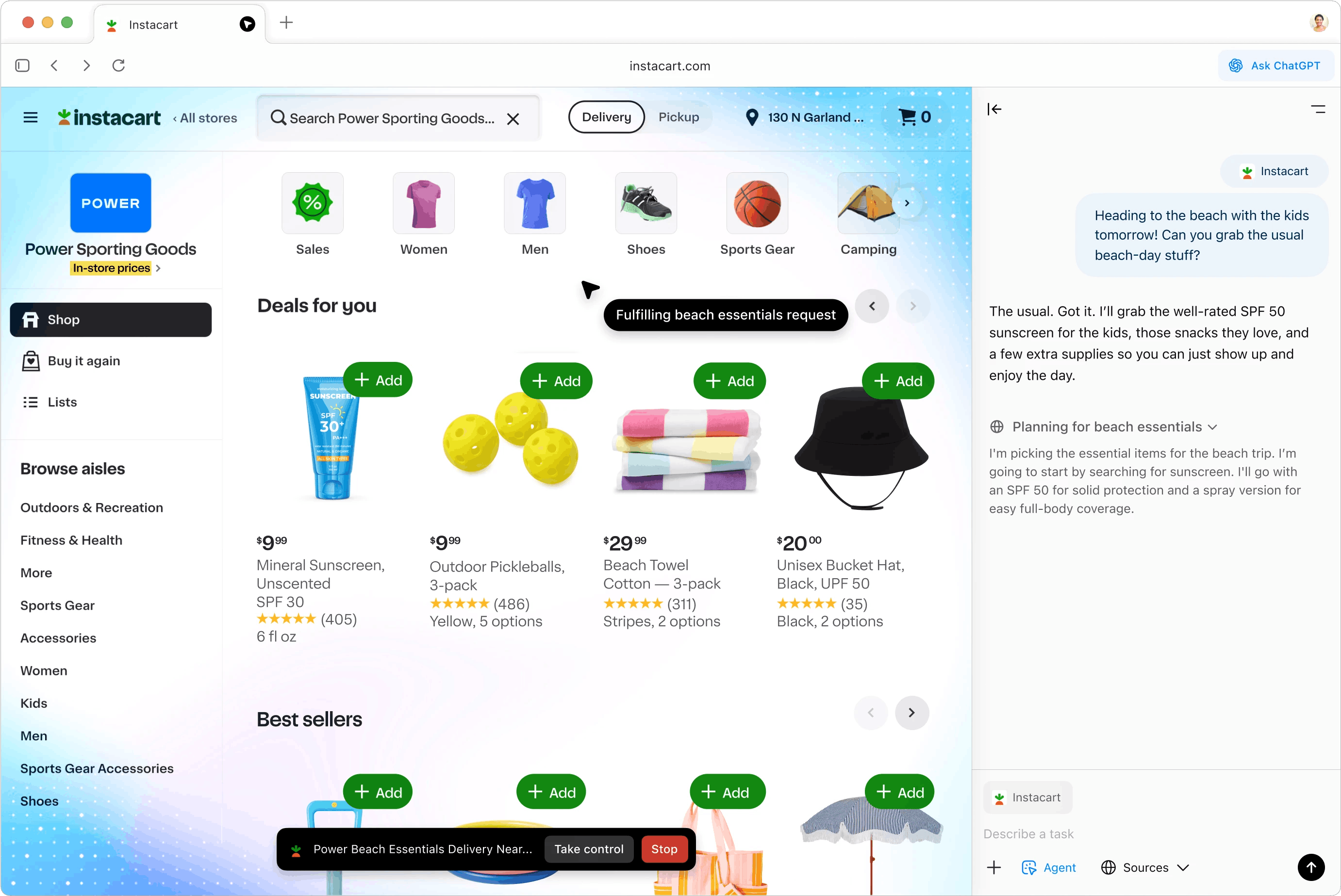
Screenshot of ChatGPT Atlas browser
(OpenAI)

OpenAI releases Chrome competitor browser “ChatGPT Atlas,” sending Google shares down

ChatGPT currently poses little threat to Google’s search business, but an OpenAI browser — and the data that comes with it — could change everything.

Jon Keegan

OpenAI took aim at Google today with its own AI-powered web browser called “ChatGPT Atlas.” The new browser, which is currently only available for Macs, aims to merge ChatGPT with a modern web browser.

An OpenAI team member on the livestream called it “a new kind of browser for the next era of the web.” The newly-unveiled browser could help OpenAI further insert itself into users’ interactions with their computers, and prompt users to more extensively incorporate OpenAI tools in their daily lives.

The initial screen the user sees in the new browser looks a lot like ChatGPT, with a text box in the center. But instead of just entering in the name of a website or search query, users can ask the browser questions. This may take you directly to a website, but it also might search through your tabs and browser history, or pull information together from around the web to deliver a response. Atlas is built on Chromium, the open source version of Google’s Chrome browser.

Google’s AI overviews aim to do a similar thing in response to a search query, but Atlas can deliver answers without pages of search results. Google’s Chrome browser has been key to its domination of online advertising, generating $54.2 billion last quarter alone. Even a small slice of that market would help OpenAI offset the massive losses it is incurring as it ramps up its ambitious infrastructure plans.

One of the key features in Atlas is a persistent “Ask ChatGPT” button which grants the chatbot access to the contents of the webpage being viewed, letting the user ask questions about what is on the page. However, when I tried to ask Atlas questions about the front page of the New York Times, a message popped up that said “ChatGPT is unable to access the contents of this website,” likely due to the ongoing lawsuit between OpenAI and the newspaper.

That’s a reminder that the contents of your journey around the web can be used to train future models. Atlas does give users the ability to opt out, but the setting is turned on by default (but not for Business or Enterprise subscribers). Users can also open an “incognito mode” tab that will not remember what you search for, or what sites you visit.

Atlas has a deep memory — not only does it remember your searches and what sites you visit — your ChatGPT history is available to Atlas as well to help customize responses (this can also be disabled).

Listed as a “preview” feature, Atlas also has a built-in “Agent mode” that will control the web browser to complete tasks on its own. In the livestream, a demo showed Atlas visiting a supermarket website, and adding items to an order based on a recipe. The task took about 2 minutes to fill the cart.

Shares of Google took a nosedive before the announcement on Tuesday, dropping as much as 4%. After the livestream announcing Atlas, shares recovered slightly, but the stock was still down about 1.7%.

More Markets

See all Markets
markets

Qualcomm reportedly in talks to acquire AI chip-design company Tenstorrent

Qualcomm is in talks to acquire AI chip design firm Tenstorrent for $8 billion to $10 billion, according to The Information.

This transaction, if completed, would be another concrete signal of the San Diego-based chip company’s attempt to carve out a niche in the upstream AI space (data centers), rather than focusing on end-user devices.

Qualcomm’s key business of handset chips has fallen on hard times, particularly in China, due to the memory chip shortage.

Less than eight weeks ago, the chip company was the lowlight in the Philadelphia Semiconductor Index, down about 20% year-to-date.

Shares proceeded to surge over 60%, buoyed by optimism that the rising AI tide will lift all boats. With the release of Q2 earnings, CEO Cristiano Amon said that initial shipments of AI chips to a “leading hyperscaler” were on track for later this year, and to expect more on the company’s AI growth plans at its investor day on June 24 (next week). Last month, Bloomberg reported that Qualcomm is poised to sell "millions" of AI chips to TikTok parent ByteDance.

Established AI chip giants and hyperscalers alike have reached agreements with or gobbled up burgeoning AI chip companies as the boom rolls on. In December, Nvidia announced a major licensing deal with AI inference specialist Groq, while Meta bought AI chip startup Rivos in September.

markets

It’s still the “you gotta spend money to make money” stock market

A major theme of this year is that American companies are once again becoming major sellers of stocks.

For years, companies did the exact opposite: buying back trillions of dollars worth of shares, a practice that juiced earnings and was seen as a safe option for management teams that had run out of good-enough projects to allocate their capital to. Just look at Google, which is wiping out more than two years’ worth of buybacks with an $85 billion offering, while Meta reportedly mulls an equity raise of its own.

Now, the mantra is that investment opportunities in AI — particularly as suppliers to the arms race — are a source of future returns that are also key to sustaining higher growth. In short, capex is king, and buybacks are admitting that you don’t have enough investment opportunities that allow you to benefit from the AI boom. Raise debt, raise equity, raise anything — just make sure youre spending, and the market will reward you. A Goldman Sachs basket of companies with elevated capex relative to peers is besting stocks with the strongest buyback yields by some 30% — the most ever.

This is leading to some major divergences in accrual-based profit measures, like net income and free cash flow (which takes capex into account), for companies like Oracle.

Of course, the rest of the AI complex doesnt care whether the cash spent on the next data center was raised via debt or equity. More funding for the AI build-out is more funding for the AI build-out. Indeed, if we took capex to a bazillion dollars, that spending would still be accretive for aggregate earnings in the first year (assuming all the recipients of the capex binge were public stocks). Yes, eventually the depreciation on those assets starts to be felt and we’d normalize lower, but in the short term, it’s a boon to the stock markets bottom line.

This is why Oracle’s chart is actually just a more extreme version of the wider market; free cash flow used to be about 90% of aggregate net income, and now it’s hovering around 75%, per estimates compiled by Bloomberg.

markets

Fox to acquire Roku in $22 billion deal to create streaming and live content powerhouse

Fox said it struck a deal to buy Roku in a cash-and-stock transaction valued at about $22 billion.

The deal values Roku at $160 a share, a 34% premium to where the stock had closed before reports surfaced Friday that Roku was exploring a sale, sending shares 20% higher on Friday.

On Monday, the stock edged lower to around $140, as investors digested the risk profile and timeline of the deal. The unseasonably elevated cost of funding equity positions amid elevated issuance and growth of leveraged ETFs may also be dampening the appeal of merger arbitrage strategies.

Fox stock dropped 17%, putting it at down roughly 25% so far this year.

The deal, expected to close in the first half of calendar year 2027, will expand Fox’s digital footprint as traditional cable continues to shrink. The merger would give Fox direct access to more than 100 million streaming households globally. Once the transaction closes, existing Fox shareholders will hold a roughly 73% stake in the combined company, with Roku shareholders owning the remaining 27%.

Fox has spent the past several years building out its streaming strategy through Tubi and, more recently, FOX One, its direct-to-consumer sports and news product. Just last week, Roku added FOX One as a premium subscription inside its Roku Channel, expanding distribution ahead of the FIFA World Cup.

Roku, meanwhile, has been trying to prove it can turn its scale into consistent profits. Roku generated $613 million in ad revenue in its latest quarter, up 27% year over year.

Roku had surged during the pandemic as investors piled into streaming winners and Roku was one of the beneficiaries of the stay-at-home boom. But it has given back much of those gains.

Fox CEO Lachlan Murdoch called the acquisition “a defining moment” that combines Fox’s strength in live content with Roku’s streaming scale and platform reach. “This combination will transform the scope of our company into high-growth verticals and yield a step change in our overall growth profile,” he said in the announcement.

Roku CEO Anthony Wood said the deal would help accelerate Roku’s long-term growth while maintaining its position as an open platform.

Latest Stories

Sherwood Media, LLC and Chartr Limited produce fresh and unique perspectives on topical financial news and are fully owned subsidiaries of Robinhood Markets, Inc., and any views expressed here do not necessarily reflect the views of any other Robinhood affiliate, including Robinhood Markets, Inc., Robinhood Financial LLC, Robinhood Securities, LLC, Robinhood Crypto, LLC, Robinhood Money, LLC, Robinhood U.K. Ltd, Robinhood Derivatives, LLC, Robinhood Gold, LLC, Robinhood Asset Management, LLC, Robinhood Credit, Inc., Robinhood Ventures DE, LLC and, where applicable, its managed investment vehicles.

