Markets
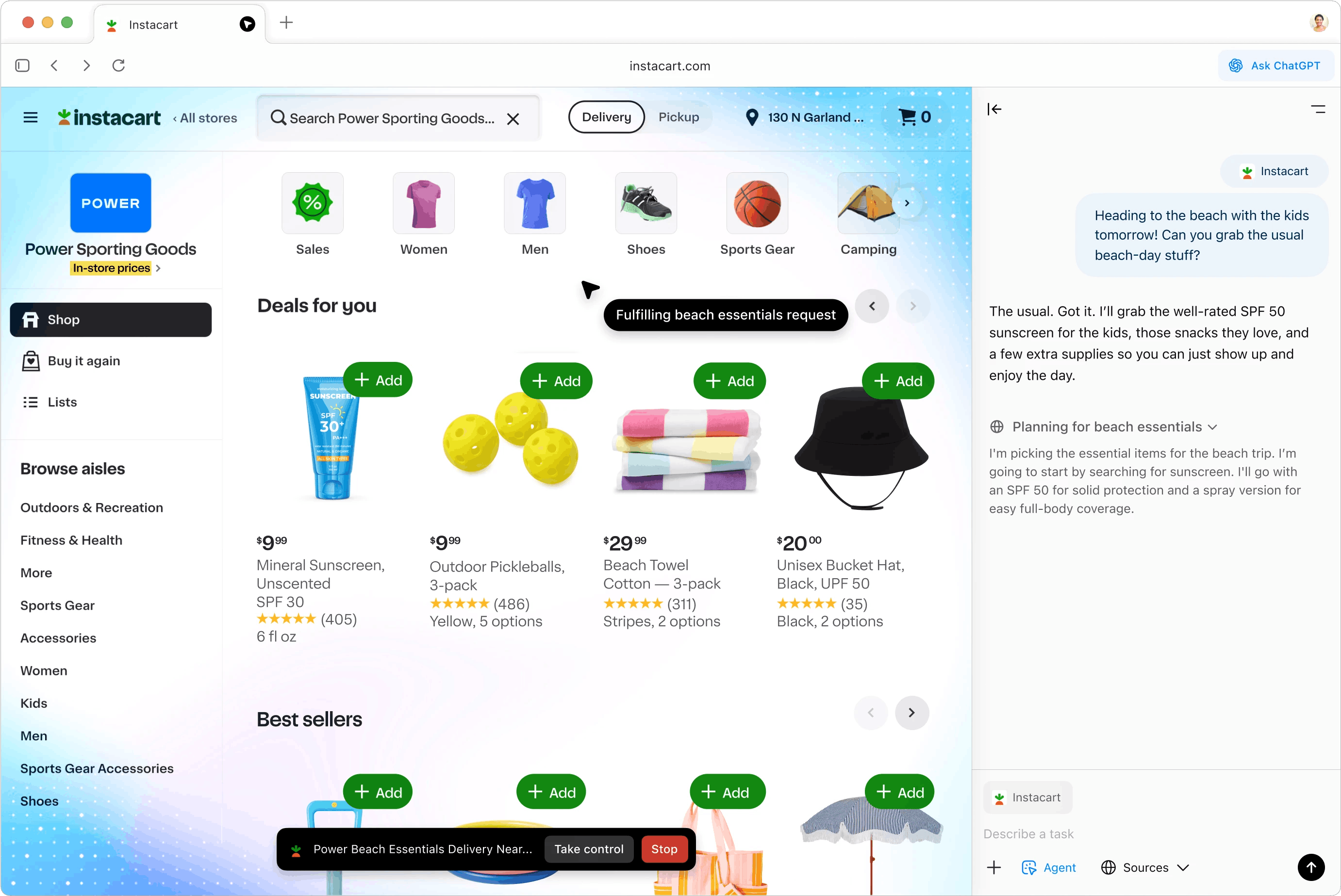
Screenshot of ChatGPT Atlas browser
(OpenAI)

OpenAI releases Chrome competitor browser “ChatGPT Atlas,” sending Google shares down

ChatGPT currently poses little threat to Google’s search business, but an OpenAI browser — and the data that comes with it — could change everything.

Jon Keegan

OpenAI took aim at Google today with its own AI-powered web browser called “ChatGPT Atlas.” The new browser, which is currently only available for Macs, aims to merge ChatGPT with a modern web browser.

An OpenAI team member on the livestream called it “a new kind of browser for the next era of the web.” The newly-unveiled browser could help OpenAI further insert itself into users’ interactions with their computers, and prompt users to more extensively incorporate OpenAI tools in their daily lives.

The initial screen the user sees in the new browser looks a lot like ChatGPT, with a text box in the center. But instead of just entering in the name of a website or search query, users can ask the browser questions. This may take you directly to a website, but it also might search through your tabs and browser history, or pull information together from around the web to deliver a response. Atlas is built on Chromium, the open source version of Google’s Chrome browser.

Google’s AI overviews aim to do a similar thing in response to a search query, but Atlas can deliver answers without pages of search results. Google’s Chrome browser has been key to its domination of online advertising, generating $54.2 billion last quarter alone. Even a small slice of that market would help OpenAI offset the massive losses it is incurring as it ramps up its ambitious infrastructure plans.

One of the key features in Atlas is a persistent “Ask ChatGPT” button which grants the chatbot access to the contents of the webpage being viewed, letting the user ask questions about what is on the page. However, when I tried to ask Atlas questions about the front page of the New York Times, a message popped up that said “ChatGPT is unable to access the contents of this website,” likely due to the ongoing lawsuit between OpenAI and the newspaper.

That’s a reminder that the contents of your journey around the web can be used to train future models. Atlas does give users the ability to opt out, but the setting is turned on by default (but not for Business or Enterprise subscribers). Users can also open an “incognito mode” tab that will not remember what you search for, or what sites you visit.

Atlas has a deep memory — not only does it remember your searches and what sites you visit — your ChatGPT history is available to Atlas as well to help customize responses (this can also be disabled).

Listed as a “preview” feature, Atlas also has a built-in “Agent mode” that will control the web browser to complete tasks on its own. In the livestream, a demo showed Atlas visiting a supermarket website, and adding items to an order based on a recipe. The task took about 2 minutes to fill the cart.

Shares of Google took a nosedive before the announcement on Tuesday, dropping as much as 4%. After the livestream announcing Atlas, shares recovered slightly, but the stock was still down about 1.7%.

More Markets

See all Markets
markets

Satellite stocks surge on “sovereign space” plans

Planet Labs is on pace to notch its second 10% gain of the month early Tuesday afternoon, adding to its astronomical run of more than 500% over the last 12 months.

Wedbush Securities tech analyst Dan Ives hiked his price target for the stock to $30 from $28 after hosting a series of meetings with the company and investors in California. Ives wrote:

“[Planet Labs] is seeing massive success through its improved GTM selling motion as the company is providing mission-critical use cases for a wide array of government applications with defense & intelligence, with more international agencies seeing the value in PL’s satellite fleet for situational and maritime domain awareness in real-time as the company is benefitting from increasing defense budgets and the urgent need for international countries to reduce its reliance on the US.”

That commentary is consistent with recent news reports that the German military is planning to build what the Financial Times calls the “the equivalent of Elon Musk’s internet service for the German armed forces.”

A separate report in The Wall Street Journal on Monday said, “Spending on space-related projects is expected to rise in many countries, giving companies new opportunities to sell their wares and services.”

Behind this push, in part, is the fact that the roughly 80-year-old NATO alliance is is under unprecedented strain due to, among other things, US President Donald Trump’s fixation on somehow acquiring the Danish territory of Greenland.

Other space plays seem to be benefiting from similar dynamics, with Rocket Lab and AST SpaceMobile both up solidly on the day.

“[Planet Labs] is seeing massive success through its improved GTM selling motion as the company is providing mission-critical use cases for a wide array of government applications with defense & intelligence, with more international agencies seeing the value in PL’s satellite fleet for situational and maritime domain awareness in real-time as the company is benefitting from increasing defense budgets and the urgent need for international countries to reduce its reliance on the US.”

That commentary is consistent with recent news reports that the German military is planning to build what the Financial Times calls the “the equivalent of Elon Musk’s internet service for the German armed forces.”

A separate report in The Wall Street Journal on Monday said, “Spending on space-related projects is expected to rise in many countries, giving companies new opportunities to sell their wares and services.”

Behind this push, in part, is the fact that the roughly 80-year-old NATO alliance is is under unprecedented strain due to, among other things, US President Donald Trump’s fixation on somehow acquiring the Danish territory of Greenland.

Other space plays seem to be benefiting from similar dynamics, with Rocket Lab and AST SpaceMobile both up solidly on the day.

markets

Corning-Meta deal reignites optical connections trade

Corning’s $6 billion deal with Meta to provide fiber-optic cable connections for its AI data centers is reigniting an AI-related trade that’s been stalled out over the last month.

Fellow opto-electrical makers of plugs, cables, and various doodads needed to connect data center servers — such as Amphenol, Coherent, and Lumentum — are also soaring Tuesday.

Such stocks ripped in the second half of 2025 before the rally sputtered out in the first half of December. But the amount of money Meta plans to shower on Corning has clearly cheered up competitors — and investors — in the space today.

Such stocks ripped in the second half of 2025 before the rally sputtered out in the first half of December. But the amount of money Meta plans to shower on Corning has clearly cheered up competitors — and investors — in the space today.

markets

Richtech Robotics soars after announcing partnership with Microsoft to use AI to improve its robots

Shares Richtech Robotics are surging in premarket trading after the company announced “a hands-on collaboration with Microsoft through the Microsoft AI Co-Innovation Labs to jointly develop and deploy agentic artificial intelligence capabilities in real-world robotic systems.”

Per the press release, the two companies worked together to imbue Richtech’s flagship ADAM robot with “additional layers of context awareness” to “support smoother workflows and more responsive customer interactions in retail environments.”

Apropos of nothing, here’s an ADAM robot serving Nvidia CEO Jensen Huang a margarita:

Richtech was one of many robotics and vaguely robotics companies that caught a massive bid in early December after Politico reported that the Commerce Department was poised to go “all in” to support the industry. To date, there's been no evidence of such a plan, but that hasn’t stopped robotics stocks from having a phenomenal start to 2026. The Themes Humanoid Robotics ETF, which counts Richtech as one of its members, gained nearly 50% year-to-date through Thursday’s close, though it has since come off the boil.

Latest Stories

Sherwood Media, LLC produces fresh and unique perspectives on topical financial news and is a fully owned subsidiary of Robinhood Markets, Inc., and any views expressed here do not necessarily reflect the views of any other Robinhood affiliate, including Robinhood Markets, Inc., Robinhood Financial LLC, Robinhood Securities, LLC, Robinhood Crypto, LLC, or Robinhood Money, LLC.