
Markets
US stock market sharpe ratio risk reward Goldman Sachs
(Manan Vatyayana/Getty Images)

Goldman’s list of stocks with great risk-reward ratios

On the age-old trade-off between risk and reward.

Sure, everybody likes a big fat gain on their stock portfolios.

But among Wall Street pros, the game is slightly different, with the highest praise reserved for investors who can generate the strongest returns while taking the least risk. In other words...
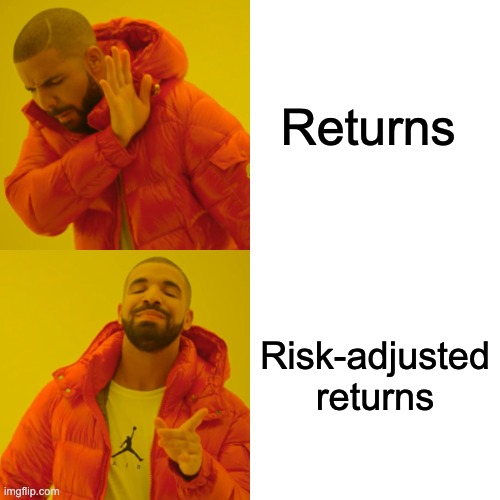
9y073b

There are lots of ways to asses the risks that are factored into “risk-adjusted” returns.

A widely used shortcut is to look at how much an investment gains (or loses) compared to a super safe benchmark — usually US government debt. Then compare that excess gain to the volatility of the investment. (That is, how much its price swings up and down.)

A Stanford economist by the name of William Sharpe came up with a handy formula that spits out a number — known as the Sharpe Ratio — that does just that.

Long story short, the higher the Sharpe Ratio, the better the risk-adjusted returns.

That seems like a good number to have. But for investors hoping to garner low-anxiety gains in the future, there’s a problem: those gains and price swings accounted for in the Sharpe Ratio have already happened. And there’s no guarantee the investment will perform that way in the future.

But maybe there’s a way to find such investments. The big brains down at Goldman Sachs have come up with a measure they call “prospective Sharpe ratios” to, well, prospect for such stocks.

It’s constructed out of expected price gains — a consensus price target published by Wall Street analysts — and a measure of expected price volatility, known as implied volatility, which is a statistical byproduct of the options market.

Analysts used this ratio to scour the S&P 500 for such stocks, which created one of Goldman’s themed baskets of stocks. They just updated the list.

So here, by Goldman’s reckoning, are the S&P 500 stocks that the market sees as the best bets for “risk-adjusted” returns over the next year.

By design, this isn’t the most glamorous list of stocks. LKQ Corp. tops it. (The company owns auto scrapyards, disassembles vehicles and sells them for parts.)

And many others on the list have had especially ugly rides in the market so far this year, like Omnicom, a giant in an industry — advertising — that’s been upended by AI. Viatris has been in the market’s penalty box since the FDA blocked imports from one its key plants in India after finding violations during an inspection. Vaccine maker Moderna has been badly battered by market sentiment as a result of big changes to US health policy under Health & Human Services Secretary Robert F. Kennedy Jr., a longtime leader of the US anti-vaccine movement.

So as you can see, even these companies are not free of risks. In the markets, nothing really is. But smart investors tried to get paid as much as possible for taking them.

More Markets

See all Markets
markets

TSMC surges as Taiwan eases single-stock investment limits for funds

TSMC’s ADRs jumped 3% in premarket trading on Friday after the island’s financial regulator announced plans to ease limits on funds’ allocations to single funds.

Previously, active fund managers were limited to allocating up to a maximum of 10% of their net assets into any one company. Under the revised framework, local equity funds and active exchange traded funds that solely invest in Taiwanese stocks can allocate up to 25% of their assets in any listed company if it has a weighting above 10% in the Taiwan Stock Exchange.

The new rule, announced Thursday, will come into effect after the regulator issues an order on Friday. Relaxing the long-standing rule will mean fewer restrictions on local money managers to take full advantage of TSMC’s skyrocketing share price in recent years. TSMC, now Asia’s largest company by market cap, has seen its share price surge 150% in the past year — adding more to its gains in the last few days after crushing estimates in its first-quarter results.

TSMC is currently the only company that meets that 10% criterion, holding some 44% weight in Taiwan’s benchmark index, though the latest change also moved other large-cap Taiwanese stocks higher on Friday.

markets

Intel’s earnings send fellow CPU sellers Arm and AMD higher

A strong set of Q1 results and Q2 guidance from Intel is sending shares of fellow CPU sellers Arm Holdings and Advanced Micro Devices about 6% and 4% higher in postmarket trading, respectively.

Intel’s robust report is seemingly a rising tide that lifts all boats in the industry, not just a company-specific dynamic.

Arm recently pivoted to designing and selling CPUs for data center customers (like Meta!) in addition to its long-standing business of licensing out the design architecture.

And AMD, of course, has been a well-established giant in the space before it ever started offering GPUs.

It’s the latest reminder that the AI boom isn’t just juicing demand for the most advanced chips, but also memory, older-school units, and a wide array of hardware.

markets

Intel crushes Q1 earnings expectations, forecasts strong Q2 revenue, shares soar

Intel shares surged in after-hours trading Thursday after the semiconductor giant reported much better-than-expected Q1 earnings and sales numbers, as well as robust guidance for Q2.

Intel reported:

  • Q1 revenue of $13.6 billion vs. a consensus expectation for $12.42 billion.

  • Adjusted earnings per share of $0.29 vs. the $0.02 consensus estimate from FactSet.

  • A forecast for Q2 sales of between $13.8 billion and $14.8 billion vs. analysts’ $13.11 billion expectation.

  • A forecast for adjusted Q2 EPS of $0.20 vs. Wall Street expectations for $0.10.

“The next wave of AI will bring intelligence closer to the end user, moving from foundational models to inference to agentic. This shift is significantly increasing the need for Intel’s CPUs and wafer and advanced packaging offerings,” Intel CEO Lip-Bu Tan said in the company’s earnings release.

The quarterly result was clearly a surprise to both analysts and investors. Shares were up 15% shortly after the report in after-hours trading — despite having risen roughly 50% already in the month of April before the results were released.

Intel’s results could not be more different from the previous quarter. In its Q4 report, Intel issued lackluster guidance for Q1, which it blamed on a dearth of available silicon wafers it could use to make finished chips. The stock plunged 17% the next day.

“Intel was explicit on the Q4 call that they were living hand-to-mouth on wafers,” Cody Acree, a senior semiconductor analyst at brokerage firm Benchmark/StoneX, said in a brief phone interview with Sherwood News Thursday. “If this kind of upside was possible, than why the ultraconservative guidance?”

The Q1 results are a significant coda to what has been one of the best periods of share price performance for the company in decades. The stock has more than tripled over the last 12 months.

That run-up, however, had seemed to far outpace Intel’s actual business results, resulting in a nosebleed-inducing forward price-to-earnings valuation nearly 100x expected earnings over the next 12 months, dwarfing even the valuations the company was receiving during the peak of the dot-com boom of the 1990s. But the Q1 numbers suggest the market was picking up good vibrations that seem to have been borne out.

markets
Saleah Blancaflor

The national average of US gas prices drops to $4.03

Drivers can breathe a small sigh of relief... for now. The national average gas price has gone down $0.06 since last week to $4.03 per gallon, according to the American Automobile Association.

The national average was at $4.09 per gallon a week ago.

Meanwhile, US crude oil prices have gone under $100 per barrel, which has played a part in helping drive down the cost of gas for customers. But how long the downward trend will continue remains uncertain due to instability along the Strait of Hormuz.

Loading...
 

(Event contracts are offered through Robinhood Derivatives, LLC — probabilities referenced or sourced from KalshiEx LLC or ForecastEx LLC.)

Gas prices are currently the highest theyve ever been this time of the year going back to 2022, when the national average was $4.11 on April 23.

As we head into the end of April, prediction markets currently show traders pricing in an 81% chance the price of gas could still rise above $4.10 by the end of the month.

Meanwhile, US crude oil prices have gone under $100 per barrel, which has played a part in helping drive down the cost of gas for customers. But how long the downward trend will continue remains uncertain due to instability along the Strait of Hormuz.

Loading...
 

(Event contracts are offered through Robinhood Derivatives, LLC — probabilities referenced or sourced from KalshiEx LLC or ForecastEx LLC.)

Gas prices are currently the highest theyve ever been this time of the year going back to 2022, when the national average was $4.11 on April 23.

As we head into the end of April, prediction markets currently show traders pricing in an 81% chance the price of gas could still rise above $4.10 by the end of the month.

Latest Stories

Sherwood Media, LLC produces fresh and unique perspectives on topical financial news and is a fully owned subsidiary of Robinhood Markets, Inc., and any views expressed here do not necessarily reflect the views of any other Robinhood affiliate, including Robinhood Markets, Inc., Robinhood Financial LLC, Robinhood Securities, LLC, Robinhood Crypto, LLC, Robinhood Derivatives, LLC, or Robinhood Money, LLC. Futures and event contracts are offered through Robinhood Derivatives, LLC.

