Markets
GameStop volumes

GameStop’s trading volumes are ridiculous

Here we go again?

It’s all feeling very 2021 this week as GameStop — which, until three years ago, was a quietly ailing gaming retailer — has once again regained its status as the meme stock du jour, with shares in the company gaining more than 180% so far this week.

Why GameStop is soaring, whether its rise was weeks in the making (options trading suggests maybe yes?), and how this saga will end for the company and its flurry of new investors, are all fascinating questions. Another is: just how much money is actually changing hands in GME stock?

Although we might be numb to meme stock moves at this point, it’s worth reminding ourselves just how extraordinary these phenomena are. Stocks moving 50%+ in a day isn’t completely unheard of, but those kinds of swings are usually reserved for thinly-traded stocks with low liquidity. That’s not what’s happening here.

GameStop volumes

Data from Koyfin reveals the list of the most-traded stocks in the US & Canada yesterday. The table reads: Nvidia, Tesla, GameStop, Apple and Berkshire Hathaway. Right there, in between some of the biggest companies on Earth which trade billions of dollars everyday, is GameStop.

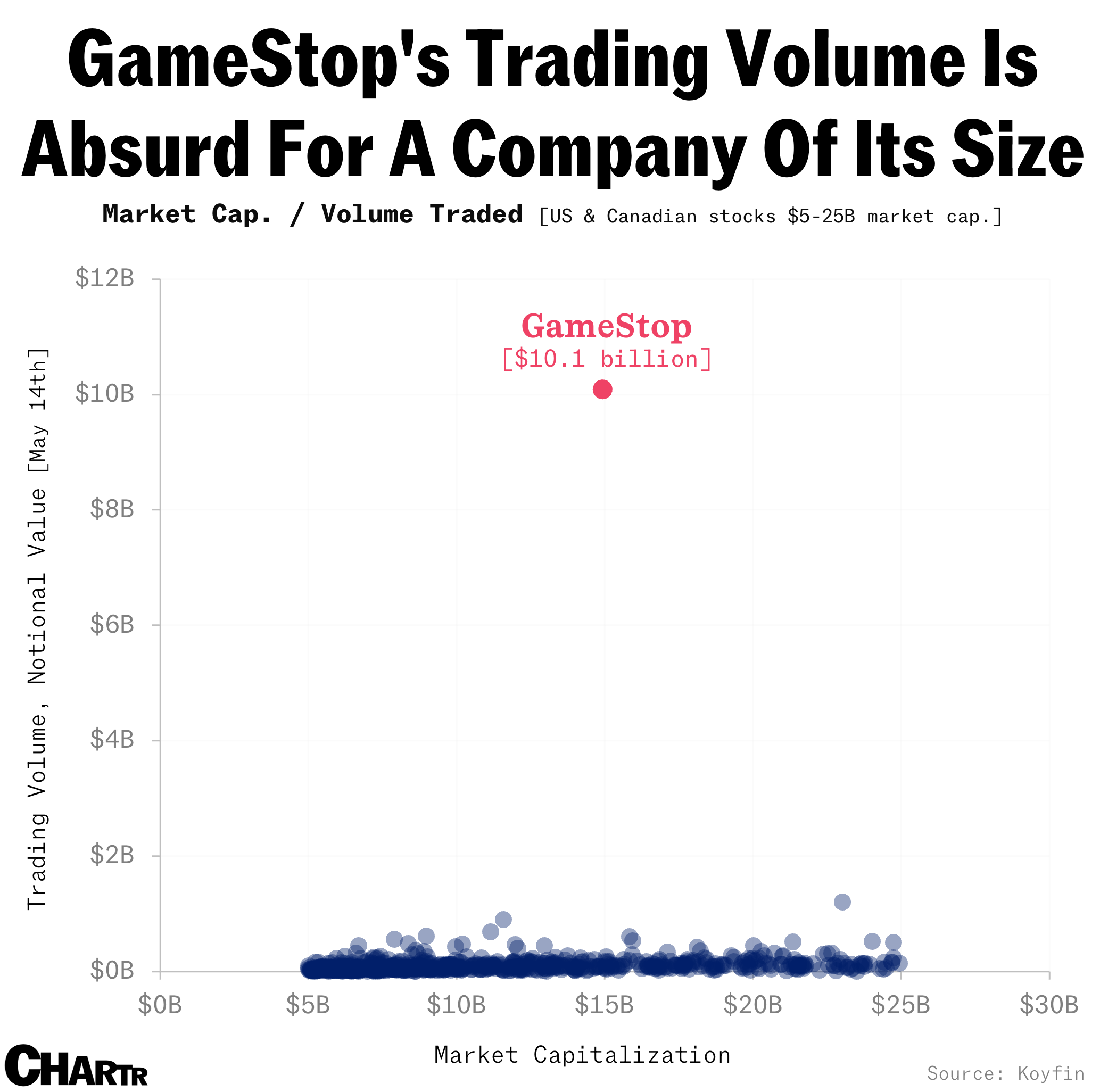
Indeed, for companies of its size (which we’ve defined loosely as $5-25 billion, but recognize that it’s something of a moving target), GME’s trading volume — which surpassed $10 billion yesterday — is a serious outlier. The average for that subset of similar companies? Just $94 million.

More Markets

See all Markets
markets

Oracle plans to raise up to $50 billion in debt and equity this year to fund its AI ambitions

On Sunday evening, Oracle told investors just how much money it’s going to need to from them to fund its data center expansion efforts.

Management said it plans to raise $45 billion to $50 billion this calendar year, split roughly equally between debt and equity in a bid to maintain its investment grade rating.

The lion’s share of the equity raise ($20 billion) will come from at at-the-money offering that enables the firm to opportunistically issue shares. This year’s debt issuance will come in one fell swoop, per the company, and happen early in the year.

Carl Quintanilla Vital Knowledge ORCL
Source: Bluesky

On the bright side, at least this is an answer. During the conference call that followed Q2 results in December, Oracle said that capex for the fiscal year would be $15 billion higher than previously anticipated. When asked how much money the company would need to raise, CEO Clay Magouyrk said “it’s hard to answer that question exactly,” before saying he thought it would be “less, if not substantially less” than $100 billion in order to complete its multi-year AI buildout.

“Oracle is raising money in order to build additional capacity to meet the contracted demand from our largest Oracle Cloud Infrastructure customers, including AMD, Meta, NVIDIA, OpenAI, TikTok, xAI and others,” per the press release.

Put it in alphabetical order all you want, we all know who your biggest customer is!

Oracle’s (over)reliance on OpenAI as a source of future revenues has prompted markets to view the firm as less creditworthy.

Gold and silver plunge, suffering their worst losses since the 1980s

Gold and silver suffered their worst losses in decades on Friday, with the iShares Silver Trust falling more than 30% at one point during afternoon trading before recovering slightly.

After recently crossing $5,000 per ounce for the first time, golds dip was relatively muted compared to silvers rout, but nevertheless eye-watering for a traditional safe haven asset. At one point, golds intraday dip exceeded 10%, its worst intraday drop since the 1980s and surpassing its declines seen during the 2008 financial crisis, per Bloomberg.

Silvers drop was its worst in percentage terms since 1980.

Gold, and particularly silver, have been pushed higher recently by a storm of retail trader enthusiasm for the metals, as well as more traditional drivers of precious metals such as geopolitical risks and concerns over a fall in the dollars value due to trade wars and possibly waning central bank independence.

Leveraged ETFs that hold gold and silver futures have become increasingly popular trading vehicles amid the parabolic moves in precious metals prices, and likely contributed to the magnitude of the unwind today.

Case in point: look at silver futures for delivery in March. That’s the dominant contract held by the ProShares Ultra Silver ETF, which offers exposure to 2x the daily move in the shiny metal. Volumes exploded (and the contract rebounded modestly) right around 1:25 p.m. ET, which is when silver futures settled and around the time the ETF performed its daily rebalancing (which in this case, involved massive selling).

Gaming stocks plunge following release of Google’s AI tool that can create playable, copyrighted worlds

Shares of major gaming companies are plunging on Friday as investors get a deeper look at the capabilities of Google’s new generative-AI prototype, Project Genie.

The tool allows users to “create and explore infinitely diverse worlds” with a text or image prompt. Users have already exposed its ability to realistically recreate knockoffs of copyrighted games from Nintendo and other gaming companies.

As users experiment with recreations of game worlds like Take-Two’s “Grand Theft Auto 6,” shares of major gaming companies are sinking. Unity Software, the maker of the popular Unity game engine, is down over 25%, while gaming platform Roblox is down about 9%.

Latest Stories

Sherwood Media, LLC produces fresh and unique perspectives on topical financial news and is a fully owned subsidiary of Robinhood Markets, Inc., and any views expressed here do not necessarily reflect the views of any other Robinhood affiliate, including Robinhood Markets, Inc., Robinhood Financial LLC, Robinhood Securities, LLC, Robinhood Crypto, LLC, or Robinhood Money, LLC.