
Markets
Money ring surrounding earth
(Getty Images)

Fund managers are worried about AI overinvestment. Bank of America is worried about fund managers overinvesting.

For the first time ever, fund managers surveyed by Bank of America think companies are investing too much.

Luke Kawa

For the first time ever, fund managers surveyed by Bank of America think companies are investing too much.

“Bad news…1st time in 20 years investors say companies ‘overinvesting’ (read ‘slow down, hyperscalers’),” Chief Investment Strategist Michael Hartnett wrote, commenting on the results of BofA’s monthly fund manager survey. “Asked about the biggest ‘tail risk’ for the economy and the markets, 45% of FMS investors said ‘AI bubble’ (up from 33% last month).”
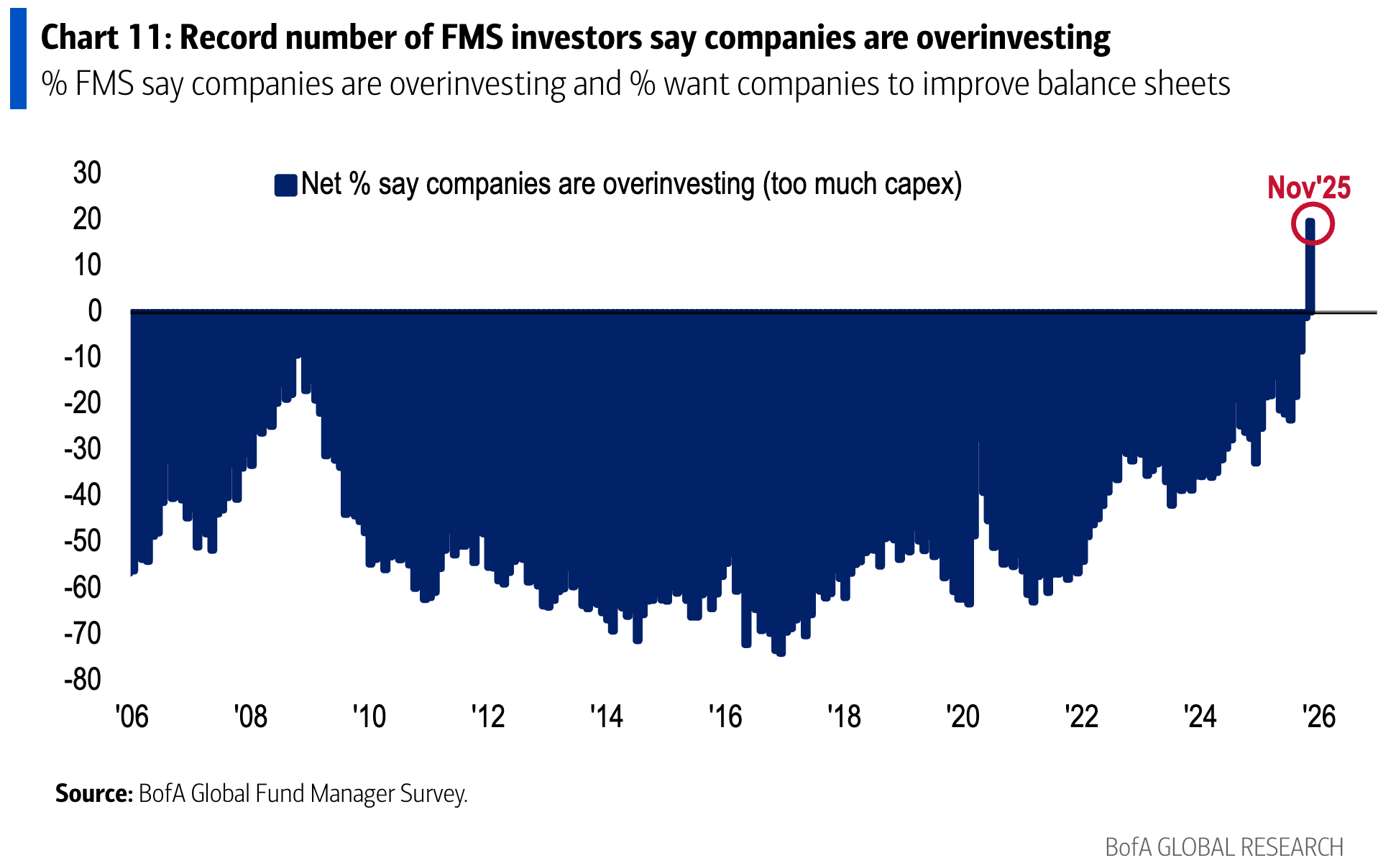
BofA capex overinvesting

Now, what this really shows, as Hartnett alludes to, is a very concentrated industry-specific concern around the aggressiveness of the AI build-out. Over on Bluesky, Bespoke analyst George Pearkes flagged that net private investment as a share of US GDP has effectively been a flat line for years.

“Just shows how tech-centric investors are. AI of course might be over-investing but the non-tech economy is stagnating or in recession and definitely isn’t overinvesting,” added Conor Sen, founder of Peachtree Creek Investments. “Office construction is weak, residential construction is weak, the freight industry is in recession, autos are pulling back on some EV spending.”

Fund managers would prefer that companies improve their balance sheets or return more cash to shareholders rather than boost business investment. That would certainly be a shift in what’s been rewarded in the stock market.

Year to date, a basket of the most capex-intensive stocks in the S&P 500 compiled by Goldman Sachs is up over 21%, outperforming baskets of companies with strong balance sheets and high shareholder returns by about 14 and 5 percentage points, respectively. Firms with high levels of investments have also bested these other cohorts over the past one and three months.

The irony about this survey is that while it says fund managers purport to be worried about overinvestment, if anything, BofA suggests that the overinvestment they should be worried about is their own: average cash levels among those surveyed dipped to 3.7% from 3.8%.

“Note cash levels of 3.7% or lower has occurred 20 times since 2002, and on every occasion stocks fell and Treasuries outperformed in the following 1-3 months,” says Hartnett, who called this low level of dry powder a “sell signal.”
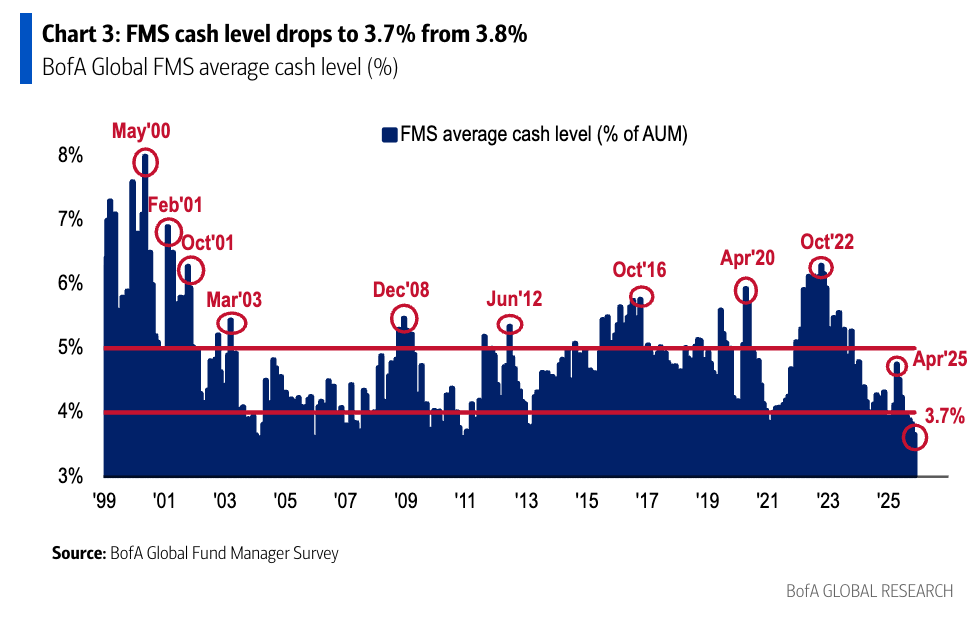

BofA cash levels

More Markets

See all Markets
markets

Palantir rises on Navy deal announcement

Palantir rose early Wednesday after officially announcing a new deal — valued at $448 million — with the US Navy to manage its submarine maintenance and supply chain.

While Palantir has been rapidly building its business selling software that helps private enterprise companies better use AI technology, its largest customer remains the US government.

markets

Nextdoor soars after Eric Jackson, architect of Opendoor rally, lays out bullish thesis

Nextdoor rose by more than 30% in premarket trading after hedge fund manager Eric Jackson, the architect behind the rally in Opendoor Technologies earlier this year, said he is long on the neighborhood social media platform.

In a thread on X, Jackson explained that Nextdoor has an undervalued opportunity to leverage AI, similar to Opendoor or Carvana, another company he has been bullish on. “Nextdoor checks every layer and is ready like them for a massive re-rating,” said Jackson, head of Toronto-based EMJ Capital, referring to other stocks he is bullish on.

Nextdoor generates revenue predominantly through advertising sales, and has not yet reported a profitable quarter since going public in 2021. As of market close on Tuesday, the company was down about 17% this year and 80% since its IPO.

markets

Chewy’s Q4 forecast underwhelms, overshadowing solid Q3 results

Chewy tumbled as much as 6.7%, before paring its losses, in premarket trading on Wednesday after the online pet product retailer issued softer-than-expected Q4 guidance, which appeared to overshadow solid Q3 numbers.

In the third quarter, revenues rose 8.3% year over year to $3.12 billion, slightly above the $3.1 billion estimate compiled by Bloomberg, while adjusted earnings per share of $0.32 topped the $0.30 forecast. In a statement released today, CEO Sumit Singh said the company continues to outperform the pet category and expand market share, with profits once again growing faster than sales.

The company also revealed that it had 21.155 million active customers, up nearly 5% year on year, and that its autoship (recurring, subscription-like) sales made up nearly 84% of its total revenue.

However, Chewys Q4 outlook disappointed investors, as it expects $3.24 billion to $3.26 billion in revenue and $0.24 to $0.27 in adjusted EPS, both below Wall Streets estimate of $3.26 billion and $0.29, respectively, per Bloomberg.

As of 8:35 a.m. ET, shares have pared back earlier losses and are up 0.66% in premarket trading, bringing year-to-date gains to 3.91%.

markets

China’s DeepSeek is using banned Blackwell chips to train its newest AI model, The Information reports

DeepSeek, the Chinese AI startup whose chatbot built on the cheap turned the US tech world upside down in early 2025, is using “several thousand” of Nvidia’s top Blackwell chips to build its next model, per The Information.

The outlet cites six people with knowledge on the scheme, where the advanced chips, which are not allowed to be sold to China, make their way into the world’s second-largest economy piecemeal after servers are disassembled.

The Trump administration recently gave the go-ahead for Nvidia to send the H200, the best chips from its Hopper generation, to China. Though the US president teased discussing the possibility of permitting Blackwell sales ahead of his meeting with President Xi at the end of October, that item was not on the agenda.

DeepSeek said that its V3 model — the one that captured global attention earlier this year — was trained using Nvidia’s H800 GPUs, but some observers in the AI industry argued that the startup likely had access to more advanced compute. The White House and the FBI reportedly investigated this amid signs of chip smuggling.

Earlier this year, Singapore charged a group of men with fraud for allegedly routing servers containing Nvidia chips to Malaysia (with their ultimate destination unknown, but presumed to be China).

Oracle Earnings Market Sentiment

Oracle’s earnings unlikely to get the giddy reaction they did last time

In September, news of Oracle’s massive deal with OpenAI sent shares to a record high and created over $200 billion in market wealth in minutes. All that value has since disappeared.

Latest Stories

Sherwood Media, LLC produces fresh and unique perspectives on topical financial news and is a fully owned subsidiary of Robinhood Markets, Inc., and any views expressed here do not necessarily reflect the views of any other Robinhood affiliate, including Robinhood Markets, Inc., Robinhood Financial LLC, Robinhood Securities, LLC, Robinhood Crypto, LLC, or Robinhood Money, LLC.