


From God to Gordon Gekko: New book tracks how greed became good
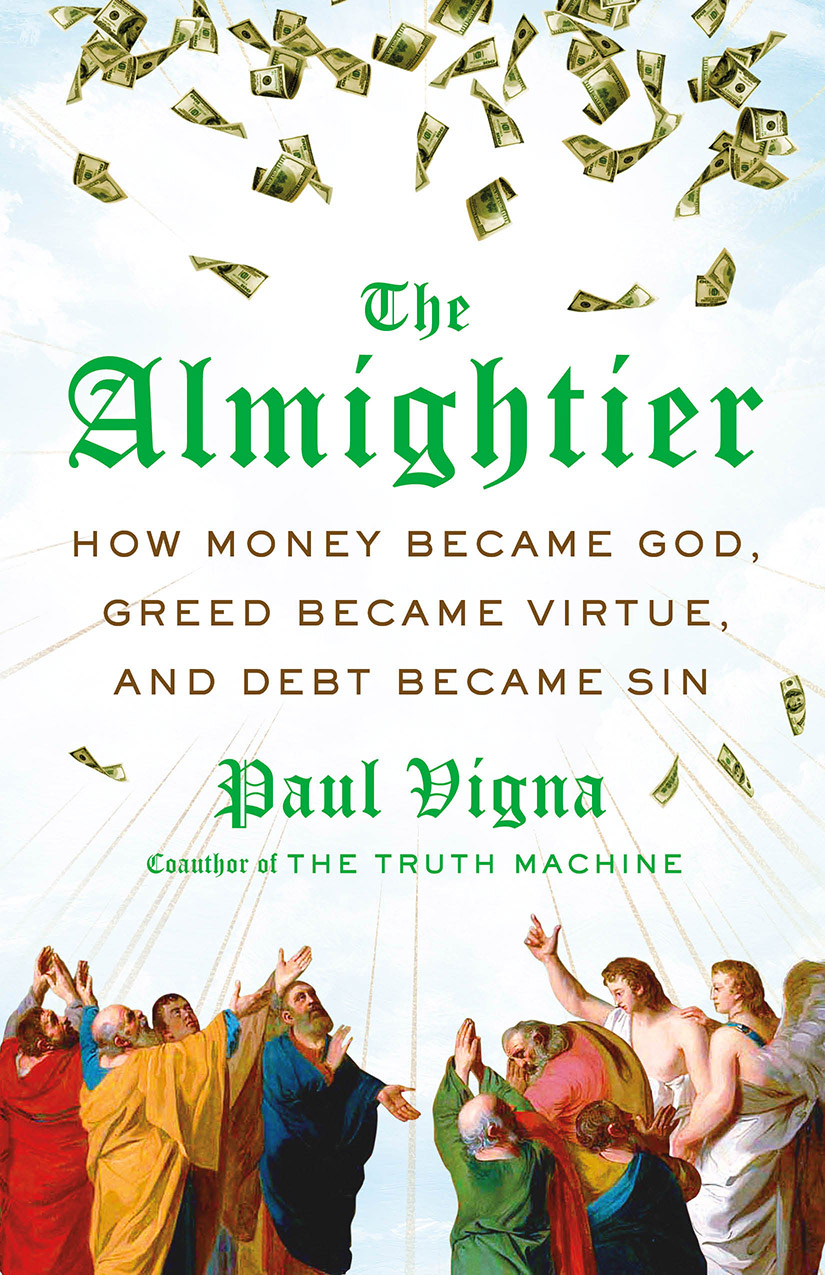
Paul Vigna’s new book, “The Almightier,” follows the transformation of avarice from a mortal sin in medieval Europe to a broadly fetishized force that drives the modern world.
This is the first in Sherwood News’ Q&A series, Talk Your Book, featuring brief discussions with writers of new work on finance, economics, and markets.
Paul Vigna’s first two books were about as far from the 14th-century Florence of the Medicis as you could get.
“The Age of Cryptocurrency” (2015) was one of the first books on the topic written with a general readership in mind, after Bitcoin exploded onto the national consciousness. Its follow-up, “The Truth Machine” (2018) — both coauthored with fellow financial journalist Michael J. Casey — was even more forward-looking, speculating on the potential impact of blockchain technology.
Vigna’s latest, “The Almightier,” instead turns to the past, digging deep to the history of late medieval Italy and early modern capitalism to understand how greed, which for centuries had been one of the deadliest sins, emerged from the shadows and came to be embraced by both Western secular and spiritual authorities alike.
Such a book could easily be a slog for readers. But Vigna — full disclosure: a former colleague — delivers a readable romp through the theological and intellectual underpinnings of what would become capitalism, all delivered in Vigna’s everyman New Jersey twang.
Vigna took a few minutes to chat with Sherwood about how he came to write the book, what he hopes readers get from it, and the connections he sees between the world of crypto and the world of the Medicis.
(This interview has been edited for clarity and concision.)
Matt Phillips, Sherwood News: Paul Vigna, great to talk to you. Congrats on the new book.
Paul Vigna: Thanks Matt. I appreciate it.
Sherwood: It’s called “The Almightier: How Money Became God, Greed Became Virtue, and Debt Became Sin.” It essentially traces the origin and development of the idea that, as Gordon Gekko said, “Greed is good.” That is, it tracks the transformation of greed from a sin to a virtue. Do I have that right?
Vigna: That’s it. The bulk of the book is spent explaining that evolution. You know, a thousand years ago, the church view of usury was that it was completely banned. It was literally the root of all evil. It was just the worst possible thing. So the question is, well, how did we get to today where not only is it not seen as the root of all the evil, but the pursuit of wealth is a virtue and the central incentive of our entire culture?
Sherwood: And you track this idea back to a pretty obscure figure from late medieval Italy.
Vigna: There was an Italian writer named Poggio Bracciolini in the 1400s. He worked in the church and was basically the pope’s secretary, and he was a very close friend of Cosimo de’ Medici, the Florentine banker. Bracciolini ran in this extremely influential circle of Italians in the 1400s.
He wrote a dialogue that was called “On Avarice.” It really fascinated me because within this dialogue — as far I’ve been able to find — is the first time that somebody was coming out and saying, no, actually, you know what? Greed is — his words were, “avarice sometimes is beneficial.”
If you go watch the clip in Wall Street, you know, “Greed, for lack of a better word, is good.” The cadence is almost the same exact cadence.
Sherwood: So he’s not just saying maybe greed isn’t always bad under church law; he’s making the affirmative case for it.
Vigna: He’s saying not only is greed not a bad thing, but that greed is a natural thing. Greed is a human emotion like any other human emotion. Moreover, greed is what drives every single person to do anything. If people didn’t want more than they already have, everybody would be a subsistence farmer and there would be no need to even have a society. There would be no society.
He lived in Florence and asked, who makes this city great? The wealthy. They’re the ones who have the money to build the walls. They’re the ones who have money to hire an army to protect the city. They’re the ones that have the the money to help us build the churches and build the monasteries. We need men who will go out there and make a lot of money.
Sherwood: One of the most fascinating parts of the book was about how this innovation of double-entry bookkeeping reflected Catholic anxieties about eternal damnation. Could you sum that up or talk a little bit about that?
Vigna: In the 1400s in medieval Europe, people were obsessed with confession. This was in the decades after the black death, when half the continent had died. They really thought that God was coming down and the end times were near. So you have this obsession with justifying yourself in front of God, justifying your actions. You don’t want to go to hell.
What happens is you have these merchants who also are worried about the fact that they are engaged in usury. They are engaged in practices that the church frowns upon.
And double-entry bookkeeping also came into Europe — from the Middle East, it was an Arab invention — in the 1400s. What’s different about double-entry bookkeeping is that every transaction is recorded as both a credit and a debit, so for everything that comes in, something goes out.
This allows merchants to tell a story about their business. It’s a narrative where for every dollar that they get... well, it wasn’t a dollar obviously...
Sherwood: A florin? A ducat?
Vigna: Right, but for everything that comes in, something equal is going out. That is, he’s providing a service to society. These guys are not just greedy merchants taking, taking, taking. They are also giving. That’s sort of the underlying impetus for double-entry bookkeeping taking off in Europe in the 1400s.
Sherwood: Let’s fast-forward to today. The book is basically a history and not designed to be a comment on the current state of society’s relationship with greed, but I’m sure you see connections between the ideas in the book and what we’re seeing every day in the markets and society more broadly.
Vigna: I do absolutely see how this book and the ideas in the book connect to what’s going on. My hope was that people would read it and make those connections on their own.
I think our problem is that we still have a view of money that’s rooted in an era when there was a lot of resource scarcity — in the 1400s, in the 1700s, before the Industrial Revolution, before we had all the technology of the last century.
So I think capitalism, our ideas about money, all these things were formulated 600 years ago. And we haven’t really changed our attitudes about it. I don’t think our economics actually reflect the conditions that exist today.
In my mind, money is supposed to be part of a system for distributing resources. That’s what economics is, you know? You have a group of people who come together as a society because it’s better for us to all work together and contribute our skills and collectively build something bigger than any of us could do on our own. Money plays a big, important role in that.
I’m not trying to say we should have a moneyless society; I’m not saying capitalism is awful. I’m saying that what has happened is that we’ve come to have this very misguided view of what money is.
The original idea was that you should do something positive and contribute to society, and if you do, you’ll get rewarded. (It does happen and I’m not saying it never happens.) But you also have huge swaths of people who have figured out how to game this system.
Sherwood: It’s almost like an inversion of that anxiety that the Florentine merchants had about things being in balance. They were anxious to be seen to be giving — products, wool, or some sort of societal benefit — as much as they were getting monetarily.
It’s interesting to compare that with a world you know a lot about, crypto, where it’s very clear that there’s a lot of avarice, but what’s the benefit? Where’s the benefit to society?
Vigna: You look at Bitcoin, look at Ethereum, look at the technology — yeah, I think the technology is very interesting. It fascinated me 12 years ago, and it fascinates me today.
But what service is bitcoin providing to the world right now? The answer, quite frankly, is none. I would be willing to bet, fairly confidently, that at least 90% of all bitcoin activity is just speculation on the price. That’s what bitcoin has built. Well, what’s the point of that?
It kind of gets exactly to what I’m saying. Money has become its own reward.
Sherwood: There’s no entry on the other side of the balance sheet. Crypto may be worth $4 trillion — in other words, it may have debited society $4 trillion — but where’s the offsetting credit?
Vigna: They had a long time — a long time — to build something valuable and useful to society. They had a window of opportunity where nobody else was building digital money systems, and they could have done it. And they didn’t, because they got obsessed with the price.
To me, crypto really illustrates very cleanly everything I’m talking about in the book.




