
Markets
Business consept, Financial graphs
(Getty Images)

Foreigners have piled into Japan’s stock market — now more locals are being encouraged to invest

Tokyo wants to shake off its cash-hoarding habits and get young people in Japan investing again.

Hyunsoo Rim

At Berkshire Hathaways annual meeting last week, Warren Buffett reaffirmed his bet on Japan’s trading houses — now a combined 9.3% of Berkshire’s stock portfolio, its fifth-largest holding. His successor and soon-to-be CEO of the conglomerate, Greg Abel, said they could hold the stakes “50 years or forever.”

That mindset, though, is hardly the norm back home in Japan. For decades, the culture of hoarding cash instead of investing took hold among older generations, haunted by the 1990s asset bubble burst, when overheated stock and property markets crashed and burned. Indeed, ~54% of Japanese households keep their assets in cash or deposits today — compared to just 13% in the US and 31% in the UK — per The Economist, leaving plenty of room for overseas buyers to step in.
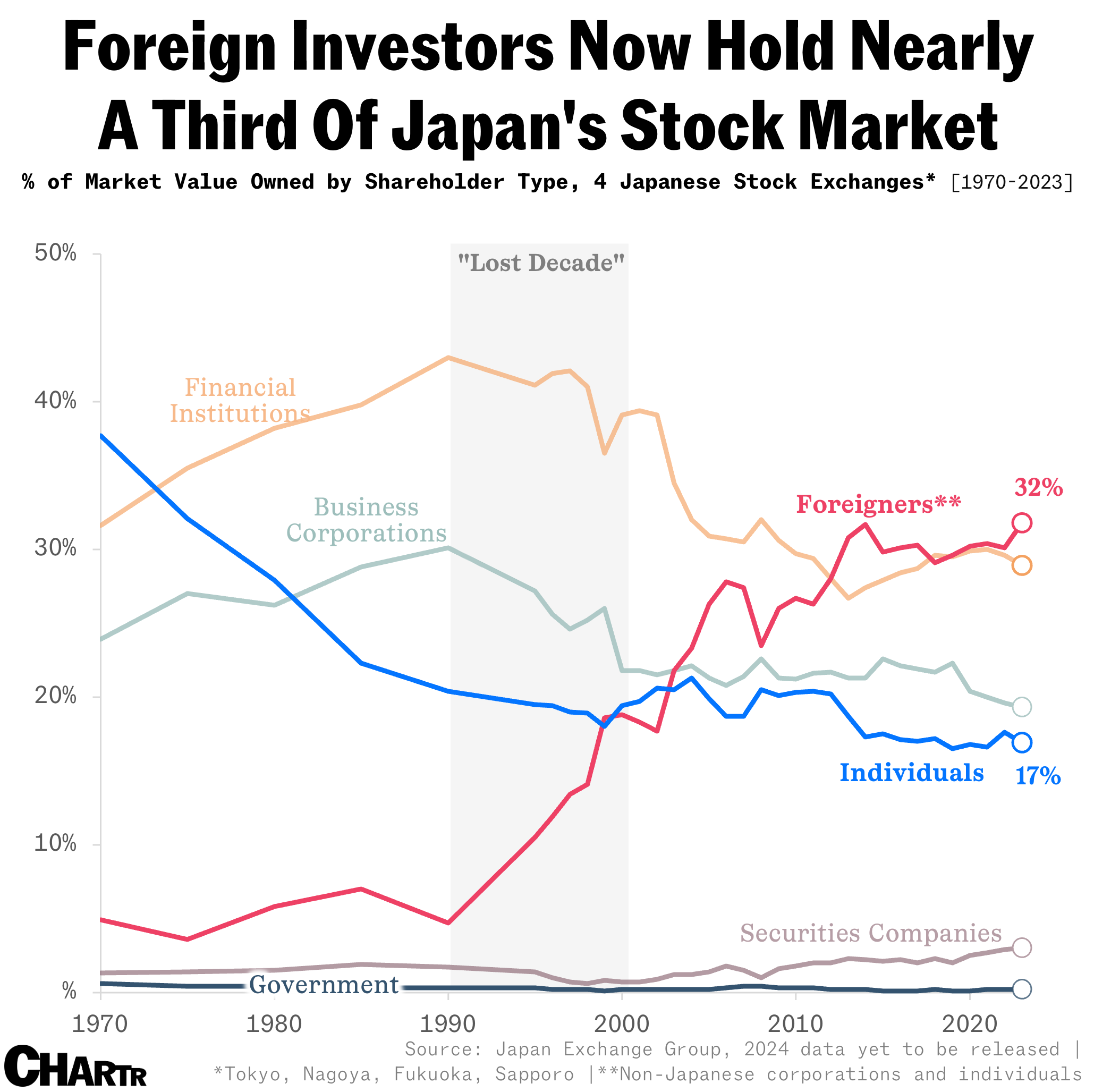
Japanese stock ownership
Sherwood News

According to Tokyo Stock Exchanges latest data, foreign investors now own 32% of Japans stock market, up sharply from 5% in the 1970s, while locals hold just 17%. And the gap might keep growing: as US stocks slumped amid tariff threats in April, foreign investors pumped a net $8.3 billion (¥1.2 trillion) into Japanese equities — a sharp reversal from net outflows in the previous two months, per data from Japan Exchange Group.

Lower the bar

Now, Japan is trying to lure its young, less trauma-ridden locals back into the market. The Tokyo Stock Exchange plans to lower the minimum investment threshold, aiming to make stocks more accessible, while the government expanded tax exemptions for retail investors last year. Its also promoting financial literacy among millennials and Gen Zs. All of this might be starting to pay off: according to the Investment Trusts Association, 36% of people in their 20s in Japan invested in mutual funds, stocks, and bonds last year, up nearly 3x from 2016.

More Markets

See all Markets
markets

Oracle slides after-hours after beating on earnings, missing on revenue

Shares of Oracle fell over 6% in postmarket trading, after beating earnings expectations for its second quarter while coming in slightly below analyst estimates for revenue.

Adjusted earnings per share were $2.26, up 54% year on year, blowing past analyst expectations of $1.64 per share.

Revenue for the quarter was $16.06 billion, up 14% year on year, but missing estimates of $16.2 billion.

Sales from Oracle’s cloud computing unit were $8 billion for the quarter, up 34% year on year. Analysts were expecting $8.8 billion.

Oracle shares got a huge boost in September, after announcing a $300 billion deal with OpenAI, but all of that value has since disappeared. Shares are up 30% for the year so far.

Last quarter, Oracle reported $455 billion in RPOs (remaining performance obligations, or backlogged business). This quarter, that figure shot up to $528 billion, up 438% year on year.

The company announced it has sold its interest in its Ampere chip company. Oracle Chairman and CTO Larry Ellison said, “We are now committed to a policy of chip neutrality where we work closely with all our CPU and GPU suppliers. Of course, we will continue to buy the latest GPUs from Nvidia, but we need to be prepared and able to deploy whatever chips our customers want to buy. There are going to be a lot of changes in AI technology over the next few years and we must remain agile in response to those changes.”

Latest Stories

Sherwood Media, LLC produces fresh and unique perspectives on topical financial news and is a fully owned subsidiary of Robinhood Markets, Inc., and any views expressed here do not necessarily reflect the views of any other Robinhood affiliate, including Robinhood Markets, Inc., Robinhood Financial LLC, Robinhood Securities, LLC, Robinhood Crypto, LLC, or Robinhood Money, LLC.
