Markets
US-ECONOMY-FEDERAL RESERVE-POWELL
US Federal Reserve Chair Jerome Powell (Kamil Krzaczynski/Getty Images)

Federal Reserve lowers policy rate by 25 basis points, dot plot signals 25 basis points in cuts for 2026

The Federal Reserve lowered its policy rate by 25 basis points to a range of 3.5% to 3.75% in its final scheduled meeting of 2025.

Luke Kawa

The Federal Reserve lowered its policy rate by 25 basis points to a range of 3.5% to 3.75% in its final scheduled meeting of 2025. The move was nearly universally expected by both economists and prediction markets.

“The Committee is attentive to the risks to both sides of its dual mandate and judges that downside risks to employment rose in recent months,” per the statement accompanying the decision.

The central bank also inserted the bolded words (emphasis added by us) into this sentence that had appeared in the previous statement, to nod at the idea that policymakers aren’t in a hurry to cut rates going forward: “In considering the extent and timing of additional adjustments to the target range for the federal funds rate, the Committee will carefully assess incoming data, the evolving outlook, and the balance of risks.”

During the press conference, Fed Chair Jerome Powell said the language indicated that the central bank is well positioned to wait and see how the economy evolves before taking any additional action.

The SPDR S&P 500 ETF was modestly lower before 2 p.m. ET, and rose as much as 0.4% before Powell’s press conference started. Stocks rose to session highs as he fielded questions from the press, with the SPDR S&P Regional Banking ETF performing particularly well.

The chair suggested that the labor market has probably been a little softer than headline job creation numbers suggest. Payroll growth is averaging about 40,000 per month since April, which is likely overstated by 60,000, Powell said. Tariffs are the biggest reason why inflation remains well above the central bank’s target, per Powell, and the labor market does not appear to be strong enough to be a catalyst for an acceleration in price pressures.

The central bank’s updated Summary of Economic Projections shows that the median policymaker anticipates it will be appropriate for the policy rate to go down to 3.375%, or another 25 basis points, by the end of 2026. That’s the same as the “dot plot” from mid-September, and in line with the consensus estimate from economists polled by Bloomberg.

There is high dispersion among Fed officials’ outlooks. Powell also reassured markets that despite what some members indicated on the dot plot, rates are still more likely to go down from here than up.

“I don’t think that a rate hike is anyone’s base case at this point, and I’m not hearing that,” he said. “When people are writing down their estimates of policy and where it should go, it is either holding here or cutting a little or cutting more than a little.”

Uncertainty over how much the Fed may ease going forward also reflected in event contracts, which had a more dovish tilt heading into this decision compared to the central bank. Event contracts on Kalshi showed the likelihood of 50 basis points or 75 basis points of easing above 20% apiece, with 25 basis points at 13%.

Compared to September, monetary policymakers are much more bullish on economic growth. The GDP growth forecast was upped to 2.3% from 1.8%.

The forecast for the unemployment rate to end 2026 at 4.4% was unchanged versus September, while the core PCE projection was nudged down a tick to 2.5%.

Three officials dissented from today’s decision. Governor Stephen Miran preferred a 50-basis point cut, while Chicago Fed President Austan Goolsbee and Kansas City Fed President Jeffrey Schmid voted for no change to rates.

At the Fed’s last meeting in October, Fed Chair Jerome Powell warned that a reduction at this meeting was “far from” a foregone conclusion. In the interim, a number of Fed officials (especially nonvoting members) expressed skepticism about delivering a rate cut or disagreed with easing already delivered by the US central bank to date in 2025. But the decisive turn in prediction markets occurred when New York Fed President John Williams said in a speech on November 21, “I still see room for a further adjustment in the near term.”


More Markets

See all Markets
markets

Budget airline stocks dip as Spirit pilots ratify contract that’ll help the carrier stay afloat

Low-cost airlines JetBlue and Frontier are trading lower on Thursday following the news that Spirit Airlines pilots ratified modifications to their labor contract that will lower costs for the carrier, which filed for bankruptcy in August.

According to the Air Line Pilots Association (ALPA), Spirit pilots approved a deal that included “temporary reductions to pay rates and retirement contributions.” Beginning January 1, hourly pay will be reduced 8% and retirement contributions will drop by half from 16% to 8%.

"Spirit pilots made a difficult choice that provides the Company with what it needs from labor to secure financing and complete its restructuring,” said Captain Ryan P. Muller, chairman of the Spirit Airlines Master Executive Council.

Wall Street sees Jetblue and Frontier as the biggest beneficiaries to Spirit’s woes, and both carriers have attempted to purchase Spirit in recent years.

markets

Planet Labs rips on strong earnings report

Satellite services company Planet Labs was on track for a new record closing high after rising more than 35% in early afternoon trading on Thursday.

The roughly $5 billion company posted better-than-expected quarterly results and guided toward higher-than-expected sales for the current quarter after the close of trading Wednesday.

“AI continues to be a major tailwind as the company is seeing significant demand through enhanced capabilities for its advanced satellite data solutions,” wrote Wedbush tech analyst Dan Ives, adding “We continue to believe the PL is well-positioned at the intersection of Space and AI.” He has an “outperform” — basically a “buy” — rating and a price target of $20 on the stock.

Other satellite services AST SpaceMobile and Rocket Lab also enjoyed a bump on Thursday, seemingly riding the momentum of Planet Labs’ numbers.

“AI continues to be a major tailwind as the company is seeing significant demand through enhanced capabilities for its advanced satellite data solutions,” wrote Wedbush tech analyst Dan Ives, adding “We continue to believe the PL is well-positioned at the intersection of Space and AI.” He has an “outperform” — basically a “buy” — rating and a price target of $20 on the stock.

Other satellite services AST SpaceMobile and Rocket Lab also enjoyed a bump on Thursday, seemingly riding the momentum of Planet Labs’ numbers.

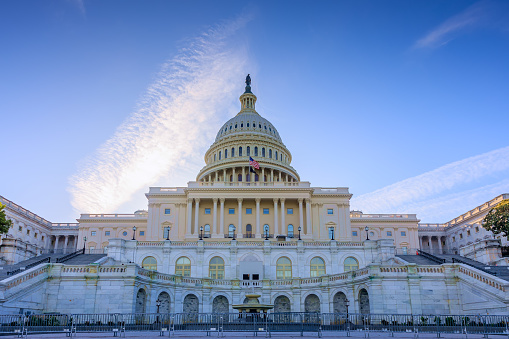
The East Side of the US Capitol Building in the early morning, Washington DC, USA.

Health insurers rise after the Senate rejects competing healthcare plans

The Democratic plan would have extended tax credits, while the GOP plan would have replaced them with HSAs.

markets

Rivian sure picked a bad time for its AI Day as investors dump tech stocks

The event coordination team at Rivian is probably having a bad one, as investors dumped the stock ahead of its “Autonomy and AI Day” amid a broader AI trade sell-off.

Heading into the event that began at noon ET, Rivian shares were down 5%, following a strongly negative reaction to Oracle’s earnings results. The stock began climbing as Rivian’s event started, but remains in the red on the day.

A year flush with tariffs and the end of the EV tax credit has pushed Rivian to pitch a techier version of its future. During Thursday’s event, Rivian said its forthcoming vehicles would ditch Nvidia chips for its own AI chips produced by Taiwan Semiconductor.

The vehicles will feature lidar sensors, enabling “level 4” autonomous driving (similar to Google’s Waymo), the company said. According to CEO RJ Scaringe, the updates will allow Rivian to “pursue opportunities in the rideshare space,” hinting at future robotaxi plans, which rivals Tesla and Lucid have already begun.

Wall Street appears skeptical of Rivian, with Morgan Stanley this week downgrading the stock to “underweight” and dropping its price target to $12. Lucid, which in October announced it’s planning a privately owned autonomous car built with Nvidia tech, also received a downgrade.

A year flush with tariffs and the end of the EV tax credit has pushed Rivian to pitch a techier version of its future. During Thursday’s event, Rivian said its forthcoming vehicles would ditch Nvidia chips for its own AI chips produced by Taiwan Semiconductor.

The vehicles will feature lidar sensors, enabling “level 4” autonomous driving (similar to Google’s Waymo), the company said. According to CEO RJ Scaringe, the updates will allow Rivian to “pursue opportunities in the rideshare space,” hinting at future robotaxi plans, which rivals Tesla and Lucid have already begun.

Wall Street appears skeptical of Rivian, with Morgan Stanley this week downgrading the stock to “underweight” and dropping its price target to $12. Lucid, which in October announced it’s planning a privately owned autonomous car built with Nvidia tech, also received a downgrade.

markets

Robinhood tumbles after November trading volumes post monthly drop across equities, options, and crypto

Robinhood Markets is getting crushed today, and not just because it’s the place where people go to buy AI stocks (which are under big pressure after Oracle’s earnings report). As stocks retreated in November, activity on the platform did, too.

(Robinhood Markets Inc. is the parent company of Sherwood Media, an independently operated media company subject to certain legal and regulatory restrictions.)

The brokerage reported that November trading volumes fell across equities, options, and crypto compared to October. Equity notional volumes were down 37% month on month, options contracts traded were off 28%, and crypto notional volumes fell double digits. The bright spot: its prediction markets business is still in boom mode, with 3 billion contracts traded, up 20% versus the prior month.

Cantor Fitzgerald analyst Brett Knoblauch trimmed his price target on the shares to $152 from $155 following this release, noting that this monthly decline was somewhat expected.

Latest Stories

Sherwood Media, LLC produces fresh and unique perspectives on topical financial news and is a fully owned subsidiary of Robinhood Markets, Inc., and any views expressed here do not necessarily reflect the views of any other Robinhood affiliate, including Robinhood Markets, Inc., Robinhood Financial LLC, Robinhood Securities, LLC, Robinhood Crypto, LLC, or Robinhood Money, LLC.