
Markets
2024-04-19-norway-fund-site

Norway now has a wealth fund worth $290k+ for every citizen of the country

Norway’s nest egg

The value of Norway's sovereign wealth fund rose 6.3% last quarter, adding a whopping $110 billion to the country’s stockpile despite technically falling just shy of its target benchmark return.

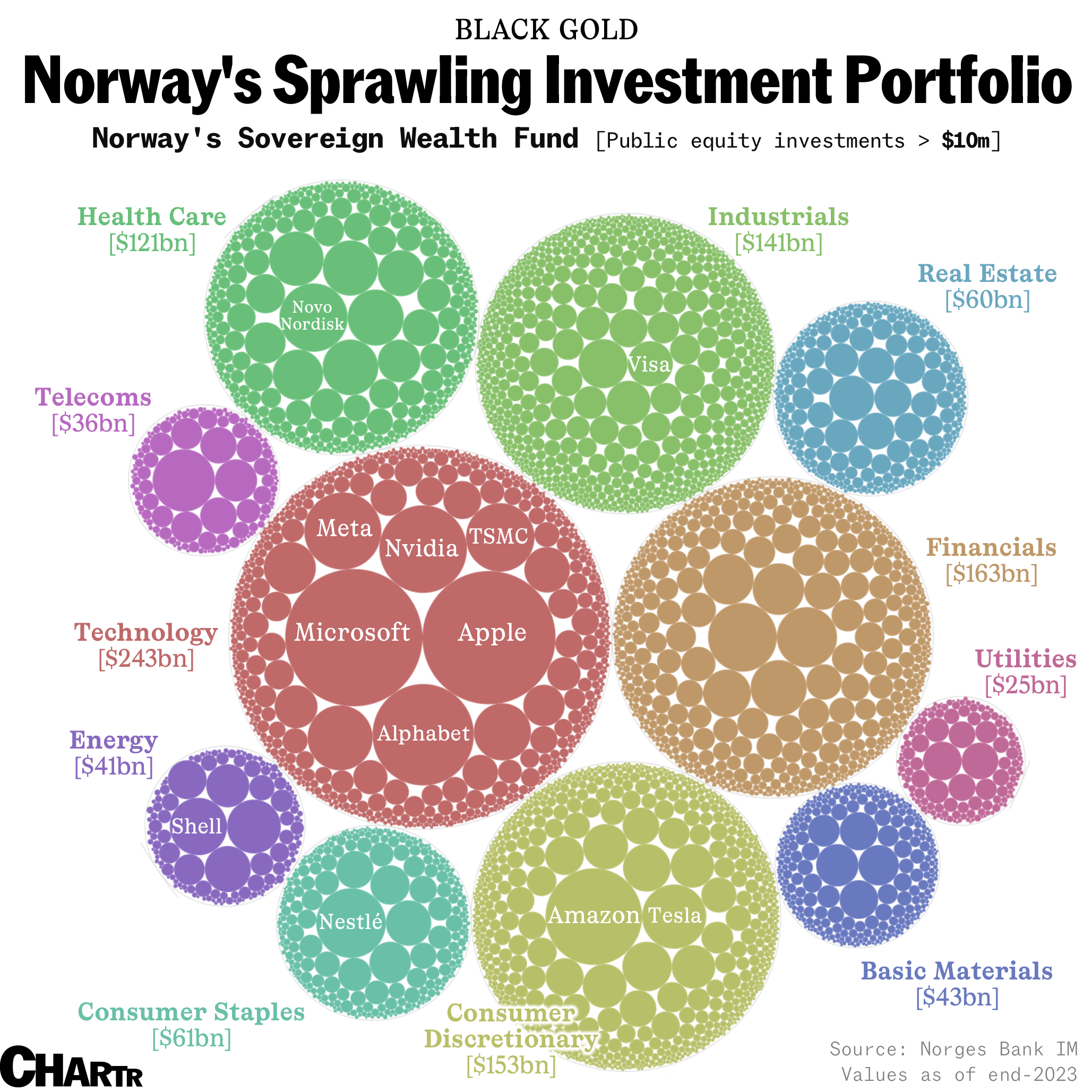
What started as the Norwegian government’s rainy day fund — somewhere to put its excess oil revenues in the 1990s — has become the largest investor on the planet. Today, 71% of its investment portfolio is in equities: a total of $1.1 trillion spread across more than 8,800 companies in 65 countries. Mirroring a diversified market index due to its sheer size, the fund has slices of every major sector. Visualized above are ~4,900 of the fund's equity investments: the smallest dots in the chart, the ones that you can barely see, represent $10 million stakes in individual companies.

Keeping it public

But, while its equities portfolio returned a respectable 9% in Q1, its fixed income and unlisted real estate investments saw losses, pulling down the overall return. Indeed, in the past 2 decades, the fund's equity investments have grown some 21x in value — and its success in public stocks is one reason why the Norwegian government last week confirmed it wants nothing to do with private equity, even as other institutional investors increase their exposure to the asset class.

In case managing this behemoth portfolio wasn't enough, you can catch the fund's chief hosting his podcast, where he interviews the likes of Elon Musk and Satya Nadella — two CEOs of companies that the fund owns a large slice of.

Slippery slope: When you're managing a pot of $1.6 trillion, even a tiny Excel error can result in a $92 million miscalculation.

More Markets

See all Markets
markets

Microsoft is in talks to shift its custom chip business to Broadcom from Marvell, The Information reports

The Information’s profile of custom chip specialist Broadcom includes this tidbit:

“And now Microsoft is also in talks to design future chips with Broadcom, which would involve Microsoft switching its business from Marvell, another maker of custom chips, according to one person involved in the discussions.”

Shares of Marvell Technology briefly dipped into the red after this report hit the wires, but then pared that drop to trade modestly higher. The company codesigns the Maia line of ASICs for Microsoft that are custom-built for Azure. Microsoft is its second-biggest hyperscaler client, behind Amazon.

Marvell tumbled on a ho-hum earnings report earlier this week before going on to surge after CEO Matt Murphy offered a $10 billion revenue target for its upcoming fiscal year, which was above analysts’ expectations.

Perhaps this is a bit of Information fatigue, given how Microsoft was quick to deny a report from the outlet earlier this week about how the tech giant lowered its sales targets for AI products.

markets
Luke Kawa

Memory stocks soar as AI supporting cast repairs damage from steep November declines

There’s not much rhyme or reason to it, but memory stocks are ending the week with a stellar showing.

Shares of high-bandwidth memory specialist Micron, hard disk drive sellers Seagate Technology Holdings and Western Digital, and flash memory company Sandisk are all rising today.

Three of these stocks dropped about 20% in November as credit risk seeping into AI and a downturn in speculative momentum stocks weighed on the theme, with Sandisk faring the worst.

Micron, Western Digital, and Seagate have all since rebounded strongly and are about 5% or less from reclaiming all-time highs, while Sandisk has made up the least ground.

While GPUs (and, more recently, TPUs) get most of the headlines, data centers also need a boatload of memory chips that store information and feed it to those processors.

markets

Ulta soars as Q3 beat sparks flood of price target hikes

Ulta’s latest makeover is happening on Wall Street. Shares leapt Friday morning as analysts hiked their price targets after the beauty retailer topped Q3 estimates and raised its full-year outlook after the bell Thursday.

Earnings came in at $5.14 per share, handily beating analyst expectations of $4.64. Revenue also topped estimates at $2.86 billion, compared with the $2.72 billion expected. Ulta has benefited from resilient beauty spending, even as consumers pull back elsewhere and hunt more aggressively for discounts.

Ulta now expects full-year net sales of about $12.3 billion, up from a prior forecast of $12.0 billion to $12.1 billion. The retailer also lifted its earnings outlook to $25.20 to $25.50 per share, up from $23.85 to $24.30 previously. This marks Ulta’s second straight quarter of hiking its sales and profit forecast. Analysts are taking note:

  • Goldman Sachs maintained its “buy” rating and raised its price target to $642 from $584.

  • DA Davidson maintained its “buy” rating and raised its price target to $650 from $625.

  • JPMorgan maintained its “outperform” rating and raised its price target to $647 from $606.

  • Baird maintained its “outperform” rating and hiked its price target to $670 from $600.

  • Telsey Advisory maintained its “outperform” rating and raised its price target to $640 from $610.

  • Piper Sandler maintained its “outperform” rating and raised its price target to $615 from $590.

  • Canaccord Genuity maintained its “neutral” rating and raised its price target to $674 from $654.

markets

Southwest cuts its earnings outlook on lost revenue due to government shutdown

Another big four airline has put a price tag on the 43-day government shutdown.

Southwest Airlines on Friday said lower revenue due to a temporary decline in demand during the shutdown, together with higher fuel costs, will ding its annual earnings before interest and taxes by between $100 million and $300 million. The carrier lowered its full-year EBIT outlook to $500 million, down from a prior range of $600 million to $800 million.

According to Southwest’s filing, bookings have returned to previous expectations following the end of the shutdown. Its shares dipped down about 1% in premarket trading.

The carrier joins Delta Air Lines in assigning a cost to the government closure. Earlier this week, Delta said the shutdown would cost it $200 million in the fourth quarter.

Latest Stories

Sherwood Media, LLC produces fresh and unique perspectives on topical financial news and is a fully owned subsidiary of Robinhood Markets, Inc., and any views expressed here do not necessarily reflect the views of any other Robinhood affiliate, including Robinhood Markets, Inc., Robinhood Financial LLC, Robinhood Securities, LLC, Robinhood Crypto, LLC, or Robinhood Money, LLC.