
Markets
ETHICS act congressional stock trading
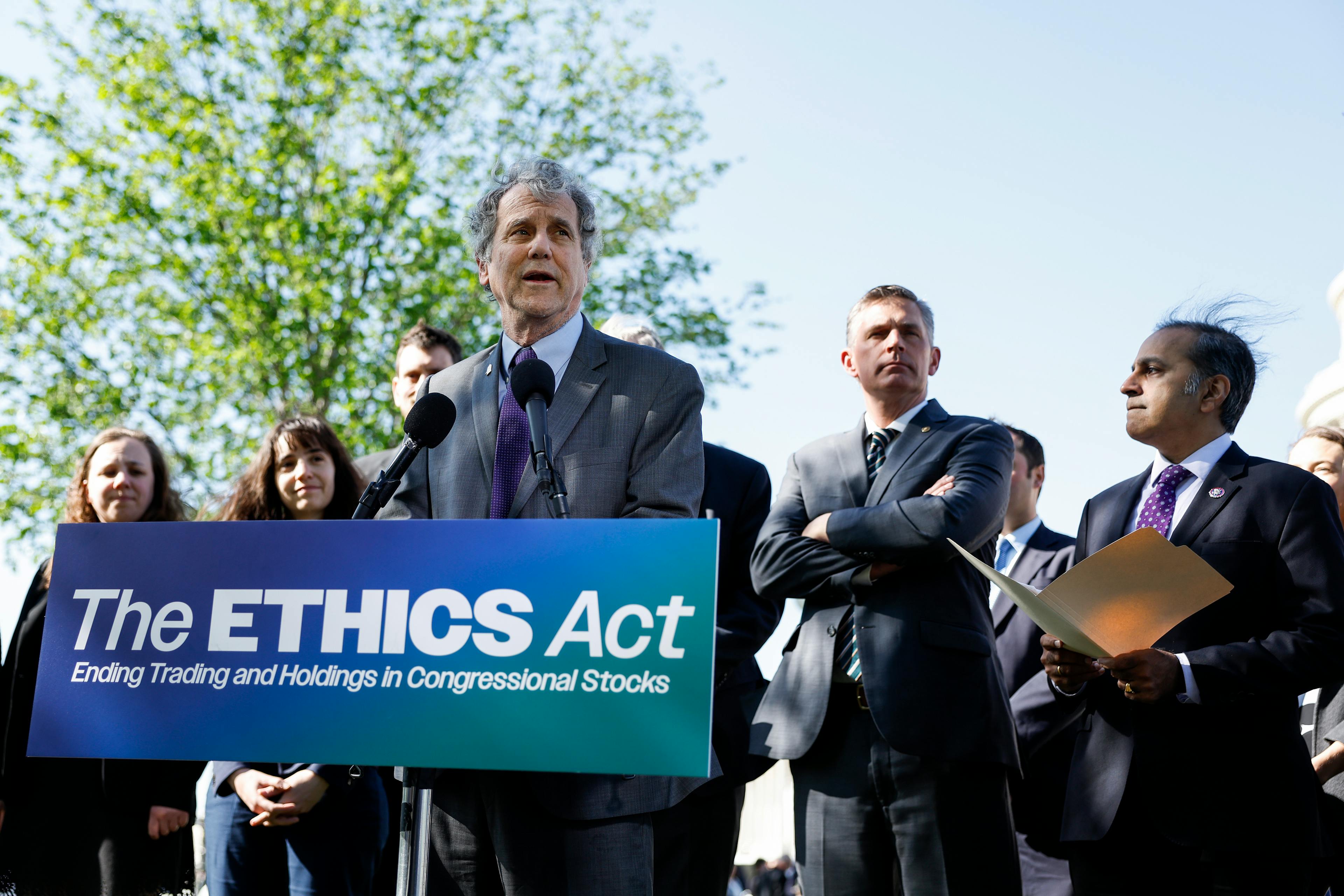
Sen. Sherrod Brown (D-OH) at a April 2023 press conference on the introduction of the Senate ETHICS Act. (Photo by Anna Moneymaker/Getty Images)

When Congress sells a stock short, it makes money

The infuriating yet unsurprising results of a new academic study

Don’t sell yourself short. Great advice in life.

When a member of Congress sells something short, they’re probably on to something.

Also great advice, according to a new paper from a pair of well-respected law and finance professors that shines additional light on the lunacy of continuing to permit stock trading by elected officials in Congress.

The analysis, from Berkeley Law’s Frank Partnoy and Peter Molk, of the College of Law at the University of Florida, uses a newly available dataset — based upon required disclosures by members of Congress in the aftermath of trading scandals over a decade ago — to gauge whether the success of their trades could indicate these public officials are basing their trade on access to better information than the public at large.

The upshot? It seems pretty likely when they’re betting that the price of a stock will fall, a technique known as “shorting.” The authors write:

Based on a new comprehensive dataset of trades by members of Congress, that negative trading not only is common, but also is associated with positive abnormal financial returns. Simply put, members of Congress’s bets on stock price drops make money...The evidence is consistent with a story that some members of Congress make money on, and are guided by material nonpublic information in, their negative trades but not their positive ones.

This stands to reason, as elected officials are regularly privy to nonpublic information concerning companies, such as regulatory actions or potential legislative changes that could influence how much money companies make. (On the other hand, these academics don’t find that Congressmen and women do much better than average when they are betting on a rise in prices.)

Despite the depressing regularity of dopey, and bipartisan, Congressional trading scandals — remember Buffalo area Congressman Chris Collins? North Carolina Senator Richard Burr? New Jersey’s Tom Malinowski? Or the members who thought it was a good idea to trade bank stocks in the midst of the 2023 regional banking crisis? — the practice continues to the allowed.

The STOCK Act was passed in 2012, after SEC investigations into the trading activity of Tennessee Republican Bill Frist, the former majority leader of the Senate, as well as a high profile “60 Minutes” examination of trading from prominent members of congress such as then House Speaker John Boehner (R-OH) and his predecessor as speaker, California Democrat Nancy Pelosi, among others. (I would note that a former colleague, the Wall Street Journal’s Jason Zweig, was well ahead of the curve on issues with Congressional trading, spotlighting it in his column way back in 2010.)

But the STOCK Act is largely a disclosure-based law that requires reporting after selling shares and, essentially, clarifies that insider trading laws also extend to members of Congress who trade on nonpublic information. There has been little sign that the law has deterred members’ trading activity that poses conflicts of interest.

But hope springs eternal. Last April, a bipartisan Congressional group unveiled the ETHICS (Ending Trading and Holdings in Congressional Stocks) Act, that aims to “prohibit members of Congress, their spouses and dependent children from abusing their positions for personal financial gain by owning or trading securities, commodities, or futures.” And just this month, the Senate introduced its version of the bill.

"The truth is Congress should not be here to make a buck. Congress should be here to serve the American people,” Sen. Josh Hawley, of Missouri, told reporters, upon the introduction of the bill.

Seems simple enough.

More Markets

See all Markets
markets

US stock futures erase losses on report of new Iranian proposal to reopen the Strait of Hormuz

S&P 500 futures erased small losses on Sunday evening after Axios reported that Iran, through Pakistan, is offering a fresh proposal to reopen the Strait of Hormuz and end the conflict. West Texas Intermediate futures are off their highs, but still up 1.6% as of 9:33 p.m. ET. According to Axios, this deal would punt the issue of Iran’s nuclear program to a later date.

This new potential off-ramp follows some less than encouraging news on the status of talks between the two sides. On Saturday, President Donald Trump said that he canceled a trip to Pakistan during which Steve Witkoff (special envoy to the Middle East) and Jared Kushner (Trump’s son-in-law) had been expected to negotiate with Iran. On Sunday, Trump told Fox News that Iran “can come to us, or they can call us” if they want to talk.

The Strait of Hormuz, a key chokepoint for global oil flows, has been largely closed since the conflict started roughly two months ago, despite a ceasefire agreement that was said to be contingent on the reopening of this waterway. In addition to Iranian military threats, which initially made passage through the strait too dangerous for most vessels to attempt, the US has also recently started a naval blockade to limit Iranian oil exports.

markets

Spectrum owner Charter Communications is on pace for its worst day ever as broadband numbers and Q1 results disappoint

Cable and broadband company Charter Communications is on pace for its worst-ever trading day on Friday, as investors dump the stock following its Q1 results and forward guidance.

Charter, which owns Spectrum, reported adjusted earnings of $9.17 per share, below Wall Street estimates of $9.96 per share from analysts polled by FactSet. On the company’s earnings call, CFO Jessica Fischer appeared to lower its guidance for full-year revenue per user.

“It’ll be close either way in terms of whether we end up with net growth,” Fischer said.

The company lost 120,000 internet subscribers in the quarter, deeper than the expected 94,800 and double its loss from the same period last year. That news comes one day after Comcast’s earnings provided a bit of optimism for broadband as a category: the company reported Q1 losses of 65,000, significantly improving from 183,000 losses in the same quarter last year. Comcast is down more than 10%, on pace for its worst day since January 2025.

markets
Luke Kawa

Nvidia poised to snap longest run without a record close since the AI boom began

The stock price of the company responsible for the brains of the AI boom is finally showing some brawn again.

Nvidia, the world’s most valuable company, is poised to close at a record high for the first time since October 29, 2025, on Friday (if it ends above $207.04).

The AI chip trade is on fire, with the Philadelphia Semiconductor Index slated to deliver its 18th consecutive gain as Intel’s robust results and outlook juice the entire ecosystem. Hyperscalers report earnings next week, and their capex guidance can be thought of as the earnings guidance for Nvidia and other AI suppliers for the quarters to come.

This would end Nvidia’s longest stretch without a record close since the unofficial start of the AI boom (when the chip designer delivered blowout quarterly results in May 2023).

(Sorry if I jinx this!)

Latest Stories

Sherwood Media, LLC produces fresh and unique perspectives on topical financial news and is a fully owned subsidiary of Robinhood Markets, Inc., and any views expressed here do not necessarily reflect the views of any other Robinhood affiliate, including Robinhood Markets, Inc., Robinhood Financial LLC, Robinhood Securities, LLC, Robinhood Crypto, LLC, Robinhood Derivatives, LLC, or Robinhood Money, LLC. Futures and event contracts are offered through Robinhood Derivatives, LLC.

