
Markets
Invest Fest 2023
Cathie Wood, Getty Images
Yeesh

Ark missed the Nvidia boat

Cathie Wood cautions investors to be wary of a stock that she sold too soon.

Jack Raines

Last week, Ark Invest founder Cathie Wood warned investors to be cautious with Nvidia, comparing the chip maker’s recent performance to Cisco in the 90s:

Cisco Systems (CSCO) offers a good history lesson. I remember well the stock's behavior at a similar technology moment in time. In the three and a half years leading to March 9, 1994, CSCO soared ~31-fold from $0.07 to $2.24 split-adjusted, as its routers, switches, and other equipment dominated the buildout of the internet backbone globally. The capital markets began to fund competitors, even those with systems inferior to Cisco’s, which confused strategic planners in corporations and cast a short-term pall on spending. In the four months leading up to July 15, 1994, CSCO dropped 51% as companies—already worried about a potential recession—reassessed their spending commitments and deliberated. After the coast cleared, CSCO entered another ~73-fold run into the peak of the internet bubble during 2000.

Today, Nvidia (NVDA) is that company. Central to the AI age, NVDA has soared ~117-fold in the roughly nine years since February 8, 2015, when analysts were beginning to understand that breakthroughs in Deep Learning were accelerating the pace of AI change, to the benefit of GPUs (graphic processing units). NVDA also had appreciated 23-fold in the five years since its last inventory correction, one triggered by a crypto winter that hit it in October 2018 and trounced the stock by 56% in three months.

Wood’s argument is fair: Nvidia’s revenue growth will likely decelerate as supply catches up with demand and key customers continue developing their own chips in-house. It was, however, surprising to hear such prudence from Wood, whose firm predicted less than a year ago that Tesla could reach an $8 trillion market cap by 2027 primarily driven by $613 billion in robotaxi revenue (reality check: Tesla currently generates $0 in robotaxi revenue). So, why the sudden caution about Nvidia?

It feels, to me, like a justification for missing the $2 trillion disruptive innovation of the last few years: Nvidia.

In September 2022, Ark owned 757,481 Nvidia shares. However, between October 2022 and January 2023, they sold their entire stake in the chip maker, despite the AI goldrush kicking off in November when OpenAI launched ChatGPT. Had Ark held their entire stake, it would be worth $677 million at today's prices.

Nvidia’s stock is up 4.9x since Ark closed their position, while Ark’s Innovation ETF is up 1.3x. Sure, it's wise to be cautious when a stock has climbed 700% in 18 months, but this "warning" feels a lot like self-justification.

More Markets

See all Markets
markets

Retail traders are selling everything but the Magnificent 7, per JPMorgan

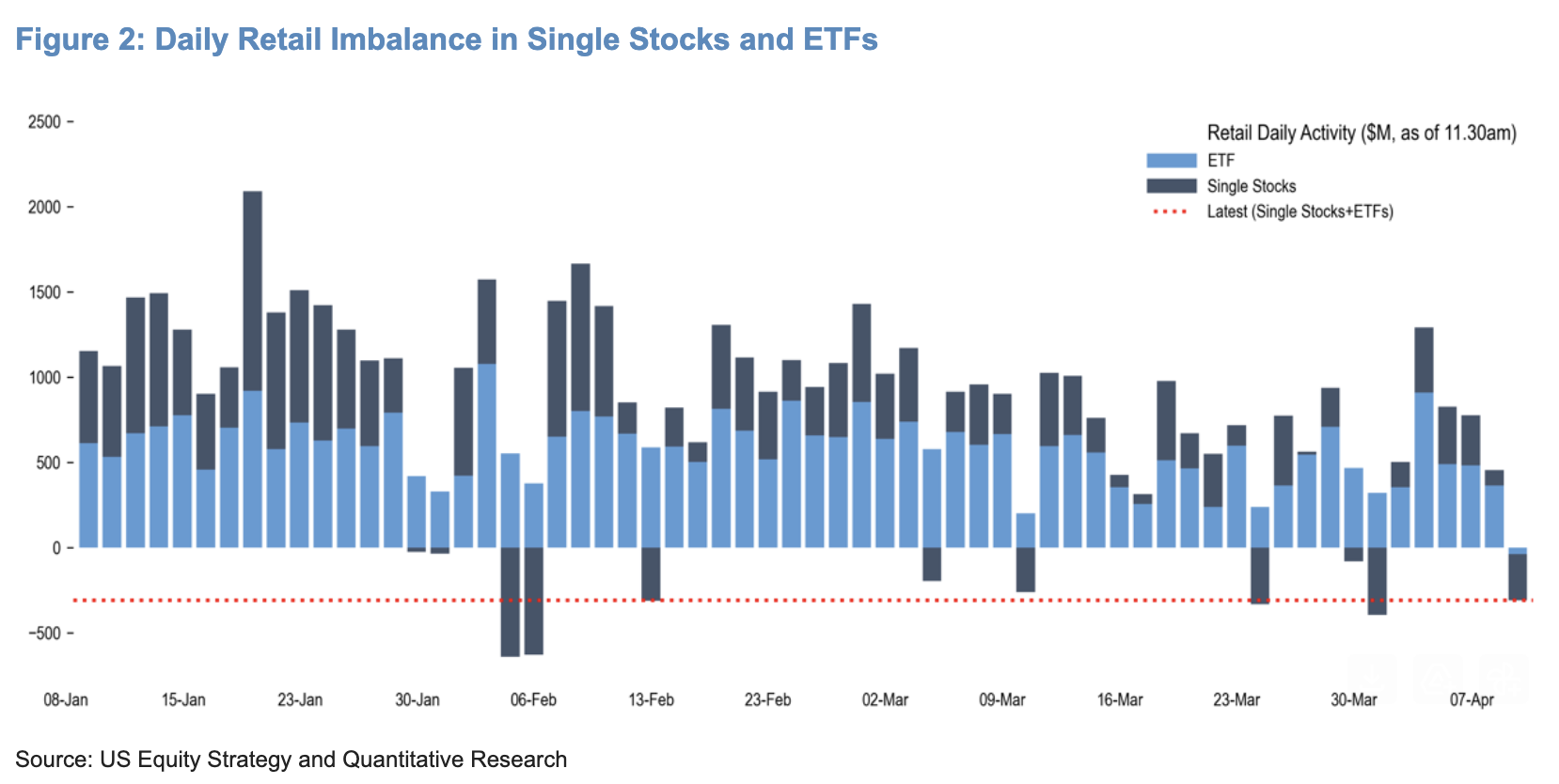
JPMorgan strategist Arun Jain with the skinny on retail trading activity through 11:30 a.m. ET today:

“Retail investors are selling into today’s strength in both ETFs and Single Stocks. In ETFs, they are trimming their broad-based exposure—a major departure from their typical pattern.

SPDR S&P 500 ETF and ProShares UltraPro QQQ suffered particularly large outflows, per Jain.

The exceptions to the selling pressure are the Magnificent 7 stocks, he writes, with Nvidia, Tesla, Meta, and Microsoft enjoying “small net purchases” while Micron, TSMC, Exxon, and Chevron the most-dumped names.

Retail trading 4/8

Last week, Jain noted that retail traders had been “skipping the dips, selling into rallies, and positioning more defensively” with markets jittery amid the ongoing Mideast war.

markets

Avis shorts facing $1.1 billion in losses as car rental company racks up 155% gains in its recent rally

Whatever traders are doing with Avis — buying, or just renting — it’s causing short sellers an immense amount of pain.

Shares of the car rental company have traded violently on Wednesday, from up nearly 7% at their highs to down almost 4% at their lows, after a face-ripping rally of 155% over the previous 11 sessions.

Per exchange data, roughly half the shares were sold short as of mid-March. S3 Partners, which tracks higher-frequency measures, said that short interest as a share of float had recently been trimmed to about 43%, down from as high as 53% at the start of the year.

Per Matthew Unterman, managing director at S3, Avis shorts are down $1.1 billion on paper over the past 30 days.

This isn’t Avis’ first rodeo: shares went parabolic in Q4 2021 as part of a meme stock moment in which it briefly became the most valuable company in the Russell 2000 small-cap index.

In any event, cheers to u/Bright_Leopard_4326, who admonished other members of the r/ShortSqueeze subreddit for not paying enough attention to the potential for a boom in the stock 10 days ago, when shares were trading below $150.

AVIS short squeeze
Source: r/ShortSqueeze
Persian Gulf

Even with a fragile ceasefire in place, the energy crisis is far from over. Here’s what to watch for.

In a Q&A with Sherwood, commodities analyst Rory Johnston lays out how to better understand the oil market’s situation.

markets

Data center trade revived on Iran war ceasefire

Data center stocks leapt early Wednesday, as the Iran war ceasefire reinvigorated risk-taking aimed at the booming AI build-out.

A wide range of stocks related to building and powering data center shells, filling them with chips, servers, racks, and memory, and then connecting those racks to one another and users around the world bounced hard in early trading.

Memory stocks like Micron, Western Digital, Seagate Technology Holdings, and Sandisk — favorites of retail traders given their massive performance in recent years — climbed.

Traders seemed to price in durable demand for memory and other chips, with the companies that make the machines that actually make semiconductors rising sharply as well. Dutch semiconductor machinery giant ASML rose, as did Applied Materials, Lam Research, and KLA Corp.

Fiber-optic cable and connecting companies like Lumentum, Coherent, Corning, and Applied Optoelectronics — which had been on a run before the outbreak of Mideast hostilities — regained momentum.

And the construction and engineering companies — MasTec, Vertiv Holdings, Quanta Services, and Comfort Systems USA — that have been feasting on the cash pouring into data center building and engineering also jumped.

Latest Stories

Sherwood Media, LLC produces fresh and unique perspectives on topical financial news and is a fully owned subsidiary of Robinhood Markets, Inc., and any views expressed here do not necessarily reflect the views of any other Robinhood affiliate, including Robinhood Markets, Inc., Robinhood Financial LLC, Robinhood Securities, LLC, Robinhood Crypto, LLC, Robinhood Derivatives, LLC, or Robinhood Money, LLC. Futures and event contracts are offered through Robinhood Derivatives, LLC.