


More babies are now born to parents over 40 than under 20 in the US
The nation’s fertility rate just hit another record low, as more young people delay, or skip, starting a family.
In what will come as a surprise to very few demographers, the US fertility rate slumped to another all-time low last year, per data from the Center for Disease Control and Prevention, released Thursday.
Continuing almost two decades of decline, and compounding one of the most consequential long-term trends of our age, America’s general fertility rate — the number of births per 1,000 women aged 15 to 44 years-old — fell slightly from 53.8 in 2024 to 53.1 in 2025, marking yet another record low. At the same time, the total number of births in the US hovered at ~3.6 million for a sixth straight year, some 700,000 less than in 2007.
So, despite a growing pronatalist movement, as well as a spate of government-proposed fertility incentives, including discussions for a $5,000 “baby bonus,” fewer children are being born in America. But while this contraction has been driven in part by those rejecting having kids altogether, much of it can also be explained by young people delaying starting a family until later in life.
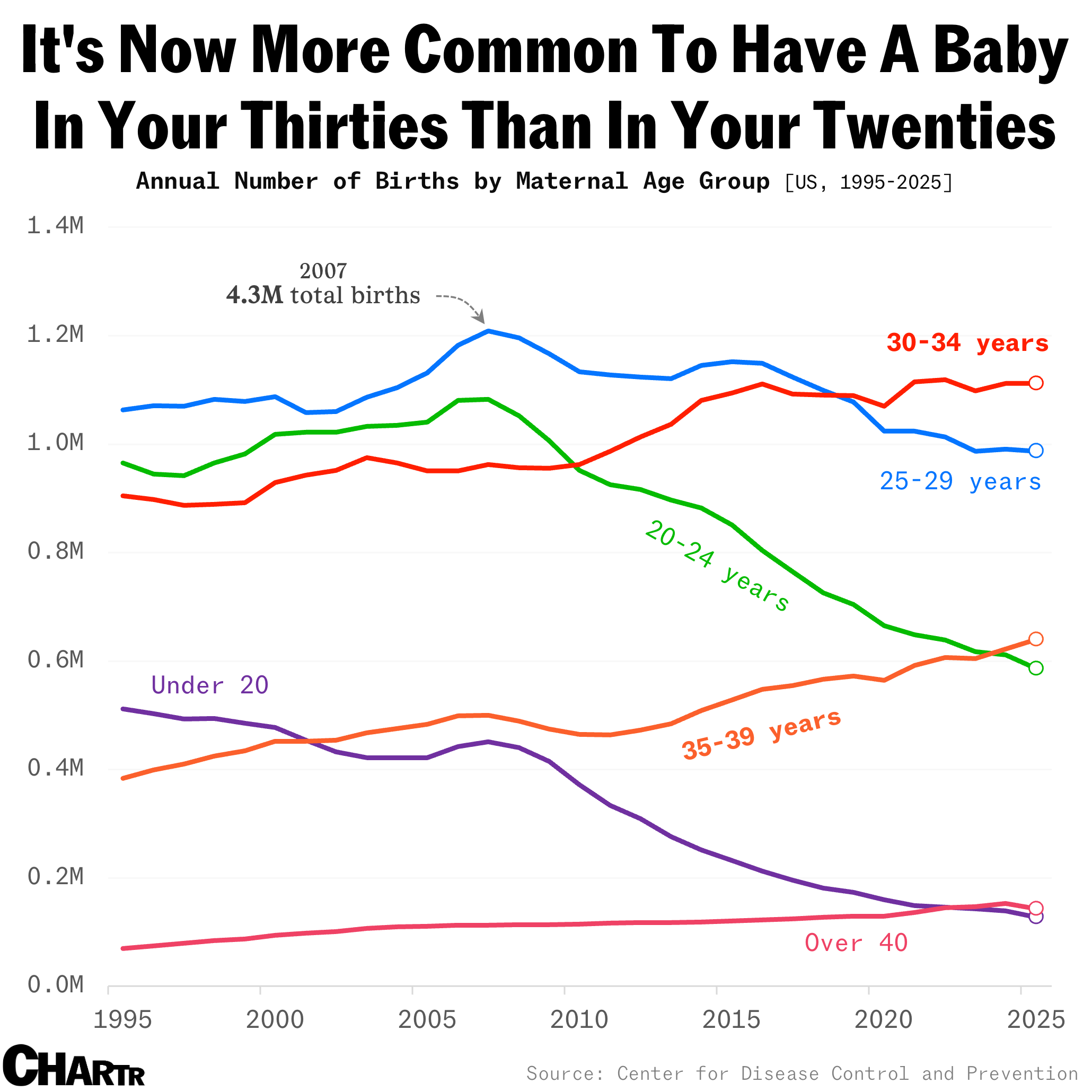
Looking at the CDC data, the total number of births in the US were highest for women aged 30-34 years in 2025 at 1.1 million, extending the cohort’s lead over women aged 25-29 (~990,000 births). Adjusting for population size, the overall fertility rate for US women in their late 30s surpassed that for women in their early 20s for the first time last year.
Zooming into extremes at both ends, a similar phenomenon is observed: in each of the last three years, there were more babies born to women over 40 years (~147,000 on average) than women aged under 20 (~136,000). As recently as 1995, those aged under 20 were having more than 7x as many babies as the over-40 band, per CDC figures.
No kidding
Though the veracity of economist Mike Konczal’s “later, not less” fertility theory has been debated, what the CDC data does point to is adolescent births decreasing with improved contraceptive access; births in advanced age groups increasing with reproductive medical advancements; and a total fertility rate that’s sinking further from the replacement level of 2.1.
What does this tell us? Well, for one, that women appear to be exercising more control over their fertility, whether that be due to financial worries, personal relationships, education, employment, or just general uncertainty about the future (or, most likely, all of the above).