


It might be less expensive to make an Oscar-winning movie than you think
Three of the 10 Best Picture nominees at this year’s Academy Awards had production budgets of $10 million or less.
Ahead of the 98th Academy Awards on Sunday, pundits will be looking toward the historic inclinations of Hollywood’s illustrious voting body to predict which of the year’s movies will win across the major categories, including, perhaps most notably, Best Picture.
And while there are a few apparent trends that suggest what kind of nominees tend to get the gold — like accumulating accolades at other awards ceremonies, studio prestige, and a compelling “comeback” narrative, to name a few — one thing that might not be such a strong indicator of performance on the night is how much a movie cost to make.
Having recently been brought into the spotlight by the unprecedented cost of a certain advertising campaign, media reports collated by People.com found that racing flick “F1” had the largest production budget of any of this year’s Best Picture nominees, at an estimated $250 million — almost double that of the nominee with the second-biggest production costs, “One Battle After Another.”
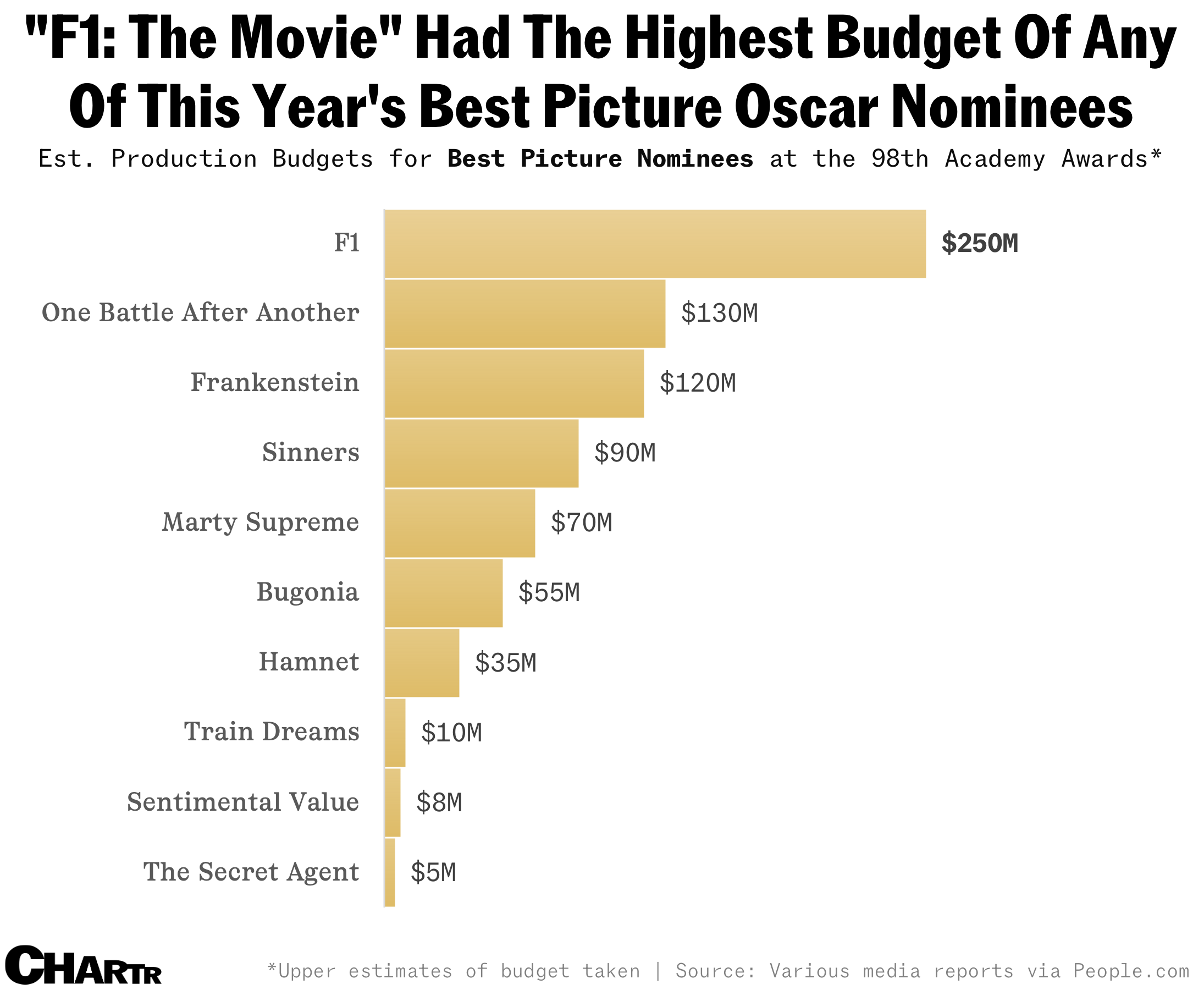
Though these figures are not inclusive of marketing budgets (for which People also estimates that “F1” likely had the highest of any nominee, at $100 million), 3 of the 10 nominees have estimated budgets equal to or less than $10 million — pretty small by Hollywood’s standards.
Buy the stars
It’s no secret that big-budget blockbusters aren’t exactly Oscars bait. Prior to the 2024 ceremony, a great visual and dataset compiled by Axios revealed how movies with modest production costs have typically dominated the Academy Awards, across decades of Best Picture nominees.
Adjusting these figures for inflation based on the Consumer Price Index for February 2026, it appears that almost 80% of nominees since 1990 have had estimated production budgets of $100 million or less — with over half costing less than $50 million in current US dollars.
At least compared with films like “Titanic” and “Avatar” — both part of the 14 movies since 1990 that have cost over $200 million to make, adjusted for inflation — a sizeable share of this year’s nominees follow the pattern of smaller indie or foreign movies scoring big with the Academy’s voters.
For example, last year’s winner, “Anora,” was backed by indie film studio Neon, the same company that distributed 2020 Best Picture winner “Parasite,” and cost just $6 million to make. Neon is also behind foreign-made nominees “Sentimental Value” (~$8 million budget) and “The Secret Agent” (~$5 million) at this year’s awards.
Still, even with the critical pull of modestly made movies, the favorite to scoop the top prize on Sunday night is “One Battle After Another.” Paul Thomas Anderson’s dark comedy has pulled ahead of its peers among experts and in prediction markets, where the market-implied probability of the movie winning Best Picture was at 76% as of 9 a.m. ET on March 13.
(Event contracts are offered through Robinhood Derivatives, LLC — probabilities referenced or sourced from KalshiEx LLC or ForecastEx LLC.)