
Culture
Man Standing in Green and Yellow Office
Getty Images
RTO FOMO

Gen Z are less likely to favor fully remote working compared with millennials and boomers

Per a new Gallup survey, it turns out young workers do want to go back to the office... sometimes.

Millie Giles

Since the pandemic, working from home has not only endured as a pretty standard practice for office-based companies, but also remains a requisite for some job seekers accustomed to having at least some days where their commute time is measured in seconds rather than minutes or hours.

Now, several years on from a string of Covid-induced lockdowns, the novelty of doing one’s job in a room of one’s own may have finally worn off... especially for the youngest cohort of employees.

New kids on the (office) block

A recent Gallup survey found that fully remote work was least popular with Gen Z among all age groups surveyed, with only 23% saying they preferred working from home full time — considerably less than the 35% of millennial, Gen X, and baby boomer respondents who favored the wholly WFH model.
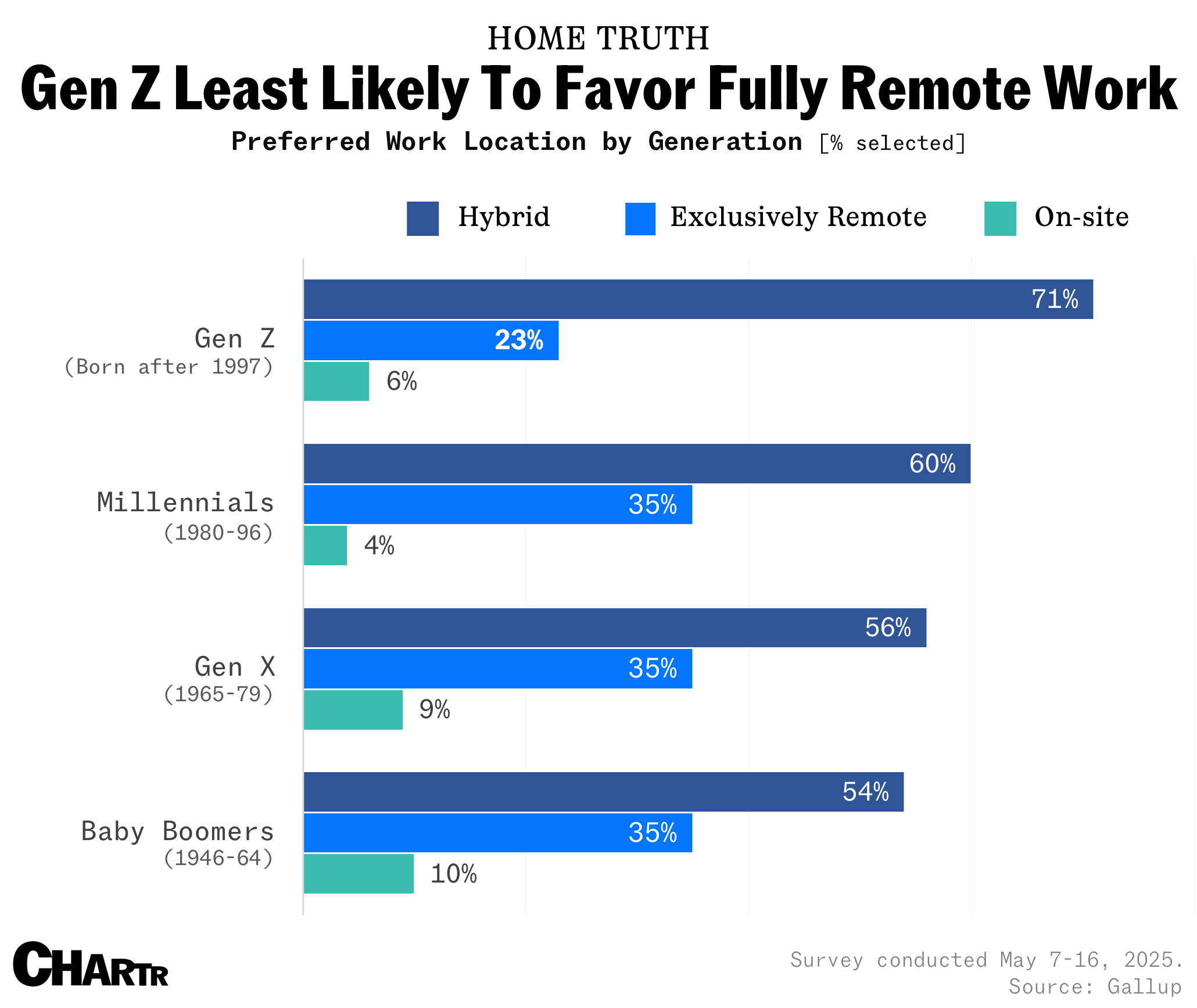
Gen Z remote work surevy
Sherwood News

Gallup outlined one factor that could be driving a desire to return to the office: Gen Z is statistically the loneliest generation. The same survey found that 27% of Gen Z reported feeling lonely the day before — almost 3x the share of boomers.

Even so, while a large faction of Gen Z don’t want to be at home permanently, they definitely don’t want to be in the office all the time either, with only 6% of Gen Z preferring to be totally on-site. Indeed, most seem to want options: while hybrid was the preferred work setup across all generations, it was by far the top pick for younger participants (71%).

Another reason for Gen Z’s office push could be that being in a coworking environment might translate to better engagement. An earlier Gallup poll, cited by Business Insider in January, found that only 30% of workers under 35 years old reported feeling engaged at work last year — dipping below the older cohort for the first time in the survey’s history.

More Culture

See all Culture
culture

Xbox cuts price of its Game Pass subscription by 23%, removes new “Call of Duty” games

A Halley’s Comet-level event in the world of subscriptions is occurring at Microsoft: the company announced it will lower the price of its Game Pass Ultimate from $29.99 to $22.99.

The move comes a little over a week after reports revealed an internal memo from new Xbox head Asha Sharma in which the exec told employees that Game Pass has “become too expensive.” Back in October, before Sharma’s tenure began, Xbox hiked its Game Pass subscription by 50%.

With the price drop, Game Pass will also see a major shift: new “Call of Duty” titles will no longer be added to the service at launch, instead joining the library about a year later during the following holiday season. The subscription will still cost a bit more than it did before the popular titles were added in 2024.

According to estimates reported by Bloomberg, the decision to put “Call of Duty” on Game Pass cost Xbox more than $300 million.

culture

The most popular male and female names in the US, according to the latest Census

New data published Tuesday by the US Census Bureau has revealed the most common names provided in the 2020 Census, in the first release to include forename data since 1990.

As described in the brief, Michael was the most popular name for males in the US, with roughly 3.5 million American men reporting having this name or a close variant. This is up from fourth place in the 1990 Census, when the top US male name was James — though there were still 3 million Jameses in 2020’s tally.

Despite a three-decade gap, Mary remained the top name for American females in both censuses, with the 2020 survey counting almost 1.8 million females with this given name. Interestingly, Mary was one of just two predominantly female names that broke the top 10 given names in the US, with the overall list dominated mostly by male monikers.

Most popular names US census 2020 chart
Sherwood News

In all, American females had far more first-name diversity than male counterparts: 16% of US males had one of the top 10 most frequent names among men, compared with 7.8% of women. Zooming out, almost 3x as many given names were needed to cover a quarter of the US female population than that of males.

culture

6 months after hiking Game Pass prices by 50%, Xbox determines it may be too expensive

Microsoft’s new Xbox chief, Asha Sharma, thinks the division’s recent price hikes have been a mistake, per an internal memo to employees seen by The Verge.

“Short term, Game Pass has become too expensive for players, so we need a better value equation,” Sharma’s memo reportedly read.

It’s an interesting take, given that Xbox hiked the price of its Game Pass subscription by 50% in October, before Sharma took over. The memo is a signal that Sharma’s tenure — which began in February, taking the industry by surprise — will include some big changes for Microsoft’s gaming strategy.

Whether Game Pass prices will drop is not yet clear. Last month, The Information reported that Sharma and Netflix co-CEO Greg Peters have “kicked around ideas” about potential bundles. That would fit with Netflix’s renewed gaming ambitions.

Xbox Game Pass Chartr
(Sherwood News)

It’s an interesting take, given that Xbox hiked the price of its Game Pass subscription by 50% in October, before Sharma took over. The memo is a signal that Sharma’s tenure — which began in February, taking the industry by surprise — will include some big changes for Microsoft’s gaming strategy.

Whether Game Pass prices will drop is not yet clear. Last month, The Information reported that Sharma and Netflix co-CEO Greg Peters have “kicked around ideas” about potential bundles. That would fit with Netflix’s renewed gaming ambitions.

Xbox Game Pass Chartr
(Sherwood News)

Latest Stories

Sherwood Media, LLC produces fresh and unique perspectives on topical financial news and is a fully owned subsidiary of Robinhood Markets, Inc., and any views expressed here do not necessarily reflect the views of any other Robinhood affiliate, including Robinhood Markets, Inc., Robinhood Financial LLC, Robinhood Securities, LLC, Robinhood Crypto, LLC, Robinhood Derivatives, LLC, or Robinhood Money, LLC. Futures and event contracts are offered through Robinhood Derivatives, LLC.