
Culture
Man Standing in Green and Yellow Office
Getty Images
RTO FOMO

Gen Z are less likely to favor fully remote working compared with millennials and boomers

Per a new Gallup survey, it turns out young workers do want to go back to the office... sometimes.

Millie Giles

Since the pandemic, working from home has not only endured as a pretty standard practice for office-based companies, but also remains a requisite for some job seekers accustomed to having at least some days where their commute time is measured in seconds rather than minutes or hours.

Now, several years on from a string of Covid-induced lockdowns, the novelty of doing one’s job in a room of one’s own may have finally worn off... especially for the youngest cohort of employees.

New kids on the (office) block

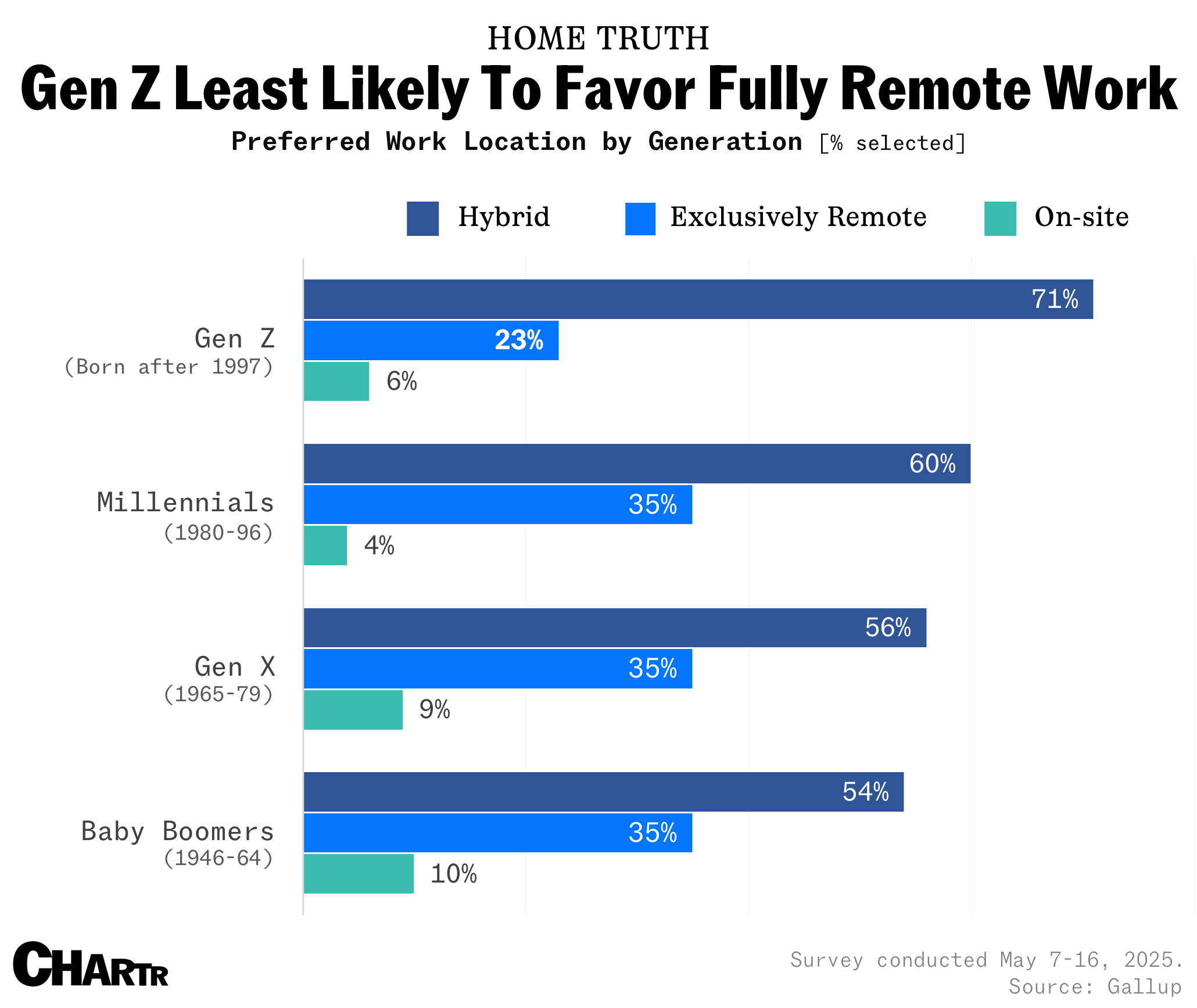
A recent Gallup survey found that fully remote work was least popular with Gen Z among all age groups surveyed, with only 23% saying they preferred working from home full time — considerably less than the 35% of millennial, Gen X, and baby boomer respondents who favored the wholly WFH model.
Gen Z remote work surevy
Sherwood News

Gallup outlined one factor that could be driving a desire to return to the office: Gen Z is statistically the loneliest generation. The same survey found that 27% of Gen Z reported feeling lonely the day before — almost 3x the share of boomers.

Even so, while a large faction of Gen Z don’t want to be at home permanently, they definitely don’t want to be in the office all the time either, with only 6% of Gen Z preferring to be totally on-site. Indeed, most seem to want options: while hybrid was the preferred work setup across all generations, it was by far the top pick for younger participants (71%).

Another reason for Gen Z’s office push could be that being in a coworking environment might translate to better engagement. An earlier Gallup poll, cited by Business Insider in January, found that only 30% of workers under 35 years old reported feeling engaged at work last year — dipping below the older cohort for the first time in the survey’s history.


More Culture

See all Culture
culture

OpenAI set to air a minute-long Super Bowl ad for a second consecutive year, per WSJ

OpenAI is expected to broadcast a lengthy commercial at Super Bowl LX, The Wall Street Journal reported Monday.

Having aired its first-ever paid ad at last year’s Big Game, the ChatGPT maker is set to take another 60-second ad slot during NBC’s broadcast on February 8, according to people familiar with the matter.

culture

Tamagotchis are making a comeback, 3 decades after first becoming a global toy craze

If you were a ’90s kid, you might remember the craze around little egg-shaped toys with an 8-bit digital screen, displaying an ambiguous pet-thing that demanded food and attention.

Now, on the brand’s 30th anniversary, the Tamagotchi the Japanese pocket-sized virtual pet that launched a thousand cute and needy tech companions, from Nintendogs to fluffy AI robots — is making a minor comeback.

Tamagotchi Google Search Trends
Sherwood News

Looking at Google Trends data, searches for “tamagotchi” spiked in December in the US, up around 80% from just six months prior, with the most search volume in almost two decades.

While the toys are popular Christmas gifts, with interest volumes often seen ticking up in December each year, the sudden interest might also have something to do with the birthday celebrations that creator and manufacturer Bandai Namco are putting on, including a Tokyo exhibition that opened on Wednesday.

Game, set, hatch

More broadly, modern consumers appear to have a growing obsession with collectibles (see: Labubu mania), as well as a taste for nostalgia (see: the iPod revival, among many other trends).

But, having finally hit 100 million sales in September last year, the brand itself is probably just glad to exist, giving a whole new generation the chance to experience the profound grief of an unexpected Tamagotchi death.

Latest Stories

Sherwood Media, LLC produces fresh and unique perspectives on topical financial news and is a fully owned subsidiary of Robinhood Markets, Inc., and any views expressed here do not necessarily reflect the views of any other Robinhood affiliate, including Robinhood Markets, Inc., Robinhood Financial LLC, Robinhood Securities, LLC, Robinhood Crypto, LLC, or Robinhood Money, LLC.