
Culture
Transport collage
(Getty Images)
in a jam

Americans now spend almost 3 full days stuck in traffic each year, per a new report

The time we spend on congested roads is rising — but it’s not just rush hour workers causing the holdup.

Tom Jones

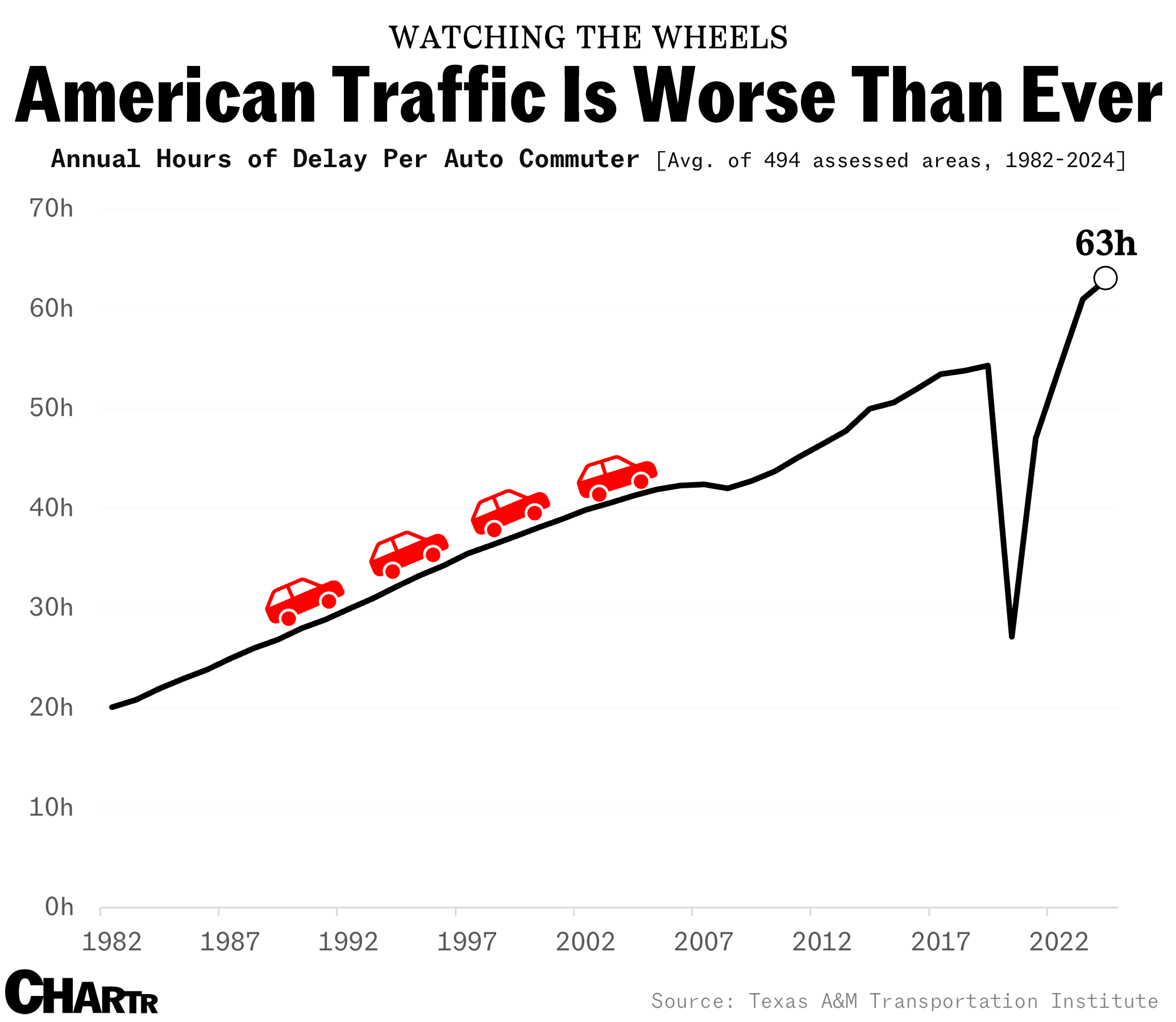
If you’re reading this at your desk, having just endured another white-knuckled, mood-ruining commute that you swear never used to be this bad, you’re not alone: Americans sat in traffic for a whopping 63 hours on average last year, a new report found. 

You are traffic

That’s the highest level that the Texas A&M Transportation Institute, which published its 2025 Urban Mobility Report last week, has recorded since it started tracking the data in 1982. Of course, measurements vary quite widely across the 494 areas that make up the Institute’s top-line figure, though that won’t make the idea of spending almost three days stuck in traffic any easier to digest for millions of Americans.
US traffic time chart
Sherwood News

Though the pandemic curbed congestion on US roads, as car journeys took a backseat in a locked-down world and nature finally started to heal, America’s roads have wound up more blocked than ever — delays are up nine hours on average from the 2019 level.

Interestingly, the Texas A&M Transportation Institute actually lays a lot of the blame for the surging stats on the way that our driving habits have changed postpandemic, with midday, midweek, and weekend slowdowns all now accounting for a higher share of total delays, rather than typical commuting hours.

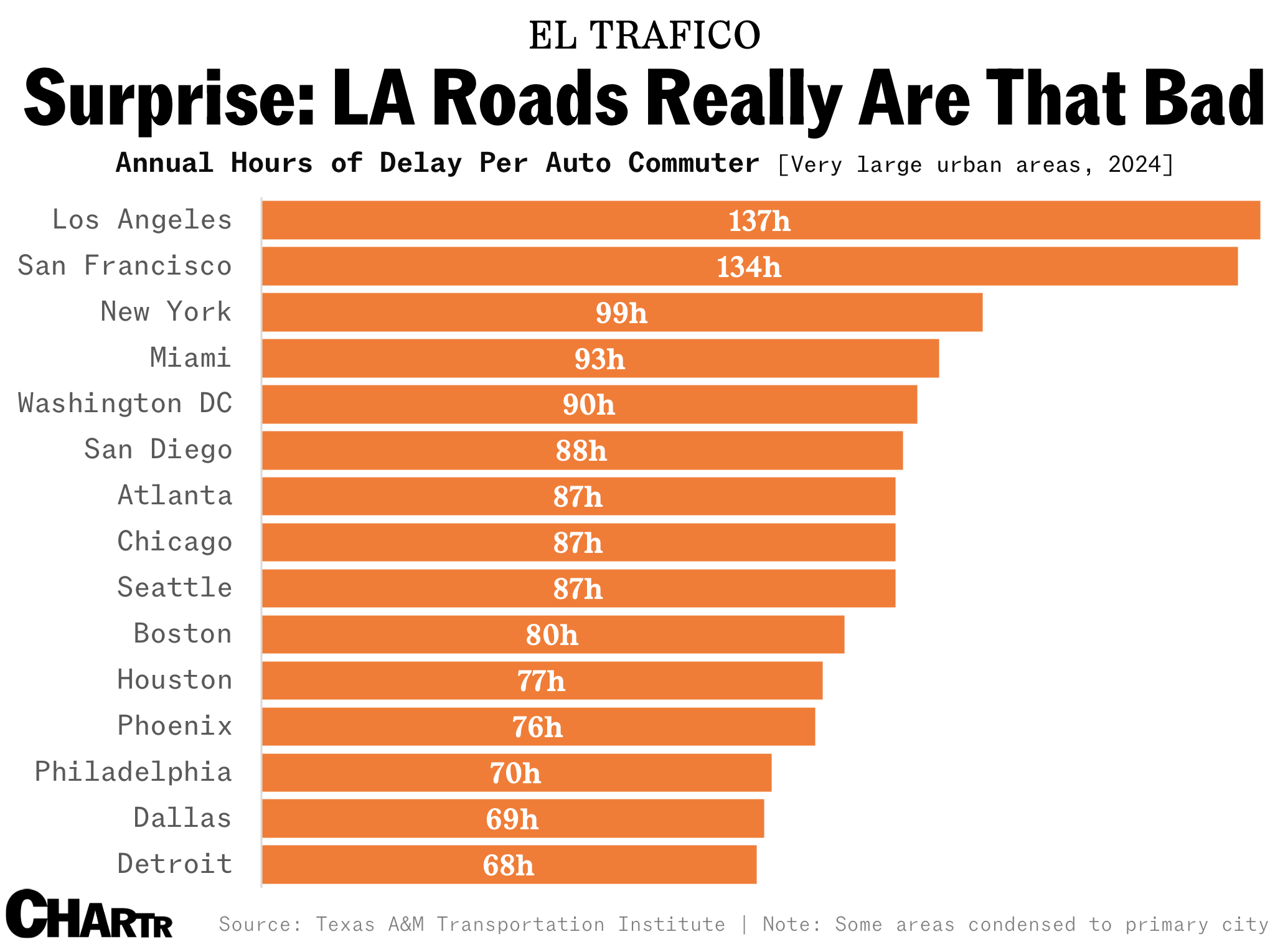
According to the report, drivers in very large urban areas (populations over 3 million) spent some 93 hours in traffic last year, with the Los Angeles-Long Beach-Anaheim and San Francisco-Oakland areas in California, perhaps unsurprisingly, topping the congestion charts in 2024.
Traffic urban area ranking chart
Sherwood News

The Institutes area-based analysis, for what its worth, differs from the INRIX Global Traffic Scorecard, which put New York City as Americas most congested city in June — second globally to Istanbul.

More Culture

See all Culture
culture

OpenAI set to air a minute-long Super Bowl ad for a second consecutive year, per WSJ

OpenAI is expected to broadcast a lengthy commercial at Super Bowl LX, The Wall Street Journal reported Monday.

Having aired its first-ever paid ad at last year’s Big Game, the ChatGPT maker is set to take another 60-second ad slot during NBC’s broadcast on February 8, according to people familiar with the matter.

culture

Tamagotchis are making a comeback, 3 decades after first becoming a global toy craze

If you were a ’90s kid, you might remember the craze around little egg-shaped toys with an 8-bit digital screen, displaying an ambiguous pet-thing that demanded food and attention.

Now, on the brand’s 30th anniversary, the Tamagotchi the Japanese pocket-sized virtual pet that launched a thousand cute and needy tech companions, from Nintendogs to fluffy AI robots — is making a minor comeback.

Tamagotchi Google Search Trends
Sherwood News

Looking at Google Trends data, searches for “tamagotchi” spiked in December in the US, up around 80% from just six months prior, with the most search volume in almost two decades.

While the toys are popular Christmas gifts, with interest volumes often seen ticking up in December each year, the sudden interest might also have something to do with the birthday celebrations that creator and manufacturer Bandai Namco are putting on, including a Tokyo exhibition that opened on Wednesday.

Game, set, hatch

More broadly, modern consumers appear to have a growing obsession with collectibles (see: Labubu mania), as well as a taste for nostalgia (see: the iPod revival, among many other trends).

But, having finally hit 100 million sales in September last year, the brand itself is probably just glad to exist, giving a whole new generation the chance to experience the profound grief of an unexpected Tamagotchi death.

Latest Stories

Sherwood Media, LLC produces fresh and unique perspectives on topical financial news and is a fully owned subsidiary of Robinhood Markets, Inc., and any views expressed here do not necessarily reflect the views of any other Robinhood affiliate, including Robinhood Markets, Inc., Robinhood Financial LLC, Robinhood Securities, LLC, Robinhood Crypto, LLC, or Robinhood Money, LLC.