
What will happen if bitcoin and ethereum hit key liquidation levels
Billions in forced liquidations have swept through crypto markets in Q4. Here are the major liquidation clusters on perpetuals protocol Hyperliquid where leverage may unwind.
Since October, bitcoin has ranged from above $126,000 to as low as $80,500, while the price of the second-largest cryptocurrency, ethereum, rose to nearly $4,900 in August before dropping to a low of $2,800 this month.
The volatility powered massive wipeouts in leveraged positions, with October 10 taking the crown for the largest liquidation event ever in a 24-hour period.
Liquidations occur when a trading platform’s risk engine forcibly closes a trader’s leveraged position because an asset’s price reaches a certain level and their margin account balance is insufficient to cover the open position.
A handful of liquidated positions barely moves the market, but if thousands of positions with similar liquidation prices are closed, the effect on the asset’s market price can be substantial.
“Market buy and sell orders triggered by liquidations can cause rapid price movements, leading to a ‘cascading effect’ where more nearby positions get liquidated,” Coinglass explains.
These levels matter for non-leveraged investors, too. Large liquidation clusters can create abrupt spikes or drops that bleed into spot markets, revealing where crypto prices may snap lower or higher.
As data on these liquidation levels from centralized exchanges like Coinbase is not public, we’ll focus on data from crypto perpetuals protocol Hyperliquid, which is all on-chain and therefore transparent.
Key liquidation levels for bitcoin:
There is a lot of money riding on different positions in bitcoin. Let’s look at what happens if the asset keeps falling or if it manages to reverse and rally.
Downside long-liquidation thresholds
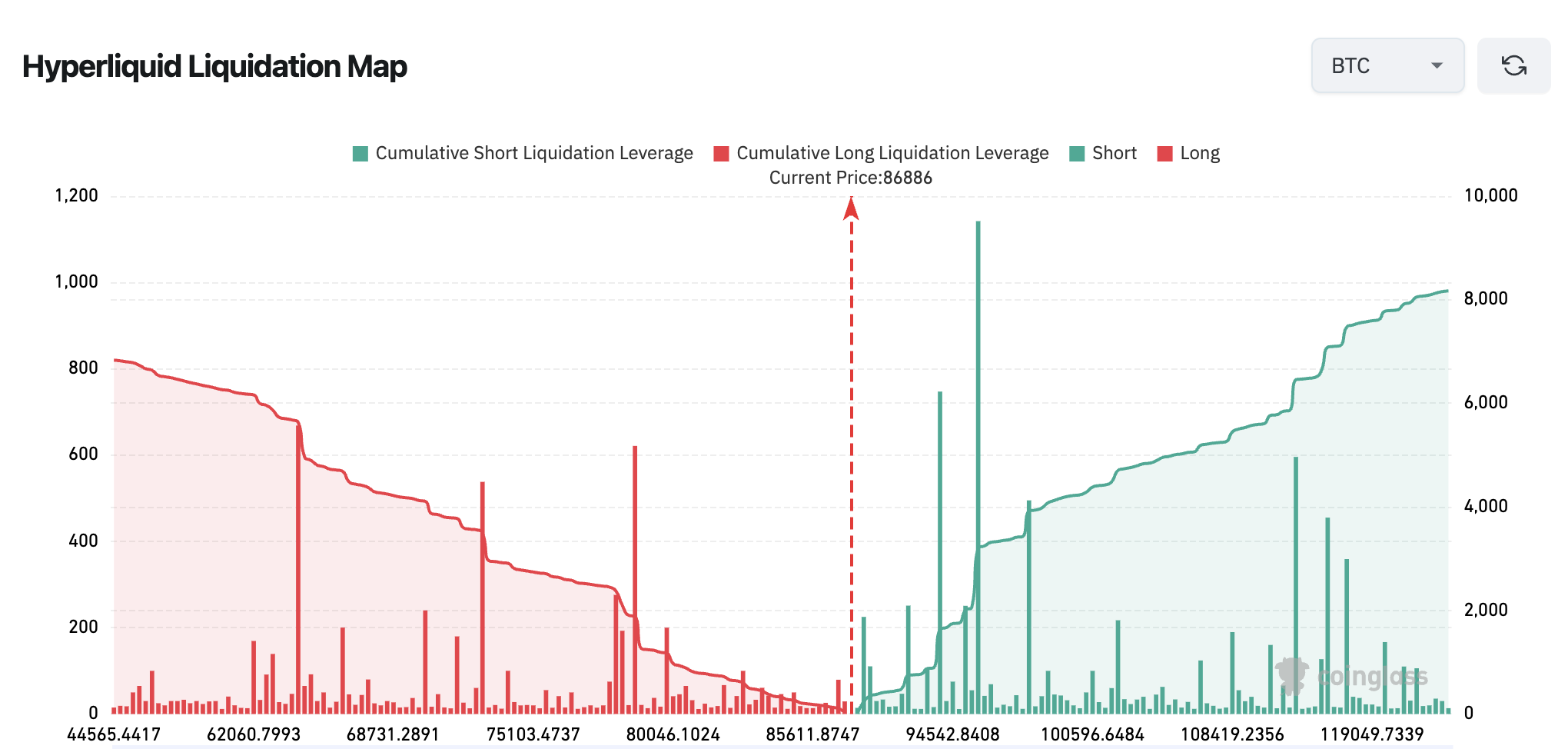
$63,875: 668.29 BTC positions or $58 million will be liquidated at the specific price. In total, the move down to $63,875 results in the liquidation of 5,630 BTC worth of leveraged long positions, or $489 million.
$73,557: 537.83 BTC positions or $46.7 million will be liquidated at the specific price. In total, the move down to $73,557 results in the liquidation of 3,500 BTC worth of leveraged long positions, or $304 million.
$78,617: 621.21 BTC positions or $54 million will be liquidated at the specific price. In total, the move down to $78,617 results in the liquidation of 1,880 BTC worth of leveraged long positions, or $163.3 million.
“For the downside: we see a large build up of puts on the $80/$75K strikes for the 5 DEC expiry, so it checks out traders are buying insurance if BTC breaks through this support,” according to Sean Dawson, core contributor and head of research at on-chain trading platform Derive.
Upside short-liquidations levels
$94,354: 747.05 BTC positions or $64.9 million will be liquidated at the specific price. In total, the move up to $94,354 results in the liquidation of 1,640 BTC worth of leveraged short positions, or $142.4 million. “We have moderate build up of calls on the $90K, but far larger spikes at $100/$110K strikes,” Dawson told Sherwood News. “If BTC rallies, traders are betting we hit the 6+ figure and probably surpass it.”
$95,123: 1,140 BTC positions or $99 million will be liquidated at the specific price. In total, the move up to $95,123 results in the liquidation of 3,200 BTC worth of leveraged short positions, or $277.9 million.
$98,356: 495 BTC positions or $43 million will be liquidated at the specific price. In total, the move up to $98,356 results in the liquidation of 3,920 BTC worth of leveraged short positions, or $340.5 million.
$112,005: 595.68 BTC positions or $51.7 million will be liquidated at the specific price. In total, the move up to $112,005 results in the liquidation of 6,460 BTC worth of leveraged short positions, or $561 million.
$114,295: 455.08 BTC positions or $39.5 million will be liquidated at the specific price. In total, the move up to $114,295 results in the liquidation of 7,080 BTC worth of leveraged short positions, or $615 million.
Key liquidation levels for ethereum:
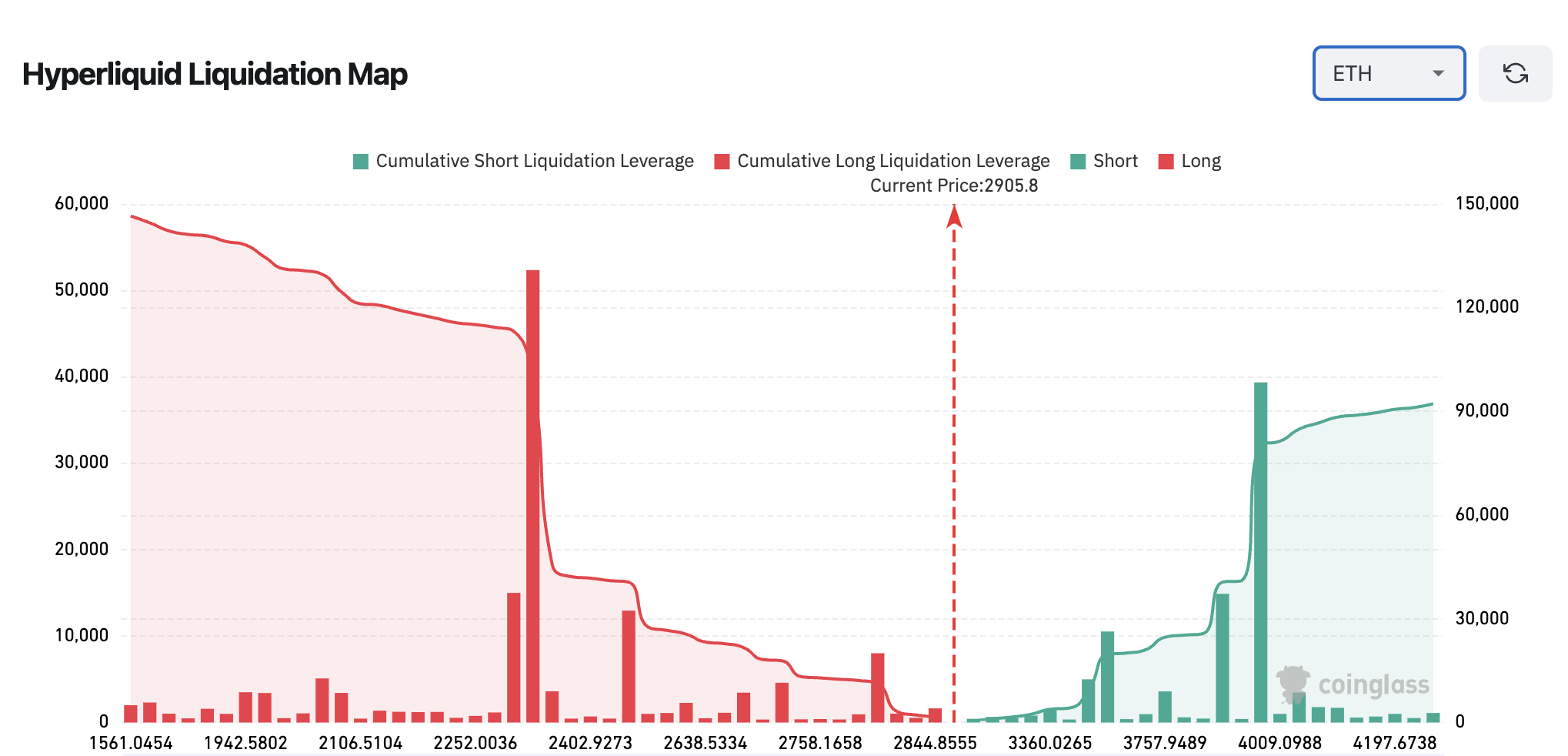
For ethereum longs, the largest liquidation band sits around the $2,300 and $2,400 levels. A drop to $2,327 would liquidate 15,000 ethereum tokens’ worth of positions, or $43.5 million, on Hyperliquid. In total, the full move down to $2,327 would wipe out 113,180 ethereum tokens’ worth of leveraged long positions, or $328.7 million, data from the crypto derivative platform Coinglass shows.
Nicolai Søndergaard, research analyst at blockchain analytics firm Nansen, echoed a similar sentiment. “For ETH, key levels from consensus seem to be around $2.4K-2.5K range as a bottom,” he told Sherwood. “These numbers also coincide with where puts seem mostly concentrated.”
For shorts, the key ceiling is under $4,000. A jump to $3,976 would liquidate 39,360 ethereum tokens’ worth of positions, or $114.3 million, while the cumulative move up to $3,976 results in the liquidation of 80,390 ethereum tokens’ worth of leveraged short positions, or $233.4 million.
These price levels matter beyond Hyperliquid, because they act as a proxy for leverage across other centralized exchanges, which don’t have publicly available data. Stress on one trading platform, whether on-chain or off-chain, can spill into the broader ecosystem.
The liquidation event in October saw the price of bitcoin on Hyperliquid peak at $122,460 and fall down to a low of $100,837, a nearly 17.7% move, while ethereum traded at a high of $4,395 before going as low as $3,241, a 25% decrease. When price fluctuations trigger large scale liquidations on any venue, the forced buying and selling can spread into spot markets and become a market-wide swing, as shown during October’s wipeout.