Crypto
Bitcoin Conference 2023
Jack Mallers (Jason Koerner/Getty Images)
Shots fired

Twenty One says it can be “superior” bitcoin vehicle than Strategy

The Tether- and Cantor-backed new company led by Jack Mallers isn’t trying to be a copy of Michael Saylor’s firm.

Yaël Bizouati-Kennedy

Many companies are emulating Michael Saylor’s bitcoin accumulation mission at Strategy. One is taking a direct shot at it.

Twenty One, the new bitcoin-native company launched by Tether, SoftBank Group, and Strike CEO Jack Mallers via a merger with Cantor Equity Partners, intends to offer a “potentially superior vehicle for investors seeking capital-efficient bitcoin exposure,” its SEC filing reads, titled “Project Mystery Investor Presentation.”

Twenty One, whose name is a nod to bitcoin’s finite supply of 21 million and will trade on the Nasdaq under ticker symbol XXI, plans to launch with more than 42,000 bitcoin. This would make it the third-largest bitcoin treasury in the world, following Strategy, which holds 538,200 bitcoin, and MARA Holdings, which holds 47,531 bitcoin.

According to a press release, at the closing of the business combination, the company “will be majority-owned by Tether, co-founder of Twenty One and the world’s largest stablecoin issuer, and Bitfinex, with significant minority ownership by SoftBank Group Corp.”

Twenty One’s arguments for being a superior vehicle to Saylor’s bitcoin-holding company, Strategy, include:

  • Strategy’s sheer size “poses questions about potential diminishing returns as it continues to purchase bitcoin.” 

  • Its simple balance sheet will allow for flexibility in capital raises.

A graphic in the presentation helps show other advantages Twenty One says it has:
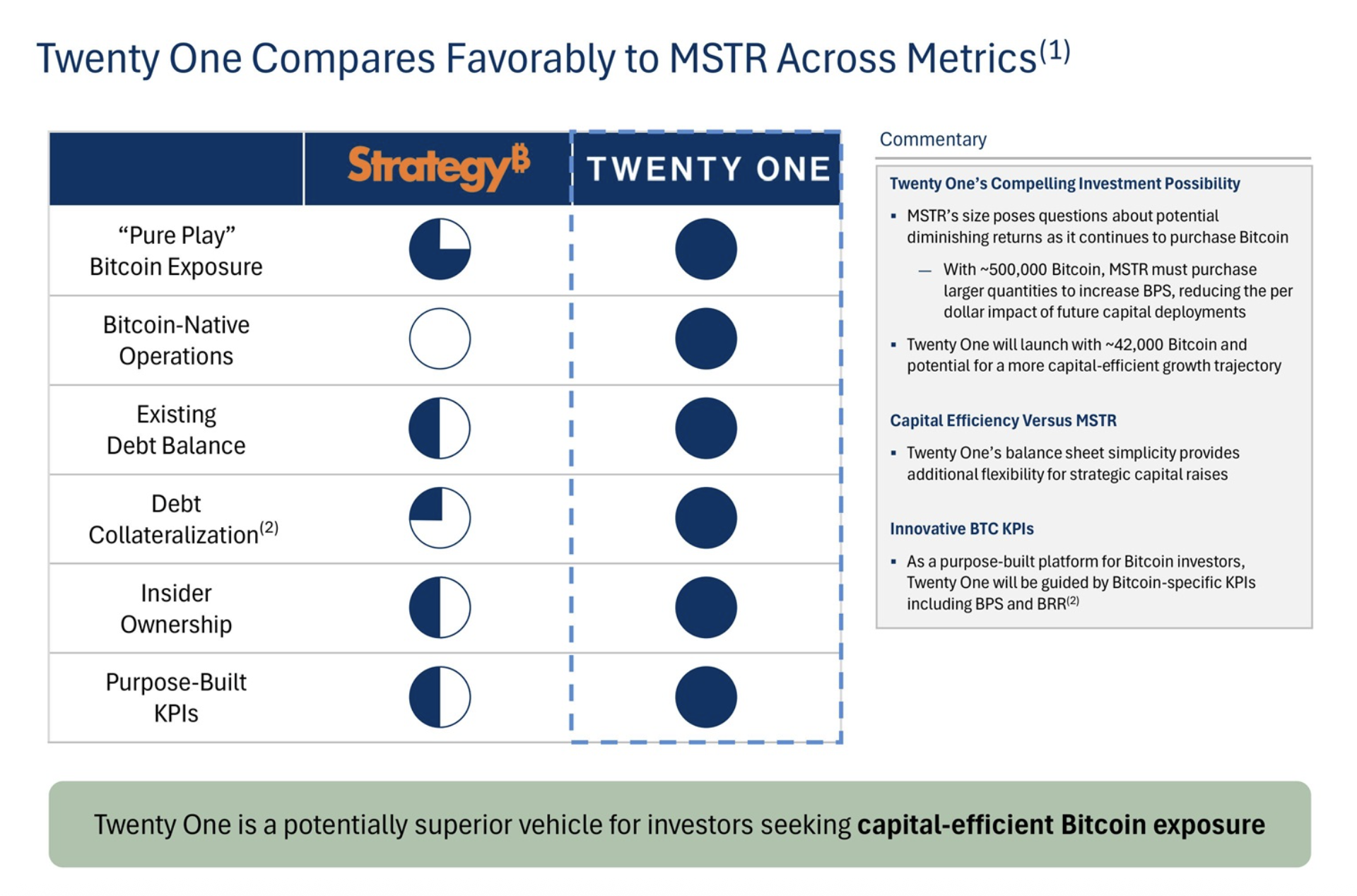
screenshot from Twenty One’s SEC document
Look at all those filled-in circles! (Source: Twenty One’s SEC filing)

Fei Chen, CEO of Intellectia AI, said that Twenty One is deliberately designed as a publicly traded bitcoin-accumulation vehicle with well-capitalized partners including Cantor Fitzgerald.

“This indicates institutional-grade design with transparency and long-term accumulation as a primary mandate — whereas MSTR is more of a leveraged bet on BTC through a business shell,” Chen added.

Another factor that could benefit Twenty One is that it can attract retail and RIAs wanting one-to-one bitcoin exposure in their portfolios who shy away from the tech-company-hinged volatility and debt strategy inherent in Strategy’s model, Chen said.

Meanwhile, TD Securities analysts deemed the launch as “the most-meaningful validation of Strategy’s bitcoin treasury operations to date,” adding that it leaves them bullish on Strategy. TD Securities has assigned a “buy” rating to Strategy, with a $550 price target, representing a 58% premium over today’s price of $348, as of writing.

It “could mark a turning point in institutional investor sentiment around MSTR shares, which despite Strategy’s strong performance has remained largely skeptical,” they wrote. “We continue to model Strategy holding 757k bitcoins by the end of FY27, representing 3.6% of all bitcoin ever to be mined.”

Whether the new entrant will affect the price of bitcoin remains to be seen. The emergence of another large buyer creates competition and increases demand, potentially boosting the price.

“At the same time, the offering here is essentially for retail and institutional investors to buy shares of a stock, instead of buying bitcoin directly,” Two Prime CEO Alexander Blume said. “This means huge purchases don’t actually move the price much in the short term, as you don’t see true price discovery on the open market.”

Meanwhile, Saylor remains unbothered, posting that “the first $100 billion is the hardest.”

More Crypto

See all Crypto
crypto

Altcoin trading activity has lost its mojo

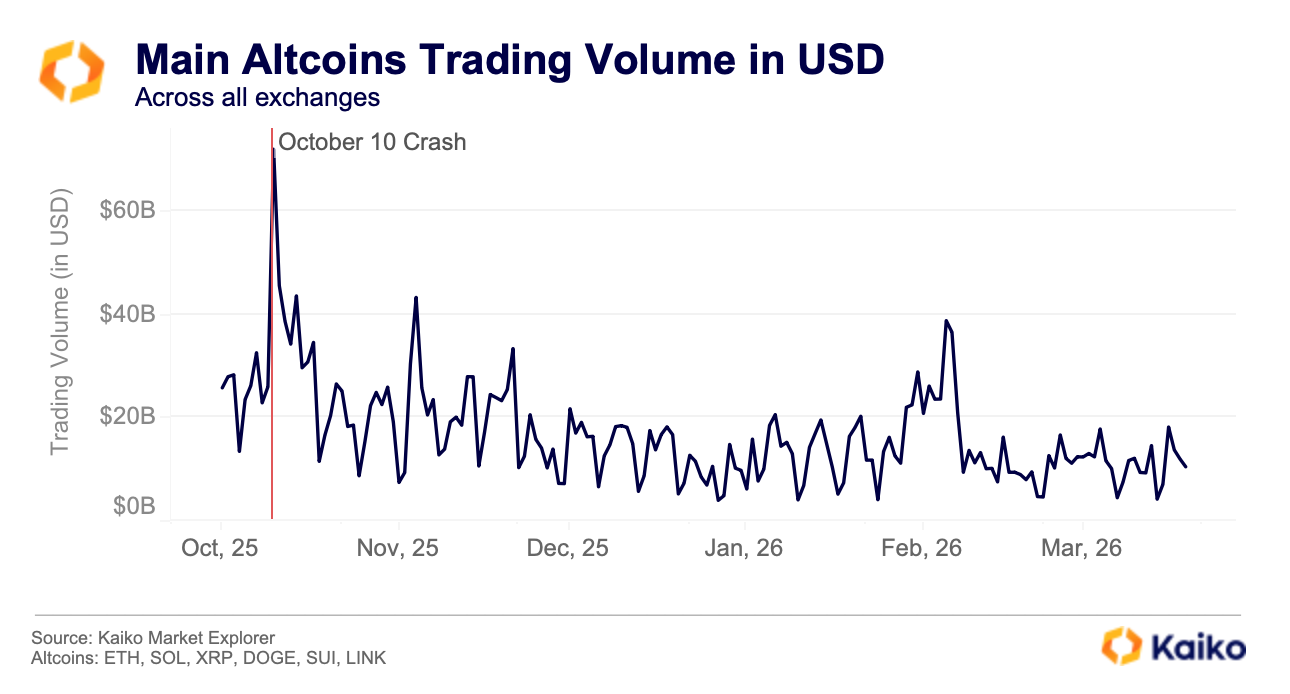
Non-bitcoin cryptocurrencies have seen their trading volume plummet in the past five months. The combined trading volume of ethereum, XRP, solana, dogecoin, SUI, and chainlink has decreased by 60% since crypto’s October 10 liquidation event, according to Thomas Probst, a research analyst at crypto markets data provider Kaiko.

Main Altcoins Trading Volume in USD
The trading volume of ETH, SOL, XRP, DOGE, SUI, and LINK.

For all altcoins, spot trading volume on Binance has declined between 80% and 85% to $7.7 billion, while altcoin volume on other exchanges has dropped to $18.8 billion, down from a range of $63 billion to $91 billion in October, a Friday report from Decrypt found, citing data from CryptoQuant.

“This trend may be explained by a contraction in market liquidity over the same period,” Probst told Sherwood News. “This phenomenon is also reflected in the average 1% market depth, which stood at approximately $2.6 million before the October 10 crash and is now closer to $1.7 million when aggregated across ETH, XRP, SOL, SUI, and LINK.” 

Market depth is used by investors and traders to gauge the scale of liquidity in a market. 1% market depth refers to the amount of liquidity needed to move the market by 1%. 

CoinGlass’s Altcoin Season Index, a measure to assess the performance of non-bitcoin cryptocurrencies, has been sitting above 50 this week, suggesting that the current market is neither in a bitcoin dominant phase nor an altcoin season.

crypto

Payward, parent company of crypto exchange Kraken, puts plans for IPO on hold

Payward, crypto exchange Kraken’s parent company, has paused its plans for an initial public offering until market conditions improve, according to a report from CoinDesk that cited two people with knowledge of the matter. 

Since the firm announced in November its preparation for an IPO of its common stock, the total market capitalization of the crypto industry has shed around $652.2 billion, from $3.2 trillion to $2.5 trillion as of Wednesday, data from CoinGecko shows. 

The news comes two weeks after Kraken received approval for a master account from the Federal Reserve Bank of Kansas City, allowing the crypto exchange to connect to the Fed’s payment infrastructure used by traditional banks and credit unions. 

Last year, Kraken raised $800 million at a $20 billion valuation from institutional investors such as Jane Street and Citadel Securities.

The news comes two weeks after Kraken received approval for a master account from the Federal Reserve Bank of Kansas City, allowing the crypto exchange to connect to the Fed’s payment infrastructure used by traditional banks and credit unions. 

Last year, Kraken raised $800 million at a $20 billion valuation from institutional investors such as Jane Street and Citadel Securities.

Latest Stories

Sherwood Media, LLC produces fresh and unique perspectives on topical financial news and is a fully owned subsidiary of Robinhood Markets, Inc., and any views expressed here do not necessarily reflect the views of any other Robinhood affiliate, including Robinhood Markets, Inc., Robinhood Financial LLC, Robinhood Securities, LLC, Robinhood Crypto, LLC, Robinhood Derivatives, LLC, or Robinhood Money, LLC. Futures and event contracts are offered through Robinhood Derivatives, LLC.