Crypto
Heart
(Getty Images)

Solana getting “new heart” in biggest upgrade ever

The Alpenglow upgrade revamps solana’s consensus engine to decrease transaction finality from 12.8 seconds to 150 milliseconds, bringing the blockchain network closer to its goal of being an on-chain Nasdaq.

Solana is gearing up for its biggest upgrade ever. 

Last week, community members voted overwhelmingly in favor of Alpenglow (aka SIMD-0326) to implement a new consensus mechanism for the solana blockchain. Of those who participated in the governance process, 98.3% approved the upgrade, 1% voted against, and the remaining abstained, a solana vote tracker shows.

“Changing the consensus mechanism for a live blockchain is like a heart transplant during a marathon (or sprint, in solana’s case),” explained Rafal Klich, a research analyst for institutional staking provider Chorus One. “The chain will have a ‘new heart’ designed to meet the demands of internet capital markets,” Klich said to Sherwood News. 

Kairos Research cofounder Ian Unsworth told Sherwood, “The way I think about Alpenglow is switching out a good engine with an even better, more nimble one.” 

He added, “Taking apart your entire chain’s consensus for the sake of improvement is quite amazing, especially considering the size and activity solana facilitates today.”

Solana’s decentralized exchange trading volume reached about $693 billion in the first half of the year, making it the top network by the metric, outpacing ethereum, bitcoin, tron, and avalanche, per data pulled from blockchain analytics firms Artemis and DefiLlama.
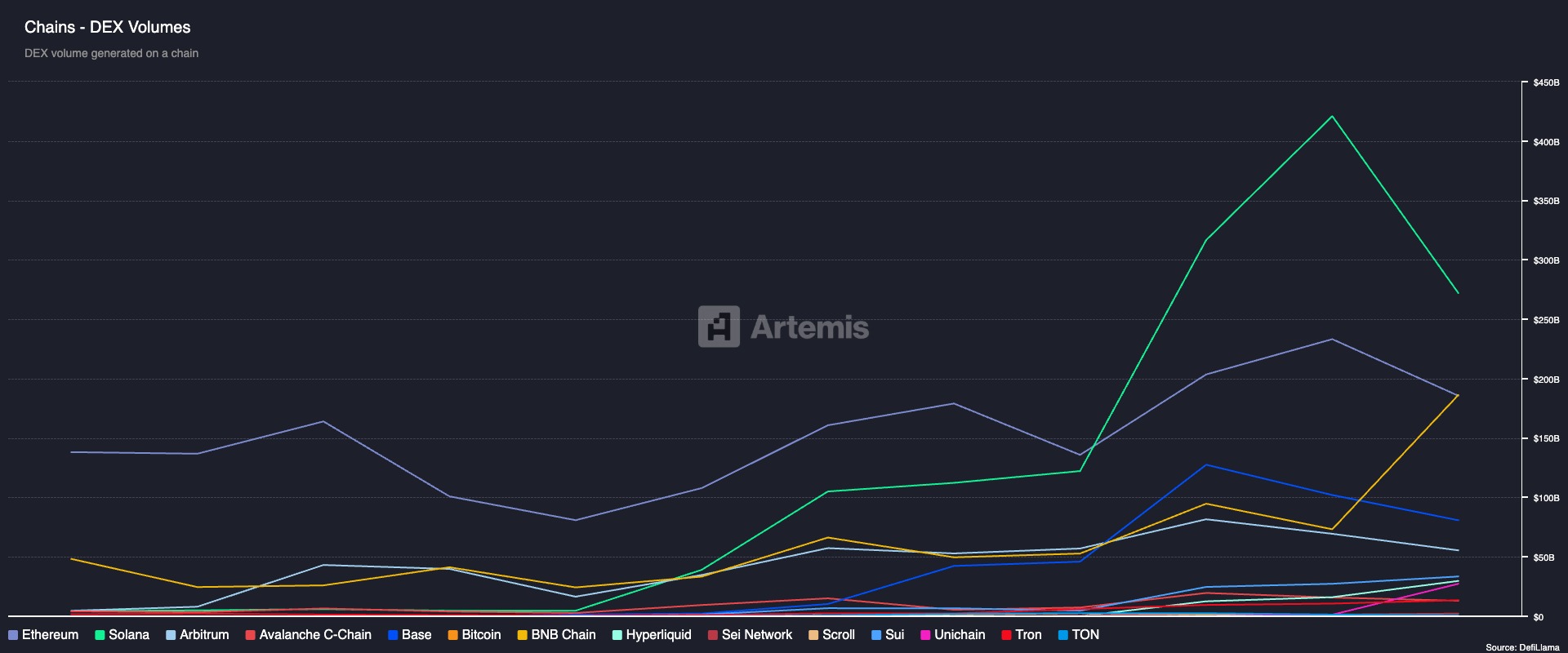
DEX volume for various blockchains by each quarter
DEX volume for various blockchains by each quarter (Credit: Artemis)

Kairos Research, which runs a solana validator, voted in favor of Alpenglow. Unsworth explained, “We view it as a pragmatic approach to rethinking solana’s consensus, which ultimately results in faster finality and potentially stronger liveness.”

Decreasing transaction finality to 150 milliseconds

The upgrade is expected to reduce the network’s transaction finality, the time when a transaction is recorded on a blockchain and after which it cannot be modified. 

Pre-Alpenglow, a transaction finalizes on the blockchain in about 12.8 seconds, but post-Alpenglow, the time would be cut to 150 milliseconds, putting solana into direct contention with centralized exchanges in terms of speed, said Jon Rotbard, an investor at venture capital firm CoinFund. 

This brings solana “potentially in striking distance of supporting the vision of a chain for executing and settling ‘everything’ on the L1 (payments, trading, capital formation, etc.),” Rotbard argued. 

Alpenglow allows solana to take a step closer to its goal of being an on-chain Nasdaq by introducing a new resilience model that allows the network to maintain operations even if 20% of its validators are malicious and an additional 20% are offline, Klich said. 

“Alpenglow brings consensus latency to a level comparable with Web2 applications while strengthening the system’s security posture, scalability, and economic fairness,” the proposal stated.

Benefiting users

The upgrade is expected to benefit all users, including retail, advanced traders, market makers, and financial applications. With 150-millisecond finality, solana is closer to institutional-grade trading, opening the door for central limit order books and tighter spreads, Chorus One’s Klich predicts. The biggest gain should accrue to various financial applications, though. 

Decentralized finance protocols “become safer, since liquidations and oracle updates can happen in near real time, reducing the risk of bad loans,” Klich continued. “Beyond trading and DeFi, payments may become more viable as near instant finality makes solana more attractive for payment applications.”

Roger Wattenhofer, head of research at solana development firm Anza, told Sherwood, “Pretty much anything that needs a fast finality will be possible with Alpenglow.”

Unsworth noted that end users won’t notice a substantial difference outside of improved reliability. “As a user, you tend to remember when things didn’t work more than they do — so this should just lead to more slightly better, more consistent user experiences,” he added. 

The upgrade comes in the same year that the network’s native cryptocurrency reached an all-time high of $292.

Even though Alpenglow is the blockchain’s most substantial technical change in its history, Unsworth doesn’t think the upgrade will change the way investors underwrite solana as an investment. 

“The larger things to watch that I think will impact price action will be DATs [digital asset treasuries] which have been announced. I know there is an open question around how much of those are in-kind contributions vs. fresh capital which will purchase SOL on the open market,” Unsworth said to Sherwood. 

The second big-ticket item are exchange-traded funds. Even though the only two cryptocurrencies to have ETFs in the US are bitcoin and ethereum, the US Securities and Exchange Commission is currently reviewing several spot solana ETFs. (There’s already a solana ETF in Canada). 

On August 30, Bloomberg Intelligence ETF analyst James Seyffart said a number of updated solana ETF filings were sent to the SEC, including ones from VanEck, Grayscale, Fidelity, CoinShares, and Bitwise.

More Crypto

See all Crypto
crypto

Payward, parent company of crypto exchange Kraken, puts plans for IPO on hold

Payward, crypto exchange Kraken’s parent company, has paused its plans for an initial public offering until market conditions improve, according to a report from CoinDesk that cited two people with knowledge of the matter. 

Since the firm announced in November its preparation for an IPO of its common stock, the total market capitalization of the crypto industry has shed around $652.2 billion, from $3.2 trillion to $2.5 trillion as of Wednesday, data from CoinGecko shows. 

The news comes two weeks after Kraken received approval for a master account from the Federal Reserve Bank of Kansas City, allowing the crypto exchange to connect to the Fed’s payment infrastructure used by traditional banks and credit unions. 

Last year, Kraken raised $800 million at a $20 billion valuation from institutional investors such as Jane Street and Citadel Securities.

The news comes two weeks after Kraken received approval for a master account from the Federal Reserve Bank of Kansas City, allowing the crypto exchange to connect to the Fed’s payment infrastructure used by traditional banks and credit unions. 

Last year, Kraken raised $800 million at a $20 billion valuation from institutional investors such as Jane Street and Citadel Securities.

crypto

SEC and CFTC issue new guidance on how securities laws apply to crypto assets

On Tuesday, the US Securities and Exchange Commission, together with the Commodity Futures Trading Commission, issued an interpretation clarifying how federal securities law applies to crypto assets, a first step toward developing a clearer regulatory framework. 

The interpretive guidance introduces a token taxonomy for different types of cryptocurrencies, with SEC Chairman Paul S. Atkins adding that “most crypto assets are not themselves securities.”

Examples of a digital commodity, “a crypto asset that is intrinsically linked to and derives its value from the programmatic operation of a crypto system that is ‘functional,’” include:

The guidance also includes definitions of digital collectibles (such as NFTs), stablecoins, digital tools, and digital securities (such as tokenized real-world assets and stocks).

This is a monumental step in the mainstream adoption of the industry and clears a hurdle in how crypto can operate going forward, according to David Pakman, head of venture investments at CoinFund. “This will allow new token designs with the confidence that their existence does not require registration with the SEC, etc.,” Pakman told Sherwood News.

Despite the clarification efforts from the two organizations, the market capitalization of the crypto industry has dropped about 2% in the last 24 hours as each of the tokens mentioned in the guidance are trading lower in the period, data from CoinGecko shows.

The joint agency action also complements congressional efforts to turn a crypto market structure framework into law. With the goal of providing regulations on the offer and sale of digital commodities, the CLARITY Act passed the House of Representatives last year and is now sitting in the Senate.

crypto

Bitcoin sees 8 consecutive days of gains, a streak not seen in 4 years

Bitcoin is on a winning streak. The cryptocurrency has generated eight straight days of positive returns, a rare phenomenon that has occurred only 15 times since Satoshi Nakamoto created it, according to a CoinDesk report.  

In the 30 days after posting an eight-day streak, bitcoin traded higher nine times and lower six times. The median return in the period is roughly 19%. Despite the historical gains that followed, the last time bitcoin had such a rally, four years ago, it dropped roughly 30%. 

Most recently, bitcoin climbed from below $66,000 on March 8 to over $75,000 yesterday before settling around $73,800 on Tuesday morning.

Traders remain modestly bullish on the likelihood of further gains, though the sentiment is fading: prediction market-implied odds of bitcoin trading above $77,500 in the month stand at 54%, a decrease from 73% on Monday. 

(Event contracts are offered through Robinhood Derivatives, LLC — probabilities referenced or sourced from KalshiEx LLC or ForecastEx LLC.)

Loading...
 

Most recently, bitcoin climbed from below $66,000 on March 8 to over $75,000 yesterday before settling around $73,800 on Tuesday morning.

Traders remain modestly bullish on the likelihood of further gains, though the sentiment is fading: prediction market-implied odds of bitcoin trading above $77,500 in the month stand at 54%, a decrease from 73% on Monday. 

(Event contracts are offered through Robinhood Derivatives, LLC — probabilities referenced or sourced from KalshiEx LLC or ForecastEx LLC.)

Loading...
 

Latest Stories

Sherwood Media, LLC produces fresh and unique perspectives on topical financial news and is a fully owned subsidiary of Robinhood Markets, Inc., and any views expressed here do not necessarily reflect the views of any other Robinhood affiliate, including Robinhood Markets, Inc., Robinhood Financial LLC, Robinhood Securities, LLC, Robinhood Crypto, LLC, Robinhood Derivatives, LLC, or Robinhood Money, LLC. Futures and event contracts are offered through Robinhood Derivatives, LLC.