
Crypto
Witch
(Getty Images)

“Triple witching” day may put further pressure on bitcoin’s price

This is not “a favorable environment for risk assets.”

Bitcoin remains stuck in the $70,000 level on Friday morning, and bitcoin ETFs experienced their second consecutive day of outflows on Thursday with a $90 million exodus, SoSoValue data shows.

In addition to broad geopolitical and macro factors weighing on crypto, another event that may add volatility to bitcoin is today’s “triple witching,” when the expiration of stock options, index options, and index futures all occur on the same Friday. Some refer to the day as “quadruple witching,” but as single-stock futures are not currently trading in the US, that final leg has little impact.

Nic Puckrin, cofounder of Coin Bureau, told Sherwood News that this is still a bear market rally and further downside is still in the cards from here.

“If BTC rallies in the short term, key resistance remains around $73,000, and then at around $81,000 if it extends gains,” Puckrin said.

He said that “witching” days tend to affect crypto in the weeks that follow, since large options expirations often force a reset in positioning and liquidity.

Historically, he said, bitcoin has tended to drift lower for one to three weeks after events like these, adding, however, that this is a short-term signal; what matters more is the macro backdrop.

“And right now, the risk of a prolonged oil shock that feeds into the economy is increasing. The longer oil remains above $100, the greater the impact will likely be on liquidity, inflation, and growth. Structurally, this is typically not a favorable environment for risk assets,” Puckrin said.

In addition, Puckrin said that as oil infrastructure disruption intensifies, investors are too complacent about the downside risks.

“If oil stays above $100 throughout Q2 and into Q3, stagflation becomes a real problem for the Fed,” he said, adding that the markets may be in for a rude awakening when investors realize that President Trump doesn’t control the outcome of this conflict.

One hopeful sign for bitcoin, however, is that long-term holder selling appears to be slowing, a potentially constructive signal, according to a Van Eck report.

“Declining transfer activity among these cohorts typically signals reduced distribution pressure from experienced market participants,” Van Eck analysts said.

On the other hand, bitcoin options markets suggest investors remain defensive, the analysts said, with total options open interest rising to $33 billion, “indicating derivatives exposure remains elevated even as futures leverage has cooled.”

“The put/call open interest ratio, which compares the volume of bearish options bets to bullish ones, peaked at 0.84 and averaged 0.77, the highest level since June 2021, when China banned bitcoin mining,” they said. “At current levels, the ratio sits in the 91st percentile of observations since mid-2019, highlighting unusually strong demand for downside hedging relative to bullish positioning.”

Abra CEO Bill Barhydt pointed to a tight liquidity situation. “All else equal, monetary inflation creates a long-term upward bias in scarce assets, but demand still dominates price in the medium term,” Barhydt told Sherwood. He added that price is still demand-driven, and in the short to medium term, it behaves like a high-beta liquidity asset

He predicted that there will be improvements in the liquidity situation this year, which equates to incremental significant money printing this year. 

“I don’t think bitcoin is front-running that yet. I don’t think the market believes everything I’m saying yet,” Barhydt said.

In terms of levels, Barhydt said that while bitcoin has “kind of stabilized,” it could stay range-bound between $60,000 and $90,000 for another several months at least. Yet, he also thinks there will be an all-time high in 2026. 

Finally, he said that crypto is still, by and large, a retail market, but right now retail money is nowhere to be found, and retail sentiment in general is “very, very low.”

“Even ETFs at the end of the day are an interface for retail to buy securitized versions of bitcoin. If you’re just talking about price, I think you need retail,” he said.

More Crypto

See all Crypto
crypto

Altcoin trading activity has lost its mojo

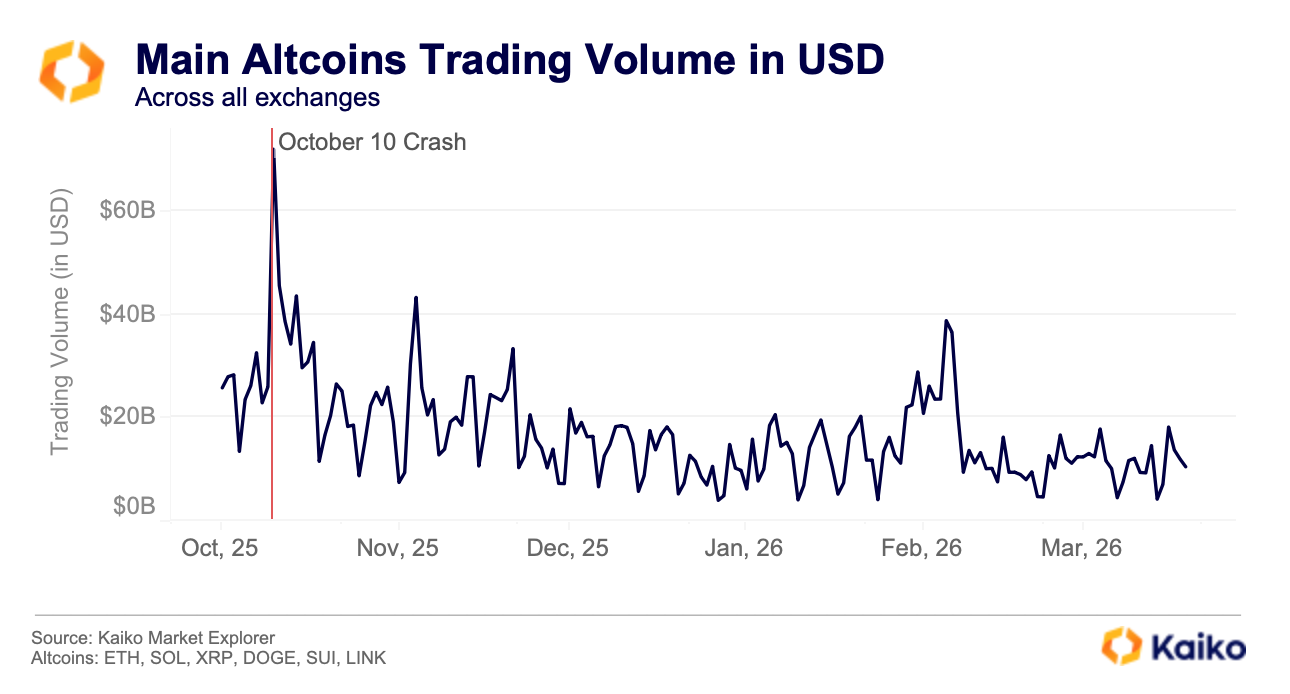
Non-bitcoin cryptocurrencies have seen their trading volume plummet in the past five months. The combined trading volume of ethereum, XRP, solana, dogecoin, SUI, and chainlink has decreased by 60% since crypto’s October 10 liquidation event, according to Thomas Probst, a research analyst at crypto markets data provider Kaiko.

Main Altcoins Trading Volume in USD
The trading volume of ETH, SOL, XRP, DOGE, SUI, and LINK.

For all altcoins, spot trading volume on Binance has declined between 80% and 85% to $7.7 billion, while altcoin volume on other exchanges has dropped to $18.8 billion, down from a range of $63 billion to $91 billion in October, a Friday report from Decrypt found, citing data from CryptoQuant.

“This trend may be explained by a contraction in market liquidity over the same period,” Probst told Sherwood News. “This phenomenon is also reflected in the average 1% market depth, which stood at approximately $2.6 million before the October 10 crash and is now closer to $1.7 million when aggregated across ETH, XRP, SOL, SUI, and LINK.” 

Market depth is used by investors and traders to gauge the scale of liquidity in a market. 1% market depth refers to the amount of liquidity needed to move the market by 1%. 

CoinGlass’s Altcoin Season Index, a measure to assess the performance of non-bitcoin cryptocurrencies, has been sitting above 50 this week, suggesting that the current market is neither in a bitcoin dominant phase nor an altcoin season.

crypto

Payward, parent company of crypto exchange Kraken, puts plans for IPO on hold

Payward, crypto exchange Kraken’s parent company, has paused its plans for an initial public offering until market conditions improve, according to a report from CoinDesk that cited two people with knowledge of the matter. 

Since the firm announced in November its preparation for an IPO of its common stock, the total market capitalization of the crypto industry has shed around $652.2 billion, from $3.2 trillion to $2.5 trillion as of Wednesday, data from CoinGecko shows. 

The news comes two weeks after Kraken received approval for a master account from the Federal Reserve Bank of Kansas City, allowing the crypto exchange to connect to the Fed’s payment infrastructure used by traditional banks and credit unions. 

Last year, Kraken raised $800 million at a $20 billion valuation from institutional investors such as Jane Street and Citadel Securities.

The news comes two weeks after Kraken received approval for a master account from the Federal Reserve Bank of Kansas City, allowing the crypto exchange to connect to the Fed’s payment infrastructure used by traditional banks and credit unions. 

Last year, Kraken raised $800 million at a $20 billion valuation from institutional investors such as Jane Street and Citadel Securities.

crypto

SEC and CFTC issue new guidance on how securities laws apply to crypto assets

On Tuesday, the US Securities and Exchange Commission, together with the Commodity Futures Trading Commission, issued an interpretation clarifying how federal securities law applies to crypto assets, a first step toward developing a clearer regulatory framework. 

The interpretive guidance introduces a token taxonomy for different types of cryptocurrencies, with SEC Chairman Paul S. Atkins adding that “most crypto assets are not themselves securities.”

Examples of a digital commodity, “a crypto asset that is intrinsically linked to and derives its value from the programmatic operation of a crypto system that is ‘functional,’” include:

The guidance also includes definitions of digital collectibles (such as NFTs), stablecoins, digital tools, and digital securities (such as tokenized real-world assets and stocks).

This is a monumental step in the mainstream adoption of the industry and clears a hurdle in how crypto can operate going forward, according to David Pakman, head of venture investments at CoinFund. “This will allow new token designs with the confidence that their existence does not require registration with the SEC, etc.,” Pakman told Sherwood News.

Despite the clarification efforts from the two organizations, the market capitalization of the crypto industry has dropped about 2% in the last 24 hours as each of the tokens mentioned in the guidance are trading lower in the period, data from CoinGecko shows.

The joint agency action also complements congressional efforts to turn a crypto market structure framework into law. With the goal of providing regulations on the offer and sale of digital commodities, the CLARITY Act passed the House of Representatives last year and is now sitting in the Senate.

Latest Stories

Sherwood Media, LLC produces fresh and unique perspectives on topical financial news and is a fully owned subsidiary of Robinhood Markets, Inc., and any views expressed here do not necessarily reflect the views of any other Robinhood affiliate, including Robinhood Markets, Inc., Robinhood Financial LLC, Robinhood Securities, LLC, Robinhood Crypto, LLC, Robinhood Derivatives, LLC, or Robinhood Money, LLC. Futures and event contracts are offered through Robinhood Derivatives, LLC.